

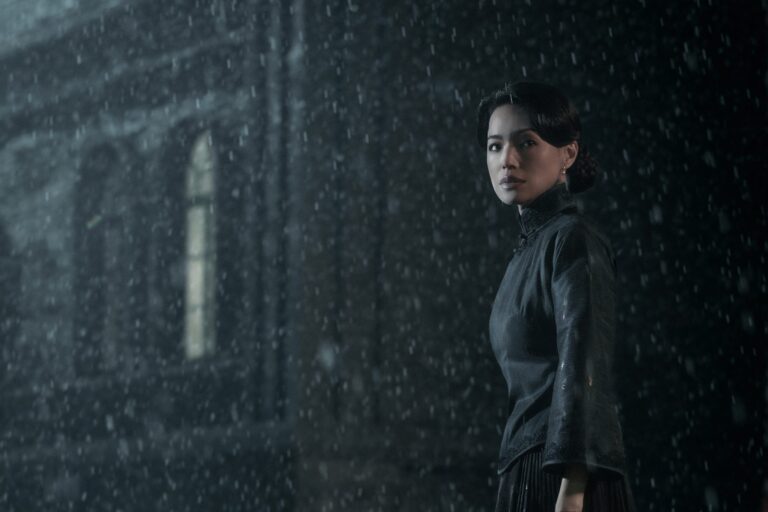
@Courtesy of NYFF
Winner of the Jury Special Prize at the last Cannes Film Festival, the visionary tale directed by Bi Gan lands at the New York Film Festival as one of the most innovative feature-films seen in the 2025 edition.
Conceived as a science fiction movie, Resurrection is set in a future where mankind has lost the capacity to dream. A woman (Shu Qi) discovers a monster-creature who is still capable of experiencing it. She decides to exploit this ancient power in order to navigate some fundamental moments in Chinese history, all over the XX century.
The first and most important quality of Bi Gan vision is courage: Resurrection in fact dares to use so many solutions, both narrative and most important visual, in order to compose a dazzling cinematic mosaic. Not everything works properly, but it doesn’t really matter in the end because the whole project is built with such bold, refreshing will that it is capable of thrilling the audience no matter what.
Divided in different chapters, the movie starts in a quite difficult way, because it privileges the beauty of surreal images to a logical plot. At the very beginning, resurrection is closer to experimental video-art, an explicit but quite obscure homage to the German Expressionism of the ‘20, especially The Cabinet of Dr. Caligari (1920) and Nosferatu (1922). Approaching the story isn’t at all an easy task, since the fragmentation of the plot doesn’t allow the viewer to find an empathic connection with the two main characters. Once we get through the first third of the movie, the script develops a more classic storytelling: the central segment tells in fact the story of a small-time crook and the young girls who helps him to play his tricks in order to gain money. The father-daughter relationship is well conceived, the mood is melancholic, the aesthetic elegant even when showing poor settings where the lower classes struggle. This central part of Resurrection is clearly a staged melodrama, elevating the tone of the entire movie. But the best has yet to come…
 @Courtesy of NYFF
As the last part of his hypnotic work, Bi Gan builds an astonishing piece of cinema: the last segment is a long show set during the last day of the Twentieth Century. Waiting for what many people thought was going to be the end of the world, a man and a young woman meet on the docks, spending the night together chasing each other, hiding their identity and showing reciprocal attraction. Everything is perfect in this long shot: the rhythm, the depth of the two characters, the excellent work of cinematographer Dong Jingson, the warmth of images and feelings shown. There is an explicit reminiscence of the cinematic poetry of Wong-Kar Wai, filtered by a genre plot that is wonderfully revealed in the end.
This is the powerful conclusion of a movie that lasts more than two hours and a half and contains a multitude of ideas, fascinations, and a love for the history of cinema all over the world. Bi Gan isn’t always capable of containing his own enthusiasm, but it’s nonetheless reinvigorating to see that when he fails it’s because of the love, the passion for what he is trying to accomplish. Resurrection is far from be a perfect movie, but it gives you so many ideas to think about, so much visual content that makes you wonder about the power of its images, and most important delivers at least a couple of stories that are emotionally satisfying, which means that the whole eccentricity of Bi gan’s mise en scene is absolutely not a sterile exercise in style. On the contrary, Resurrection owns a good deal of warmth even when it’s more difficult to navigate through. But the more the story unfolds, the more this becomes one of the most intriguing works we’ve seen this year.
Rate: B
If you liked the review, share your thoughts below.
Check out more of Adriano’s articles.
Here’s the trailer for Resurrection: