
©Courtesy of MUBI
She has been called the quietest of the great American directors. Kelly Reichardt doesn’t rush. She clears away the unnecessary and takes her time capturing the American soul. Now she returns with something as unusual and unlikely as an observational heist movie. Her style works wonders.
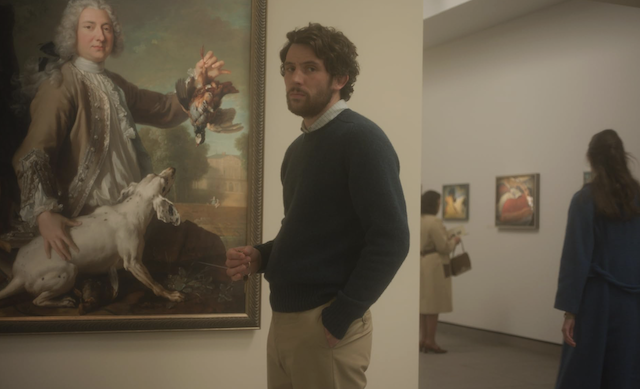
Set in a sleepy Massachusetts suburb in the 1970s, the film follows J.B. Mooney (Josh O’Connor), a restlessly charming and quietly dissatisfied husband, an art school dropout and would-be architectural designer who convinces himself he’s destined for something greater. His scheme: to steal paintings by Arthur Dove — one of America’s pioneering abstract artists — from his family’s favorite museum. He hires two men to carry out the robbery and plans to stash the works at a farmhouse, but hasn’t really thought it through. The heist itself—fumbling, brief, almost absurd—is over before it begins. What lingers is the fallout: the shame, the unraveling of family bonds, the delusion of a man who mistakes desperation for genius.
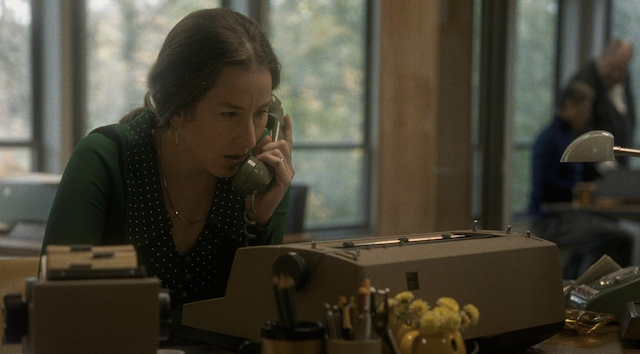
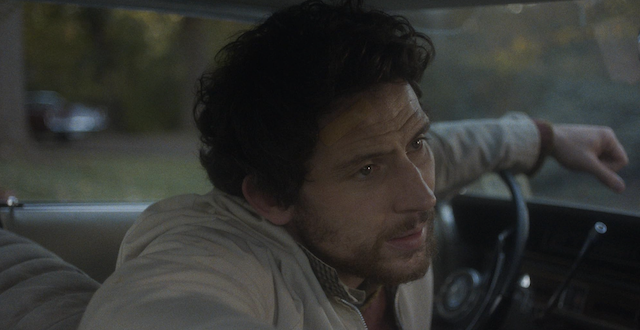
J.B. Mooney lives a relatively traditional life for a Reichardt character. Around him orbit interesting figures: Alana Haim as his weary wife; their two young sons (Jasper and Sterling Thompson), charming geeks (the opening scene with the youngest babbling incoherently at the museum is unbeatable); Bill Camp as his no-nonsense judge father; Hope Davis as his restrained mother; and Reichardt regular John Magaro as an old friend. Josh O’Connor’s Mooney is both magnetic and deluded, with a quietly strange ego; he is everything but a mastermind.
O’Connor steals scenes with his subtle, quiet intensity — as he so often does. The British actor broke through in Francis Lee’s “God’s Own Country“ (2017), and his Prince Charles in “The Crown“ (2019) brought him worldwide attention. Since then, he has sought out collaborations with directors of singular vision. He pursued Italian auteur Alice Rohrwacher, which led to “La Chimera“ (2023), where his melancholic grave robber in Italy shares kinship with Mooney. He also made his mark in Eva Husson’s “Mothering Sunday“ (2021), Luca Guadagnino’s “Challengers“ (2024), and Oliver Hermanus’s newly released “The History of Sound“(2025).
 ©Courtesy of MUBI
After nine feature films, Reichardt has secured her place among the foremost American indie filmmakers. In her cinema, small gestures carry the weight of the world. Her depictions of the daily rhythms of drifters and outsiders have been admired globally, her contemplative silences and narrative precision compared to Robert Bresson and Yasujirō Ozu. From the rootless seekers of “Wendy and Lucy“ (2008), to the stranded pioneers of “Meek’s Cutoff“ (2010), to the working women of “Certain Women“ (2016), her films thrive on minimalism and understatement. “The Mastermind“ extends this universe but feels subtly different — perhaps more accessible, thanks to the unlikely heist premise and the fact that Reichardt, for the first time, wrote the script entirely on her own (she usually collaborates with Portland writer Jonathan Raymond). For once, too, she integrates a score — by jazz musician Rob Mazurek — perfectly in sync with her vision.
As always in Reichardt’s films, ambiguity remains. The story pulses softly, cautiously, with her familiar undercurrent of critique against American capitalism. Shot by longtime collaborator Christopher Blauvelt, the film looks as though it could have been made in the 1970s — grainy, muted, yet stunning. It is a pure and calm delight to enter Reichardt’s world. From the first frame to the last, you are in the hands of an American master.
 ©Courtesy of MUBI
Grade: A-
If you like the review, share your thoughts below!
Check out more of Niclas’ articles.
Here’s the trailer of the film.