

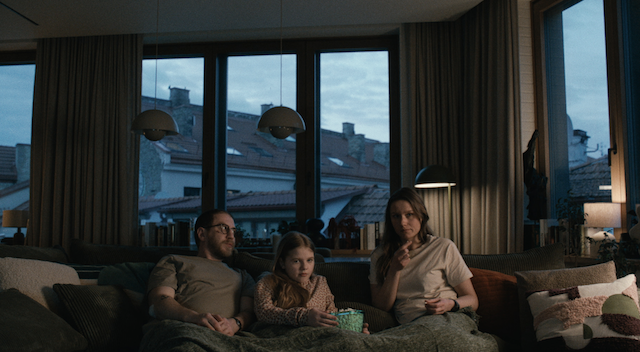
©Courtesy of the Sundance Film Festival
Lithuania knows Russia not as a distant neighbor, but as a shadow in its history — from centuries of conflict to five decades of Soviet occupation (1940–1990). In 1990, the Baltic nation became the first republic to break from the USSR and reclaim its independence. So, when Russia invaded Ukraine in February 2022, history came rushing back, reshaping daily life in sudden and intimate ways — especially when you’re in the middle of a divorce. Andrius Blaževičius’ dry, droll, and sharply observant “How to Divorce During the War”, winner of the World Cinema Dramatic Directing Award, captures this with refreshing precision.
We enter the film as the calm husband Vytas — a thirty-something screenwriter and director — tidies the stylish middle-class home while listening to Malher’s Adagietto from Symphony No. 5. Practical and attentive, he irons, cooks for his daughter, and teaches her how to mend holes in her shirts. Later, as their daughter takes violin lessons, he and his wife Marija — a successful Media executive — sit in the car, and everything suddenly shifts. Out of nowhere, she says she wants a divorce: life has become too comfortable, too boring. She has fallen out of love and wants a more exciting life.
The opening is sharp and immediately gripping. It might have unfolded as a familiar divorce drama — if the next day hadn’t brought an even greater rupture: Russia invades Ukraine. As Vytas moves in with his parents (he has no money) and Marija secretly continues her relationship with a female colleague, everything is suddenly overshadowed by the war.
Everyone wonders if their country might be next. Separately, both Marija and Vytas — played with impeccable timing and gentle irony by Žygimantė Elena Jakštaitė and Marius Repšys — try to show their support for Ukraine. In protest, Marija quits her job at Hungry Rabbit when the company refuses to shut down its Russian branch. She takes in a refugee family and hangs a Ukrainian flag from the balcony. Meanwhile Vytas, volunteers at a food bank, joins public demonstrations and performances, and even gives TV interviews about his activism. Less peacefully, he throws rocks at cars with Russian license plates.
Here, the film’s true theme emerges. Not the breakup itself or the usual explorations of relationships, but empathy and comfort at its core. With layered restraint and dry understatement, underscored by Jakub Rataj’s unsettling score, the film examines how people try to remain humane as war reshapes everything around them. Vytas’s empathy remains intact, yet he clashes with his parents when they watch Russian news — propaganda, he insists — even going so far as to destroy the house cable.
Marija struggles with her empathy and cannot fully live up to her ideals. She did good things in solidarity with Ukraine, but gradually the cost of surrendering comfort becomes too much. The line between genuine care and performative compassion blurs, and she begins to overreact, irritated by the very people she wanted to help. Her initial warmth toward the Ukrainian refugees turns into frustration when they leave messes in her ‘perfect’ apartment, or disrupt her routines. The film quietly exposes how solidarity falters when it demands sustained sacrifice rather than symbolic gestures. How far can empathy go when one’s own comfort is at stake?
The film also shows how their 12-year-old daughter, Dovilė (Amelija Adomaitytė), is shaped by forces beyond her control. Clever and withdrawn, she keeps her emotions locked inside until they spill out at school. Fear, confusion, and fragility ripple through everyone as war erupts nearby. For the girl, the divorce adds yet another layer of uncertainty. She absorbs far more than the adults around her realize.
The film’s cool restraint, static framing, and moral unease slightly echo European auteurs like Michael Haneke — but where Haneke often exposes human cruelty, Blaževičius is gentler, more compassionate. It finds dry humor in the contrast between a world in turmoil offscreen and the domestic calm, where only routines and emotional restraint are unsettled. Even the divorce, looming over everything, begins to feel strangely secondary.
It’s an impressive achievement by Andrius Blaževičius, who previously made his mark with “Runner” (2021). Through a sharp story and a careful and nuanced look at empathy, he avoids easy judgments. Instead, he lets us decide whether Marija and Vytas are just ordinary people doing their best in a difficult moment, or whether their compromises and contradictions reveal something deeper about how people live and take a stand. Marija’s early complaint — that the marriage has become too comfortable, too safe — adds a quiet irony, as the world outside grows more unstable, forcing both her and the viewer to rethink what comfort, stability, and commitment really mean when nothing feels secure anymore.
Grade: B+
If you liked the review, share your thoughts below.