

©Courtesy of TIFF
David Lynch’s surreal “Eraserhead“ was about to flicker onto screens, and Jimmy Carter had just been sworn in as president. It was early 1977 — post-Kennedy, post-Watergate America — when Indianapolis businessman Tony Kiritsis stormed into an office and wired a sawed-off shotgun to the back of a mortgage broker’s head. What followed was 63 hours of live-broadcast psychological theater. Gus Van Sant seizes on this surreal spectacle and spins it into a punchy, blackly comic thriller. It’s the filmmaker’s best film in years.
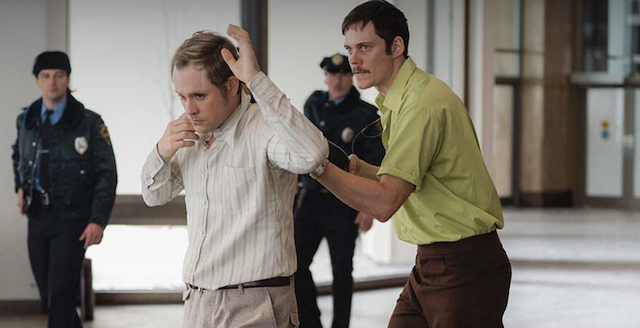
Swedish actor Bill Skarsgård, son of Stellan and brother of Alexander and Gustaf, plays the desperate, down-on-his-luck Kiritsis. After being misled on a loan that left him with no security and mounting debts, Kiritsis snapped. Fueled by frustration, humiliation, and a sense of injustice, he took Richard Hall (Dacre Montgomery) hostage (he had originally intended to target Hall’s father), rigging a sawed-off shotgun to the broker’s head. One wrong move and it would fire. He demanded $5 million and an apology from the Hall family. What could have been a private act of vengeance turned into a public spectacle when news crews, led by a TV reporter (Myha’la) captured the 63-hour standoff live on television, broadcasting Kiritsis’s strange mix of menace, wit, and absurdity into living rooms across the nation.
Bill Skarsgård shines. His characterization makes Kiritsis not only chaotic and magnetic, but unexpectedly charming — an antihero from the very start. This is arguably the actor’s strongest role to date. Before “Dead Man’s Wire“, he had already built a diverse body of work: international audiences know him best as the terrifyingly charismatic Pennywise in “It“ (2017) and “It: Chapter Two“ (2019), but his range is much broader. From Tv-series “Hemlock Grove” (2013-15) and “Nosferatu“ (2024) to Swedish films such as “Simple Simon“ (“I rymden finns inga känslor“, 2010) and “Simon and the Oaks“ (“Simon och ekarna“, 2011), to the Netflix miniseries “Clark“ (2022), where he plays the infamous Swedish criminal Clark Olofsson, who was involved in the Norrmalmstorg robbery that coined the term ‘Stockholm Syndrome’ (wittily referenced in “Dead Man’s Wire” by Al Pacino). Across these roles, Skarsgård has showcased remarkable subtlety and emotional depth.
Here, it all crystallizes. Skarsgård’s clumsy body language, apologetic tone, and quick, witty comments make Kiritsis oddly sympathetic. Morally, it’s complex: we sympathize with him even though he is holding someone hostage at gunpoint. He is a criminal, yes, but also a victim of injustice — an underdog lashing out at a system he believes is corrupt or abusive. The script by Austin Kolodney tightens this tension, pulling us between admiration for his courage and horror at his violence.
Van Sant stages it with grandeur. Beneath the black comedy, he asks audiences to confront their own morality. After more than a decade of uneven misfires (“Promised Land“ 2012, “The Sea of Trees“ 2015) and the modest film (“Don’t Worry, He Won’t Get Far on Foot“ 2018), “Dead Man’s Wire“ feels like a return to sharp form. As ever, Van Sant gravitates toward society’s outsiders — hustlers, junkies, drifters — and here he captures Kiritsis as both victim and villain. The film recalls the grainy realism of “Drugstore Cowboy“ (1989) and “My Own Private Idaho“ (1991), and the 1970s setting of “Milk“ (2008). It also tips its hat to Sidney Lumet’s “Dog Day Afternoon“ (1975). Al Pacino even appears in a brief, biting turn as M.L. Hall, the cold-hearted patriarch of the mortgage company and Kiritsis’s true intended target.
Van Sant layers the film with groovy music, too, weaving local radio DJ Fred Temple (Colman Domingo) into the story. Through Tony’s obsession with the DJ, a cool playlist anchors us in the decade: songs from Roberta Flack, Barry White, Donna Summer, Deodato’s jazz-funk “Also Sprach Zarathustra,” Yes’ “I’ve Seen All Good People,” Labi Siffre’s “Cannock Chase,” alongside Danny Elfman’s score. It’s immersive and steeped in 1977 atmosphere.
Dead Man’s Wire marks a striking return to Van Sant’s sharper instincts. Edgy, empathetic, and unafraid to unsettle, it’s the kind of cinema that lingers — a reminder of how Van Sant, at his best, can turn real-life chaos into unforgettable art.
Grade: B+
If you like the review, share your thoughts below!