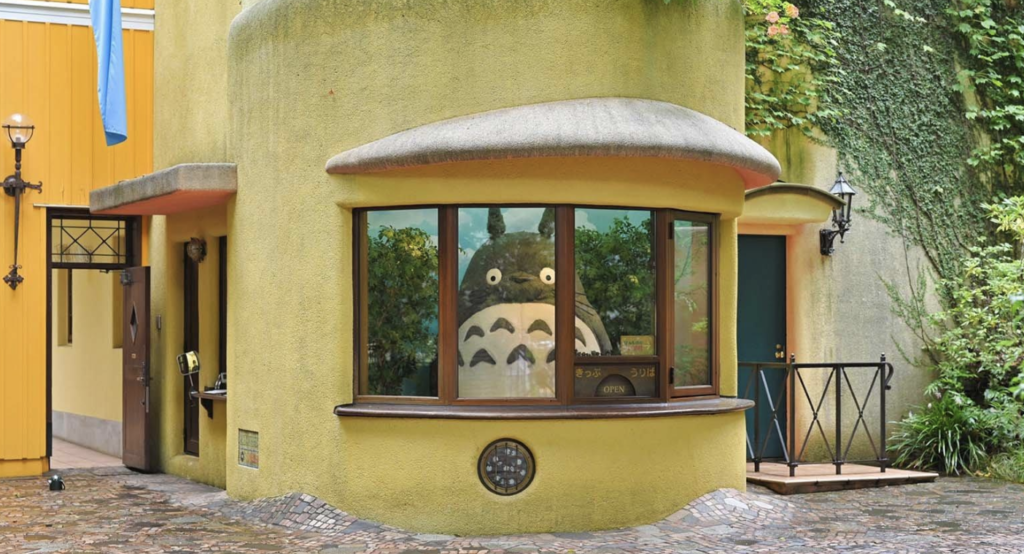
Japan has many shrines, but the Ghibli Museum in the Tokyo’s Mitaka municipality might just inspire the most reverence from visitors. The building itself is Ghibli-esque. It has Hogwartsesque charm, with its stained-glass windows and frescoes, but it is functional, housing the museum’s collection and special exhibits. However, if there is one thing you should take away from this piece, it is the need to buy your tickets in advance. Do not just show up like a pilgrim on the road to Canterbury. As Studio Ghibli’s international popularity continues to skyrocket, demand for Museum admission follows suit. However, every successful pilgrim gets a relic for the price of admission, because every ticket incorporates a frame of genuine celluloid from a Ghibli film. 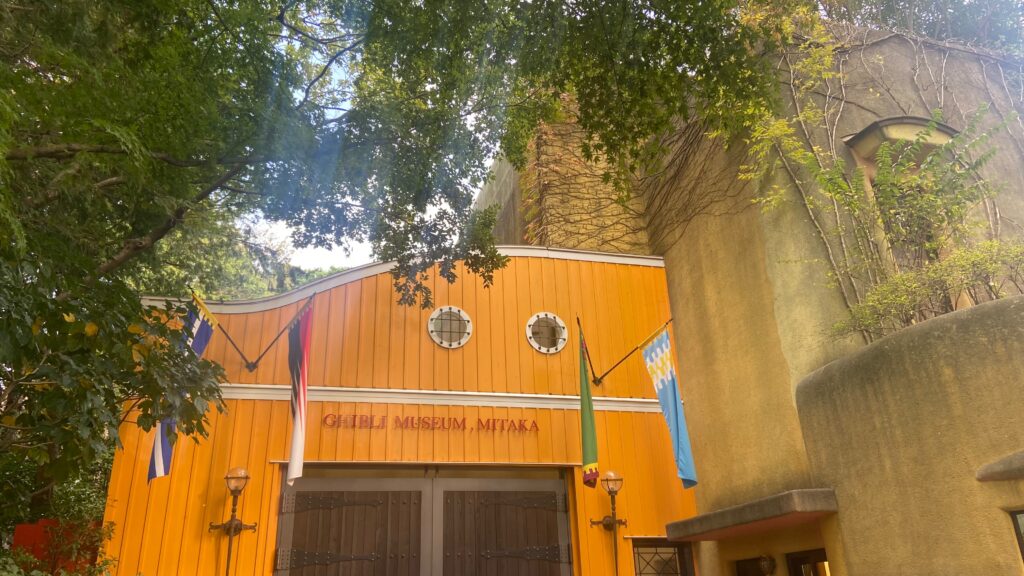 Okay, so you have your tickets, purchased when on-line sales open on the 10th of the preceding month. Even when you arrive for your timed entry on the dedicated bus from the Mitaka Station, you will still probably have to stand in line. However, that is okay, because it offers a selfie opportunity with Totoro, in his private ticket booth. In fact, this is one of the few selfie chances, because photography is prohibited inside the museum proper.
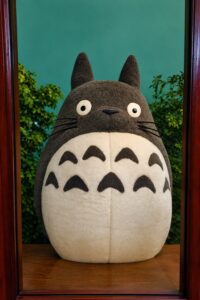 If you want to interact with costumed characters, the Disneyland-like Ghibli Park is the better bet. However, the Ghibli Museum has a giant plushy Catbus (from My Neighbor Totoro) for patrons under twelve to climb in and around. It looks like a lot of fun, so bring a kid.
The first floor is largely devoted to illustrating the history and mechanics of animation, but Ghibli fans will be most charmed by “Bouncing Totoro,” a mechanical zoetrope of characters from the titular film.
The second floor proves the Ghibli Museum is truly a pilgrimage site, where the faithful can pay their respects at the recreations of Hayao Miyazaki’s personal studio and early Ghibli animation workshops. For its rotating exhibit, the Museum also currently recreates the studio of artist Yuriko Yamawaki, who illustrated three Reiko Nakagawa children’s books that Studio Ghibli subsequently animated.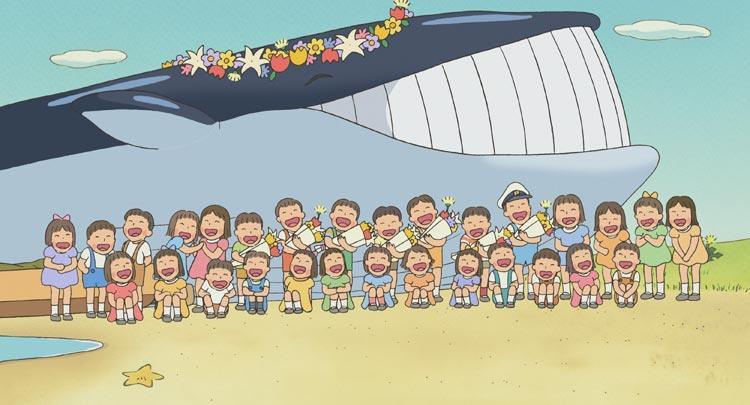 One of the Museum’s biggest attractions is its Saturn Theater, which presents Ghibli shorts that rarely screen anywhere else. To tie-into the Yamawaki exhibit, the Museum has been screening Miyazaki’s Whale Hunting, based on No-No Nursery School, the Nakagawa book she illustrated.
The 16-minute film is surprisingly, but pleasantly surreal. Essentially, a group of school boys’ playtime pretending to be sea-faring whalers suddenly turns magically real. They embrace their new adventure, but, fortunately, the gently mocking whale has a sense of humor regarding their hunt. He will even save them, when the weather turns stormy.
Whale Hunting is a relatively long short, so it represents a lot of Miyazaki a lot of most fans haven’t seen. Logically, its visual style reflects Yamawaki’s illustrations more than Ghibli’s classic masterpieces, but the sly depiction of childhood wonder is quite endearing and Miyazaki-like.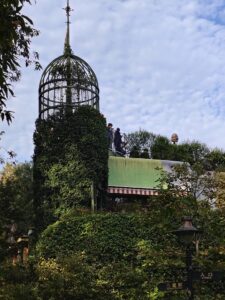 The Saturn Theater’s design and ceiling mural are charming and the projection is professional grade. However, it is built to accommodate children, so grown-ups must stoop down to sit on its continuous benches. Regardless, it is arguably one of the world’s most distinctive theaters.
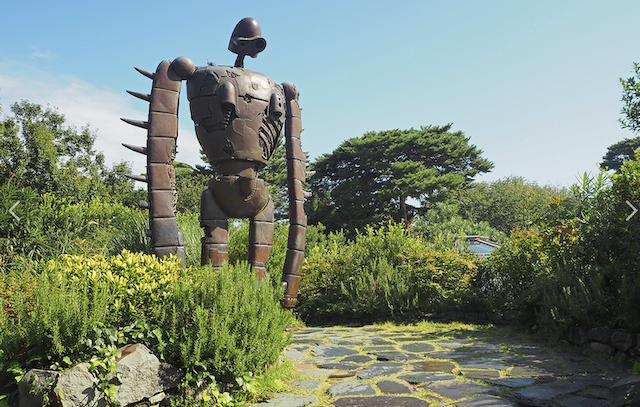
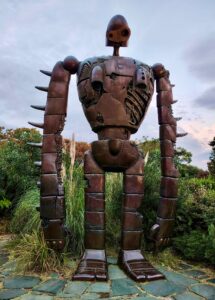 You can take your phones out again when you reach the roof garden, through a narrow circular iron stair case. There you come face to face with one of the Museum’s prime attractions: the towering Robot from Castle in the Sky. You’re going to be standing in line for this one.
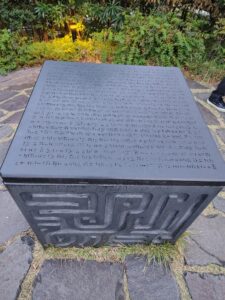 The rooftop also features the Cuneiform keystone from the same film, which definitely gives the garden a mystical vibe. It is a peaceful space that offers lovely views of the surrounding Inokashira Park.
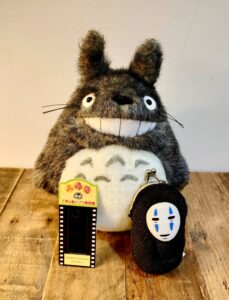 When you visit the Ghibli Museum, at least half of your fellow patrons will be western tourists. Clearly, Miyazaki has forged the sort of connection with animation fans round the world that Walt Disney had in the 1950s. Disney is not the same Disney it used to be, but Studio Ghibli has maintained its standards, arguably replacing the Mouse House as the global Gold Standard of animation. That is why the Ghibli Museum and Park are such popular attractions. By the way, if you visit, don’t forget the exclusive merch, to prove you were there (some of which you can also purchase from the Ghibli store in Tokyo Character Street, the twenty-one store anime mart under Tokyo Station in Chiyoda).
Whale Hunting Grade: A-