

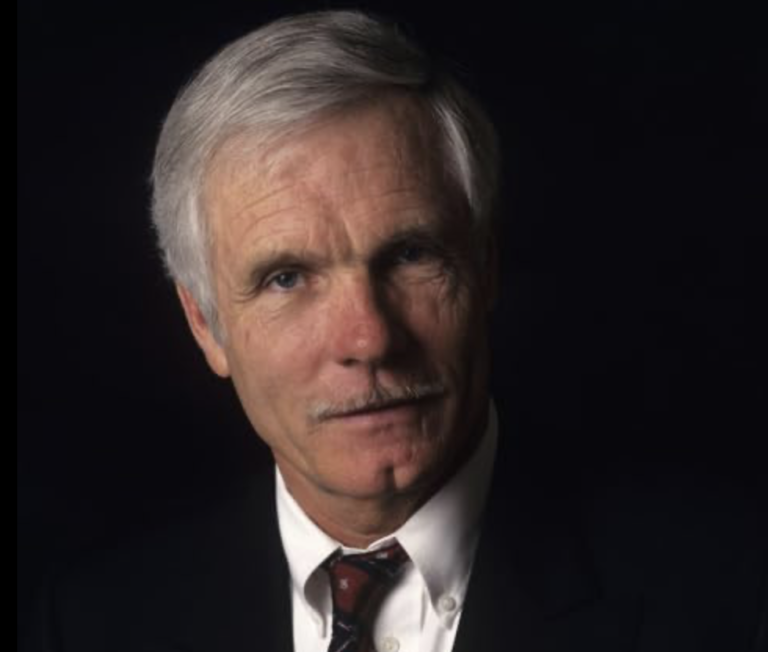
Photo by Dana Gluckstein – © 1995 Dana Gluckstein
Ted Turner, the founder of CNN, has died at age 87. His family confirmed his death after a long battle with Lewy body dementia. He passed away peacefully, surrounded by loved ones, the news company is reporting. Turner leaves behind a legacy that reshaped television, revolutionized journalism and redefined modern philanthropy.
Turner built one of the most influential media empires of the 20th century. Time named him Man of the Year in 1991 for his global impact. He earned that recognition by transforming how people consume news and entertainment. His bold vision and willingness to take risks helped create the modern cable television landscape.
Robert Edward Turner III was born in Cincinnati, Ohio, and moved to Atlanta, Georgia, during childhood. After his father’s death in 1963, Ted Turner took control of the family billboard business. He quickly turned the struggling company into a profitable operation. He then used that success to expand into broadcasting. In 1970, he purchased a failing Atlanta UHF station and rebuilt it with creative programming and aggressive strategy.
Turner transformed the station into a national superstation by using satellite distribution. That innovation allowed his channel to reach millions of homes across the United States. The move helped spark the rapid growth of cable television.
The media proprietor expanded his company, Turner Broadcasting System, into a major force in entertainment. He launched networks such as TNT, Cartoon Network and Turner Classic Movies, each serving different audiences and redefining cable programming.
In 1980, Turner introduced CNN, the world’s first 24-hour cable news network. Many critics doubted the concept, but Turner pushed forward without hesitation. CNN changed journalism by delivering news continuously instead of at scheduled times.
The network gained global recognition during the Gulf War. Its live coverage from Baghdad allowed viewers to witness events in real time. That moment marked a turning point in how wars and global events were reported.
Turner also made a major impact in sports. He owned the Atlanta Braves and the Atlanta Hawks. He used sports broadcasting to grow his television audience. The Braves won the World Series in 1995 during his ownership.
Turner also achieved personal success in sailing. He won the America’s Cup in 1977 and received multiple Yachtsman of the Year honors.
In 1996, Turner sold his company to Time Warner for $7.5 billion. The deal made him one of the wealthiest figures in media.
However, the 2000 merger between Time Warner and AOL led to significant financial losses. Turner lost a large portion of his wealth and eventually left the company. Despite this setback, his influence on media remained strong.
Turner also changed philanthropy by giving away large sums during his lifetime. In 1997, he donated $1 billion to establish the United Nations Foundation. This gift was one of the largest charitable donations ever made.
The businessman supported causes such as environmental protection, nuclear disarmament and global health. He co-founded the Nuclear Threat Initiative to reduce global threats from nuclear and biological weapons. His work encouraged other wealthy individuals to increase charitable giving.
Turner also supported environmental efforts and conservation. He owned millions of acres of land across the United States and used them to promote sustainable practices.
The philanthropist launched Ted’s Montana Grill, a restaurant chain focused on eco-friendly operations and bison meat sourced from his ranches. He remained active in addressing climate change, overpopulation and energy issues throughout his later years.
In his personal life, Turner was known for his bold personality and outspoken views. People often called him “The Mouth of the South” because of his candid remarks.
The media mogul married three times, including a high-profile marriage to actress Jane Fonda. He had five children, as well as 14 grandchildren and two great-grandchildren. Despite his public image, those close to him described him as complex and deeply driven.
Turner faced personal and professional challenges throughout his life. He experienced major financial losses and public controversies. He also spoke openly about his struggles with mental health. Despite these difficulties, he continued to pursue ambitious goals and support global causes.
Ted Turner leaves behind a legacy that spans media innovation, sports achievement, and global philanthropy. He changed how news reaches audiences and helped shape the modern information age. His creation of CNN set the standard for real-time reporting. The television producer’s charitable efforts influenced how wealthy individuals approach giving. His impact continues to shape industries and inspire future generations.
If you liked this article, please share your comment below.