
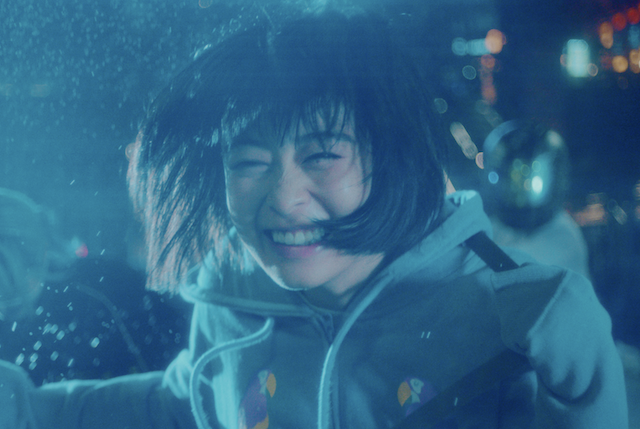
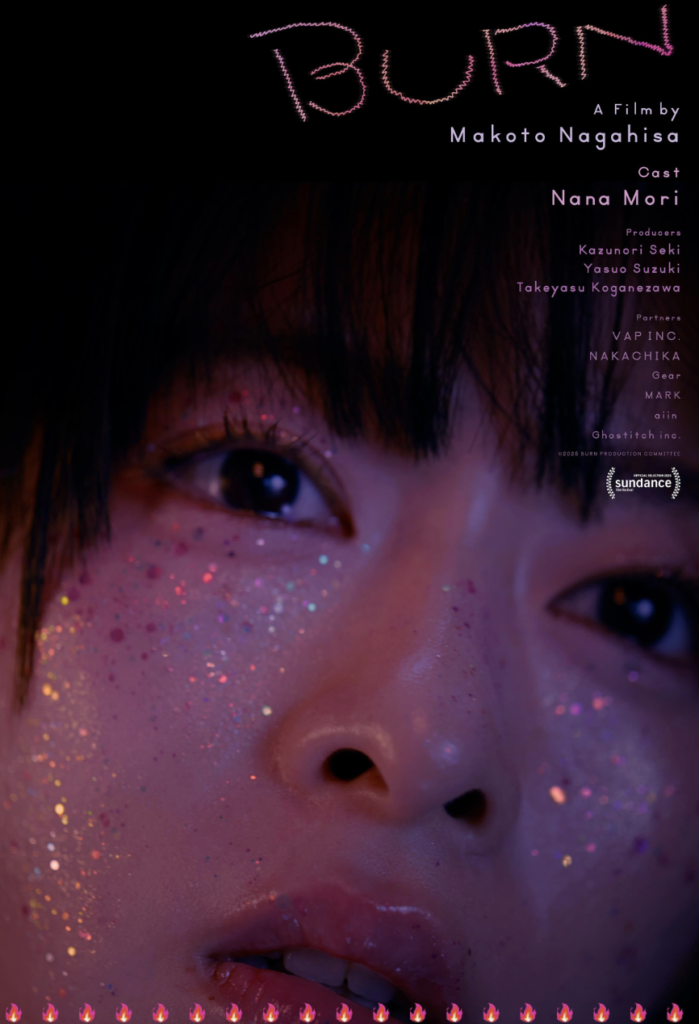
Burn : When runaway teen Ju-Ju is embraced by a tribe of misfit youths in Kabukicho, she finds belonging for the first time — until betrayal and despair twist her haven into a prison, and she’s left with one way to take back control.
An extreme juxtaposition of formal radiance and narrative dread, Makoto Nagahisa’s latest feature is a transcendently colorful gut punch. Following We Are Little Zombies (2019 Sundance Film Festival) and his most recent short, Pisko the Crab Child is in Love (2024 Sundance Film Festival), Nagahisa executes his signature hypervibrance and unique character direction with finesse.
Nana Mori bravely embodies Ju-Ju, pendulating between the embrace of a decadent Tokyo street-kid culture and the call of her ambition toward saviorhood. Nagahisa taunts us with an urban world that’s beautifully rotten and addictive — a twisted labyrinth for both character and viewer, at the center of which is an expansive darkness that’s impossible to shake. A one-of-a-kind, energetic approach to generational trauma and youth culture, BURN exhibits a brand of nihilism that’s challenging, and rewarding, to experience.
Director : Makoto Nagahisa
Screenwriter : Makoto Nagahisa
Producer : Yasuo Suzuki, Kazunori Seki, Takeyasu Koganezawa
Executive Producer : Kako Kuwahara, Ryusuke Nakajima, Hayato Arizono
Cinematographer : Hiroaki Takeda
Production Design : Yukiko Kuribayashi
Sound Design : Junnosuke Okita
Editor : Shunichi Sone
Principal Cast : Nana Mori, Aoi Yamada, kanji Furutachi, Wataru Ichinose, Reona Hirota
©Courtesy of Sundance Film Festival
Exclusive Interview with Writer/Director Makoto Nagahisa
Q: I’ve heard on the news that the area around To-Yoko (short for “next to the Shinjuku Toho Building,” originally referring to the alley on the east side of the Toho Building) is plagued by constant trouble like “overdoses” from mass consumption of over-the-counter drugs, drug dealing, and sex crimes. What prompted you to take on this film, Mr. Nagahisa?
Makoto Nagahisa : But the initial trigger was really seeing some of those reports about the Tōyō Kids—the kind of kids everyone comes into contact with.
Q : For To-Yoko Kids, since they’re away from their parents and still have to go through document screening for part-time jobs and such, they’re too young to get hired. So, ultimately, many of them end up selling themselves or engaging in sugar daddy arrangements. I do think adults who have sexual relationships with such children are also problematic. What did you feel while conducting that research?
Makoto Nagahisa : Well, yes. I mean, I can’t really go into specifics about what I researched because of privacy concerns, but honestly, it was quite difficult to judge the merits of certain situations. From my position as a director, I created this story as a work of fiction, and I felt it was a very difficult issue to confront in reality. Through my research, I truly grasped the complexity of societal structures where you can’t simply blame the individuals involved. It’s a fundamental issue, like whether poverty is solely the responsibility of those experiencing it. I suppose it made me reflect on the very notion of blaming the children themselves—that you can’t attribute each harsh situation solely to the individual responsibility of the teenagers involved.
Q : A lead actress, Nana Mori has been cast in films by Japan’s leading directors, including Kore-eda’s “The Malakai : cooking For the Maiko House,” Iwai Shunji’s “Last Letter,” and Makoto Shinkai’s Weathering With You. Having seen her work myself, I feel she possesses an overwhelming presence distinct from actresses of her generation, along with a mastery of timing. What aspects of her appeal particularly caught your attention, Mr. Nagahisa, and led to her casting?
Makoto Nagahisa: That’s right. I feel that Mr. Mori is an actor with tremendous flexibility—physically and in his approach to creating his character, he performs with a slime-like suppleness. This role requires immense delicacy while also demanding bold decisions, requiring a wide range. While I haven’t seen his performance yet, knowing only his acting ability, I felt that as a professional craftsman actor, he would be able to handle it.
Q : Miss Mori’s character has a stutter, and among the Toyoko Kids, there are children with physical disabilities. Amidst this, I felt their sense of unity—or rather, their will to live, no matter the circumstances. During your research, what did you think connected him to his Toyoko Kids friends?
Makoto Nagahisa: Speaking in terms of the film’s narrative setting rather than as a confirmed fact from research, the community depicted in the movie doesn’t expel any of its members because it lacks school rules or societal rules. It accepts them. The fact that it accepts them, no matter the situation, is what unites them. Whether they’re fundamentally united or not, I suppose that depends on how viewers perceive it. But the fact that they appear united at first glance—well, that’s how I chose to portray it.
Q : In the film, there’s a scene where Wataru Ichinose sings a song about having gender dysphoria, having parents who were murderers, being abandoned by his parents, and how he’s glad he was born. It sounded like a kind of anthem he was chanting to himself to endure that incredibly harsh environment and reality. Could you tell us a bit about how that song came to be?
Makoto Nagahisa: Regarding the origins of that song, it was actually an existing track. If you watch the end credits, you’ll see it’s by a band called Tama. I happened to hear it live when their vocalist, Mr. Ishikawa, performed it solo during a collaboration. At the time, I was writing this script. I felt that Kami-kun, the character played by Ichinose-san, was someone who purely affirmed them in a certain way. I thought this was the kind of song I wanted him to sing, the kind of message I wanted him to convey to them, so I used it.
Q: In the film, Masumi, played by Hirota Reona, states that she lives like a cockroach no matter the circumstances. I think these To-Yoko Kids possess a certain vitality or driving force—a desire to break free from their parents, become independent, and rebel against adulthood. What do you think fuels this vitality and driving force within them?
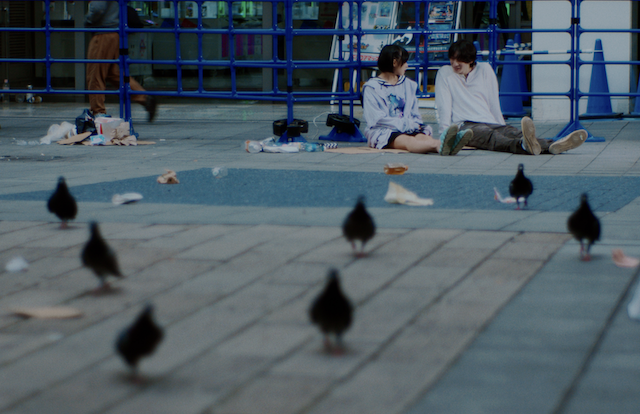
Makoto Nagahisa: Well, it’s more like we have no choice but to live, or rather, I think it’s a force that arises within all of us when faced with such circumstances. Even without a private room or home, sitting on a blue tarp and passing the time there—I think it’s simply that we were, in a very fundamental way, naturally compelled to do so.
©Courtesy of Sundance Film Festival
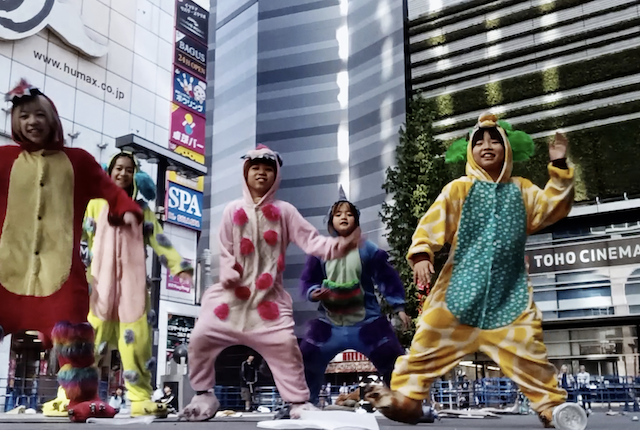
Q : I think the appeal of this work lies in capturing the reality of the young boys and girls living on the streets while also reflecting the glittering world of Shinjuku Kabukicho. On set, working alongside the cinematographer and lighting crew, what specific considerations went into capturing that world of Kabukicho through those particular angles?
Makoto Nagahisa: Regarding the cinematography. My inherent cinematic sensibility isn’t about directing in a way that strives for extreme realism. It’s more about capturing the allegorical aspects of that world, or viewing things through a low-resolution, toy-like perspective—a kind of low-resolution, jumbled, toy-like, childlike viewpoint. I’m the type of director who handles the cinematography and then directs the final look.
In that sense, rather than capturing true reality, I was shooting with the hope of reflecting a kind of sparkling, hopeful aspect that she or they might feel towards that place (To-Yoko). To be specific, for example, you know those sparkling parts on the asphalt that are actually meant to slow down cars? It might be hard to grasp since America doesn’t have that, but I thought they might have a kind of eye that can find those tiny sparkles in the asphalt – sparkles we ordinary people can’t see. So, I was careful while filming to pick up on those sparkling parts, the beauty they could feel, setting aside the books about that place.
Q I see, that’s how it is. I remember reading an article about that To-Yoko area before. It was about the father of a girl who jumped to her death there, lamenting that even though his daughter, who was actually a friend of the kids hanging out at To-Yoko, had died, the kids still hanging out there hadn’t changed at all. Given the reality that for kids with nowhere else to go, the To-Yoko area is becoming a second home, I think eliminating it entirely is just difficult, realistically speaking. So, regarding these kinds of problems happening at To-Yoko, what kind of response are the government and police currently taking?
Makoto Nagahisa: Am I supposed to answer that?
Q : Based on your research, could you tell us how the government and police are responding to this issue? Or rather, are there any signs of change in how they are handling it?
Makoto Nagahisa: I didn’t intend to address the latest developments of that sort. I’m afraid I can’t answer that. Well, I avoided talking about government matters because I didn’t want to risk saying something wrong to the American media.
Q : I thought I might learn something from your research, so I asked, but I apologize.
Makoto Nagahisa: It’s ok.
Q : Mr. Nagahisa, your feature film debut “We Are Little Zombies” won the Special Jury Prize at this very Sundance Film Festival. As a filmmaker returning to this place, this Sundance Film Festival, please share your thoughts.
Makoto Nagahisa: In film, it’s not just those kids at Tōyō; that ‘We Are Little Zombies’ too, and the short film ‘And So We Put Goldfish in the Pool,’ which was first invited to Sundance—you can watch them all on YouTube, so I really hope you’ll check them out. Last time, I was invited with ‘Pisco’s Love Born from a Crab,’ another short film about a high school girl’s memoir grappling with her origins. While it might sound simplistic to say ‘the various worries teenagers face,’ I’ve been making films wondering if cinema could offer some kind of approach to kids carrying these burdens.
I didn’t make films to get nominated for Sundance; I made them purely for the sake of making them. So, the fact that they consistently take notice of my work and pick it up—I can only feel immense gratitude. I’m truly thankful. Through Sundance, I believe it’s thanks to film festivals like this that stories and the inner workings of people—stories we in Japan can only encounter through news reports—can reach audiences in North America. I’m truly grateful for that.
Q: Now that you’ve returned to the Sundance Film Festival once again, and with the film set for release in Japan this April, what aspects of this work do you feel it captures as a microcosm of Japanese society? What do you personally hope audiences will take away from this film?
Makoto Nagahisa: Well, I’d rather not spell out the themes too explicitly, as that might feel a bit heavy-handed. But of course, I did conduct interviews and drew inspiration from them for my creative work. When I say “them,” I mean each individual I interviewed was in a completely different situation. So, what’s depicted in this film isn’t necessarily exactly what happened. I hope viewers will watch it understanding that.
First, I hope you can feel that these harsh situations aren’t their own fault, but arise from being stranded in places like this. Separately, from a cinematic perspective, I think I’ve incorporated several dream sequences. I think you’ll notice that. I have this desire to depict dreams in a certain way, separate from social commentary—though that gets into film theory, which is a bit tricky. I’m a writer who incorporates a lot of those dream sequences. It’s something that can’t quite be simulated, something difficult to put into words. It’s a bit hard to put into words, isn’t it? It’s quite difficult to articulate.
Q: May I ask one last question? I said “last” just now, but since you yourself are an overseas film director, Nagahisa-san, I imagine there are many directors who have been influenced by you. Among them, are there any directors from North America who have influenced you or left a strong impression? And what aspects of those directors resonated with you?
Makoto Nagahisa: I’m deeply influenced by director Richard Linklater. First, I think Linklater is a director whose methodology comes first. I feel a strong connection to the way he approaches time in his scripts and projects. There’s this sense that what you feel right now connects directly to what you felt ten years ago, without feeling the passage of that decade.
For example, the dialogue in Before Sunset, or the way Boyhood spans years to capture a single year, yet seamlessly connects different time periods through jumps; or the meticulous way Waking Life depicts its situations – the approach to the sense of time itself is incredibly fascinating and something I adore. Unraveling that, I realize that in that sense too, my constant desire to approach things like dreams and time against the backdrop of reality as narrative might be influenced by Richard Linklater.
Makoto Nagahisa : This is my very first interview. I’d like to hear your thoughts for about three minutes. Even if it’s just fragments, that’s fine.
Q: I haven’t seen much your work, Mr. Nagahisa, so I apologize for not having anything to compare it to. Personally, I’ve lived in America for many years, so the only exposure I’ve had to stories about the To-Yoko Kids has been through YouTube and such. I really don’t have much information on that subject.
In that state of not really recognizing it, I think there’s this distortion in Japanese society—or rather, this inability to effectively communicate things emotionally, to convey them well, to express them properly when interacting directly with people. I feel this isn’t unique to Japanese society; it’s particularly present in societies overseas as well. This distortion exists even within parent-child relationships, where it’s difficult to bridge that gap. There’s a significant amount of this distortion, and I think there’s a strong tendency for relationships to become very distant, even when living under the same roof. Especially in Japanese society, I feel this aspect very strongly from my perspective as someone from America. I think one manifestation of this is the emergence of the “Tōyō Kids” phenomenon.
Another thing that concerns me is that while there’s a huge responsibility issue for adults regarding things like sugar daddy arrangements or selling themselves, I also think adults themselves find it difficult to interact with these kids. There’s a lack of institutions or mechanisms in Japan focused on creating environments that prevent these kids from being created in the first place. I’ve only just seen it myself and can’t express it well yet, but I really felt all these things through the film from every angle. It reflects the distorted reality happening in society, seen from the parents’ perspective, the children’s perspective, and so on. As a film, I felt its stark realism and its powerful message, so I think it’s a very meaningful movie. I’m just stringing together thoughts spontaneously, and I don’t feel like I’m expressing myself very well myself.
Makoto Nagahisa: That’s good. No, really, I should have asked that at the beginning. That’s all.
Q: I see. I felt like my questions about the government and police weren’t very well-asked, but just hearing your perspective was really helpful.
Makoto Nagahisa: I’m glad to hear that. Actually, I just realized it would have been easier for me to talk after hearing what perspective you were watching this film from.
Q: Ahaha, I see. Understood. Mr. Nagahisa, thank you for your valuable time.
©Courtesy of Sundance Film Festival
If you like the interview, share your thoughts below!