

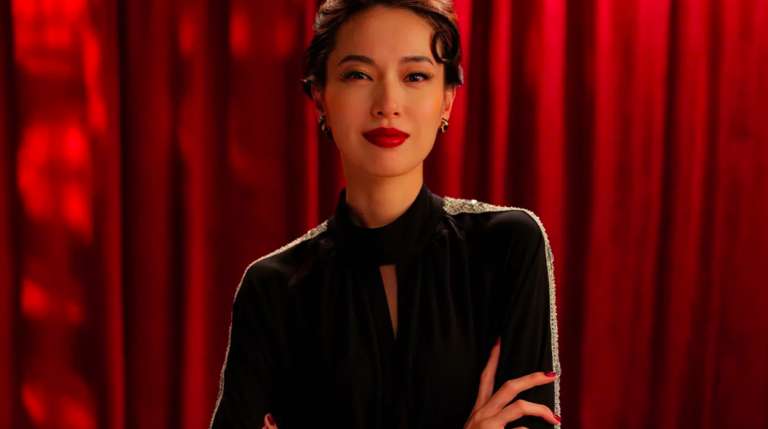
If Italy has Wanna Marchi as the controversial figure of fortune telemarketing — portrayed in the Netflix miniseries Fortune Seller: A TV Scam — Japan’s self-made, con fortune teller is embodied by Kazuko Hosoki, depicted in the fictional Netflix series Straight To Hell.
The compelling production — directed by Tomoyuki Takimoto and Norichika Oba — chronicles the story of a war child who made it to success, through hard work, resilience and at times unscrupulousness. She is the one who coined the term “You’ll go to hell!” This infernal warning applies also to her own downward spiral, that is the leitmotiv across all the episodes of the series retracing her highs and lows.
The young Kazuko, with her mother and siblings, had to survive the aftermath of the Pacific War. Hunger was a daily companion and misery seemed to be the only fate ahead. During high school her ambition started to take over, something that would be her constant energy source, allowing Hosoki to reinvent herself professionally over and over again.
Erika Toda plays the adult Kazuko Hosoki from her teenage years, through to the early 2000s. The series cunningly takes almost an investigative approach in the fictional rendition of this woman’s life, through the character of Minori Uozumi (played by Sairi Ito), as a young divorcee, mother and author who is assigned to write the biography about the woman who holds the Guinness World Record for bestselling book on fortune-telling.
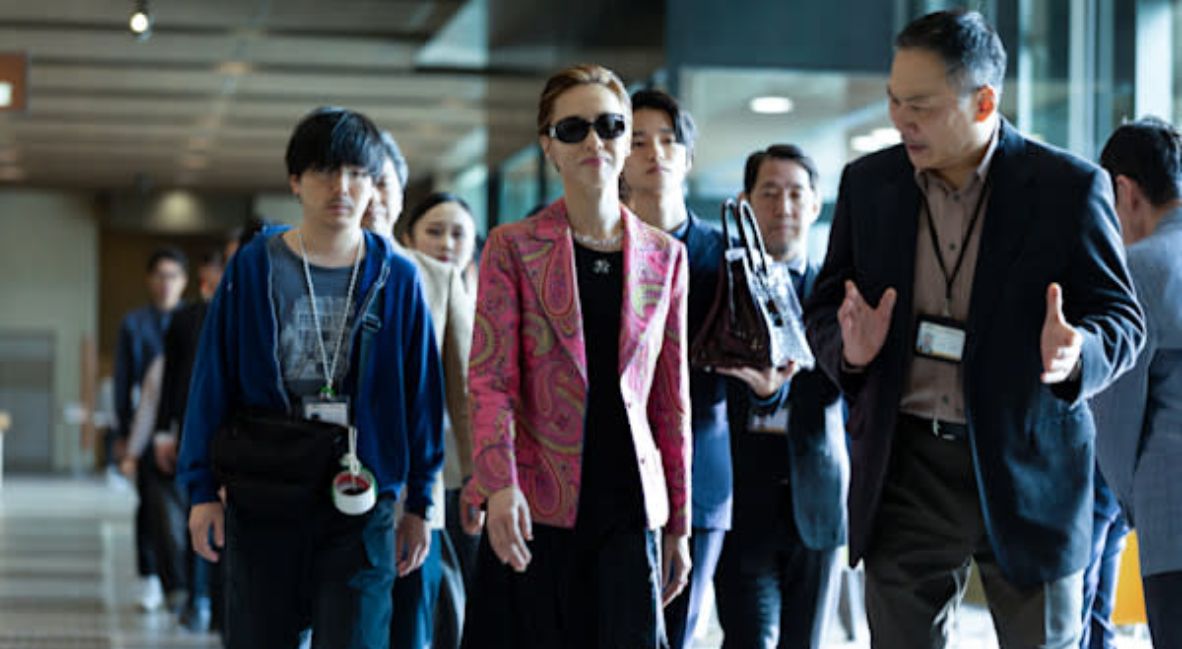
The music choices are exceptional in helping viewers navigate the decades of Hosoki’s life, with songs such as Mr. Sandman from the Fifties and Downtown from the Sixties. Also the historicisation of the events helps give context to Hosoki’s personal narrative such as the 1965 Tokyo Olympic games, the 1973 oil crisis, all the way through the 1980s, 1990s, arriving to the present in which the story is set: the year 2006.
“How did it start?” is the question that allows to turn the clock back and listen to Hosoki’s first-person account of her life. Eventually Minari gets to interview other people who have a different version of shared circumstances. This narrative choice can be perceived as the most appropriate device to channel an authentic portrait of the Six-Star Astrology celebrity, that some worship as a Messiah, whilst others (including Gendai magazines) have denounced as a ruthless hustler. Straight To Hell allows viewers to accept the contradictions of this woman who was not willing to give in to failure.
The devastation of Japan’s defeat was palpable in the way it changed the population’s frame of mind in the late Forties. The first teachings Kazuko learnt, while surviving in Tokyo’s rubble, was that “the weak end up being prey” and “the blame goes to the gullible, not the liar.” Thus, she developed a thick skin from a very young age, but not thick enough to avoid being repeatedly scammed during her youth.
Many men accompanied her journey: the manager at the club where she worked as a hostess, Mr. Ochiai; her first wealthy husband, Mr. Mita (Tamura Kentaro), the captivating Mr. Sudo (Nakajima Ayumu); her yakuza persecutor Mr. Takiguchi (Sugimoto Tetta); her true love Mr. Hotta (Ikuta Toma); her late husband and I Ching guru, Mr. Yasunaga (Ishibashi Renji). Her sentimental life was lived in earnest, but as she explains it reflected how the collection of poetry Manyoshu uses the characters of loneliness and sadness to form the word love. Also the men she was not involved with romantically had an important role in her life, such as her brother Hisao (Hosokawa Gaku) and the family friend who became an investor in her entrepreneurial activities, Mr. Nakazono (Takahashi Kazuya).
Just as multifaceted was Kazuko’s interaction with the women who populated her life, such as her sisters (Shumoto Erika and Kanazawa Miho); singer Chiyoko Shimakura played by Tôko Miura (who rose to global fame with Drive My Car); the fortune teller she called her mentor (Nakamura Yuko); Towako, the daughter of Mr. Yasunaga (Ichikawa Miwako); and her mother (Tomita Yasuko). The latter was the first one to plant the seed in Kazuko’s mind of how fortune telling can be influential in people’s lives. But while the matriarch sought genuine guidance from this ancient practice — and was allarmed when fortune tellers would claim that her daughter’s greed would swallow her — Kazuko used it as a tool to gain what she wanted. Her mother tried warning her since she was a child that “People who do bad things go straight to hell.” But Kazuko seemed to be irresistibly drawn into the bottomless swamp, to keep her fire burning. Personal advancement was the one thing she would never give up. As she says to her biographer Minari: “Now people forget to dream. Without dreams nothing begins. Without desire nothing can be obtained.”
She learnt to study human nature by forging her career through hospitality, first working at her mother’s oden stall, then as a hostess at a club, and eventually setting up her own clubs. Already in her twenties she was known as the “Queen of Ginza.” She swiftly realised that time is the essence, riding trends and manipulating people’s desires into the business she would offer. Besides being focused on becoming a money-making machine, the high school drop-out never stopped seeking intellectual self-improvement, attending college courses to learn about finance, philosophy and politics. In parallel to all this, the resourceful woman cultivated a network of bigwigs that would turn out to be resourceful for her shift of career.
Once she becomes a tv personality, Kazuko Hosoki’s hallmark is how she “doesn’t mince words.” When she delivers her ominous, blunt warnings like the “Great Calamity Period,” the crowd goes wild. Even her vulgar, nouveau rich display of wealth strengthens the image she has created for herself. However, all of this privilege is shared only with her poodle Tiara, in her luxurious and empty mansion.
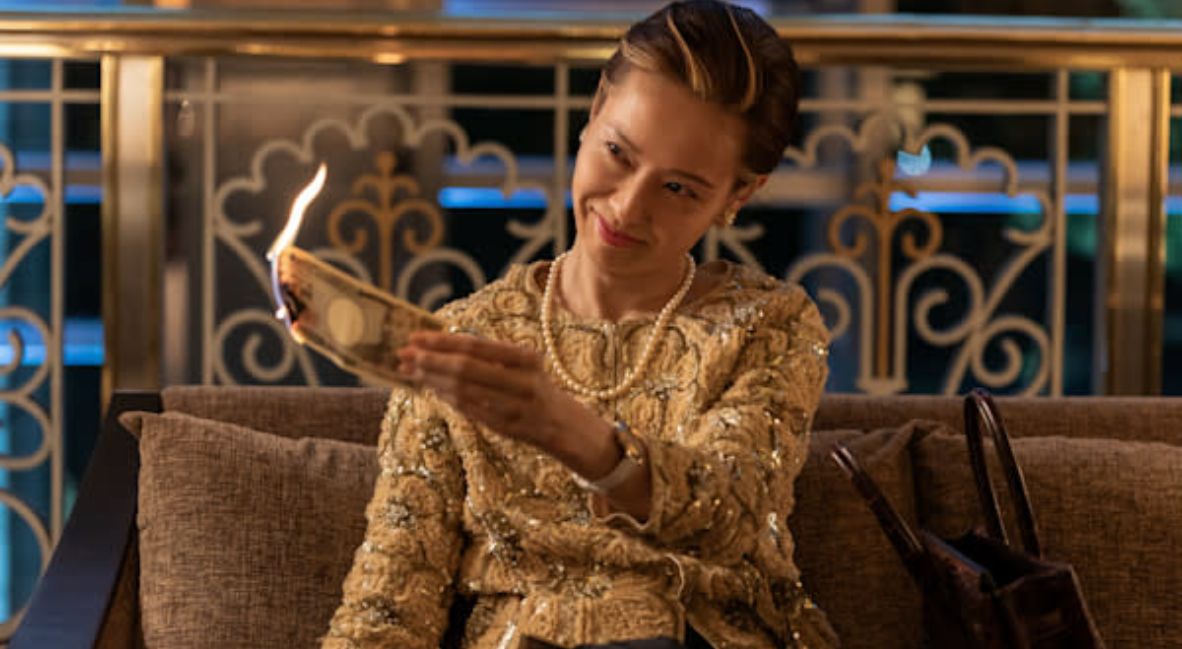
A champion of the rags to riches myth, a deceitful villain, a Phoenix who proved how “you can always turn your life around,” even if it takes making disreputable choices. Straight To Hell’s dark heroine turns out to be exceptionally magnetic, for having harnessed the art of learning, while constantly fighting tooth and nail against adversities. This is epitomised by her gesture of touching the corner of her lips with her fingers, which always anticipates the warm up for her upcoming battle.
Spanning 60 years, from the mid-20th century to the early 21st, this drama series offers a manifold account of the struggles and aspirations of an unfathomable woman.
Photos are courtesy of Netflix
Final Grade: A