

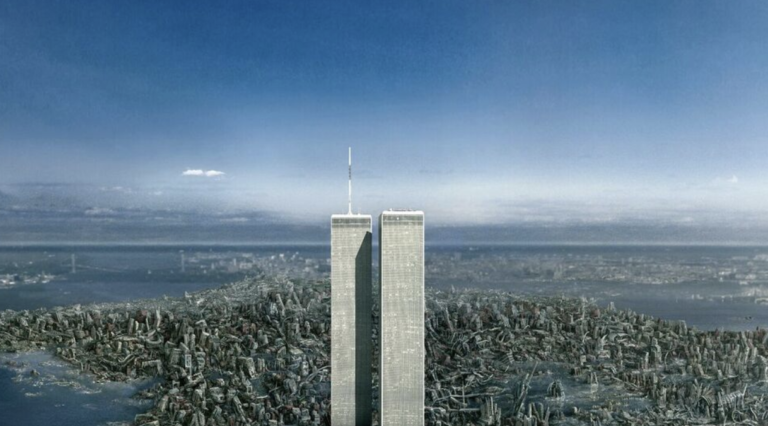
©Courtesy of IX XI
As the 25th anniversary of September draws near, filmmakers continue searching for new ways to explore one of the most documented events in modern history. In the new feature, IX XI, writer-director-producer Sean Wilsey delivers a powerful and deeply personal documentary that shifts the focus from historical analysis to human memory.
Through the recollections of twelve everyday New Yorkers, Wilsey crafted an intimate portrait of how ordinary lives were forever changed by an extraordinary tragedy. The movie offers a fresh and emotionally resonant perspective on the lasting impact of 9/11.
Rather than presenting a historical examination of September 11, IX XI creates an intimate mosaic of personal recollections. The movie’s interview subjects come from vastly different backgrounds and professions, including actor Griffin Dunne, cartoonist Roz Chast, novelist Nell Zink, a UPS employee, a former World Trade Center worker, and others whose lives unfolded in different corners of New York City. What unites them is not celebrity or accomplishment but proximity to a collective trauma that permanently altered the city they call home.
The documentary’s greatest strength lies in its interviews. Wilsey allows each participant the space to recount not only where they were when the attacks occurred but also what their relationship was with New York and the World Trade Center beforehand. This approach transforms the Twin Towers from mere architectural landmarks into living symbols embedded within the daily routines of millions of people. For some interviewees, the towers represented employment and commerce; for others, they were simply part of the city’s skyline, a familiar presence taken for granted until it disappeared.
The interview segments are remarkably engaging because they avoid sensationalism. Instead of revisiting graphic details or emphasizing spectacle, the subjects focus on mundane memories—the ordinary moments that preceded extraordinary tragedy. One interviewee recalls dining in one of the towers the night before the attacks. Another describes commuting through the city as usual. These recollections remind viewers that history is often experienced not as a dramatic event but as a sudden interruption of everyday life.
Among the standout contributors is Griffin Dunne, whose reflections carry particular resonance. Wilsey cleverly incorporates footage from Martin Scorsese’s After Hours, connecting Dunne’s cinematic association with New York City to his memories of September 11. Dunne recounts the surreal feeling that parts of the city briefly continued operating as though nothing had happened and expresses disbelief at receiving an invitation to a red-carpet premiere scheduled for that same evening. His observations effectively capture the confusion and disorientation that characterized the day.
Visually, IX XI is a striking achievement. Cinematographer Autie Carlisle and Wilsey frame many of the interview subjects within reflective environments, including mirrored rooms and glass-like pools. These visual motifs serve multiple purposes. They evoke the design language of the National September 11 Memorial while also reinforcing the documentary’s themes of reflection, memory, and interconnectedness. The mirrored imagery creates the impression that each subject’s story is being reflected through the experiences of the others, despite the fact that none of them share a direct connection.
Carlisle’s cinematography consistently elevates what could have been a conventional talking-head documentary. The compositions are elegant and deliberate, transforming simple interviews into visually compelling portraits. The use of reflections and symmetrical framing creates a subtle emotional resonance, encouraging viewers to consider how personal memories overlap and diverge in the aftermath of collective tragedy.
Equally impressive is the documentary’s extensive use of archival footage. While audiences might expect familiar images from September 11, Wilsey broadens the visual language by incorporating clips from films such as The Sound of Music, Scarface, and Ralph Bakshi’s 1978 animated adaptation of The Lord of the Rings. These selections may initially seem unconventional, but they ultimately contribute to the documentary’s larger meditation on memory. Human recollection is rarely linear or purely factual; memories are often filtered through cultural references, emotions, and personal associations. By juxtaposing archival footage from the attacks with imagery from popular films, Wilsey suggests that our understanding of history is shaped by the stories and images we carry with us.
The editing by Zara Serabian-Arthur, Nic Seago, and Tristan Daley deserves considerable praise for weaving together twelve distinct narratives into a coherent whole. Structurally, IX XI functions less as a traditional documentary and more as a collective oral history. The editors skillfully transition between subjects, creating thematic connections where none explicitly exist. Their work allows the film to maintain momentum while preserving the individuality of each participant’s experience.
Not every storyline lands with equal impact. Kifah Shah’s reflections on the racism and discrimination that intensified after September 11 introduce an important perspective that broadens the film’s scope beyond the attacks themselves. However, her story feels somewhat underdeveloped compared to the others. The documentary gestures toward the experiences of Muslim and South Asian Americans in the aftermath of the attacks but does not spend enough time exploring those realities in meaningful depth. As a result, what could have been one of the film’s most powerful avenues of discussion feels only partially realized.
Even so, this limitation does little to diminish the film’s overall effectiveness. What makes IX XI compelling is its willingness to embrace complexity rather than impose a singular narrative. Wilsey understands that September 11 was not experienced in one uniform way. By presenting twelve unique perspectives, he captures the fragmented nature of memory itself.
The documentary is further enhanced by its evocative musical score from Milena Erke, Randall Poster, and Mira Wilsey. The music remains understated throughout, never overwhelming the testimonies at the film’s center. Instead, it provides a subtle emotional framework that underscores moments of reflection and loss. The score complements the film’s meditative tone and contributes significantly to its emotional impact.
Ultimately, IX XI succeeds because it prioritizes humanity over history. Sean Wilsey has crafted a thoughtful and visually sophisticated documentary that explores how ordinary people remember extraordinary events. Through compelling interviews, inventive archival choices, exceptional cinematography, precise editing, and a moving score, the film demonstrates that the legacy of September 11 continues to live within individual memories as much as public monuments.
Rather than offering definitive answers or grand statements, IX XI invites conversation and reflection. It reminds viewers that collective tragedies are built from countless personal experiences, each carrying its own weight and significance. In doing so, the documentary becomes not just a film about September 11 but a poignant exploration of memory, community, and the enduring connections forged through shared history.
Grade: B+
If you like the review, share your thoughts below!