

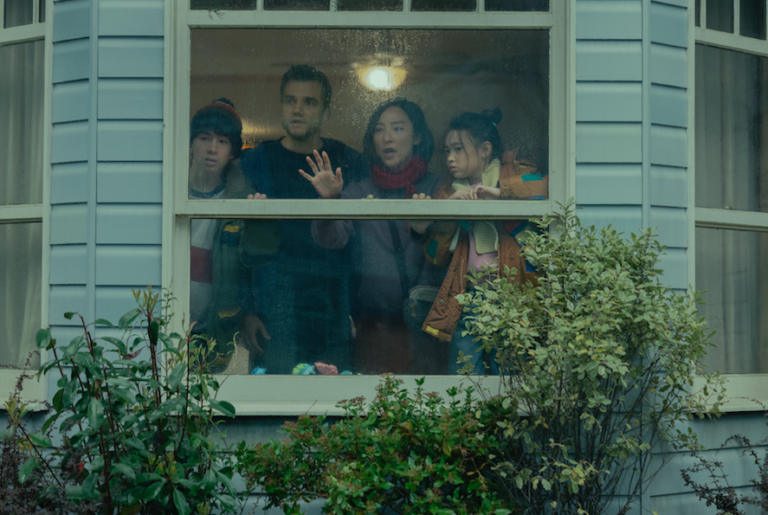
Netflix’s The Last House shows Greta Lee and Wagner Moura star in the original sci-fi thriller directed by Louis Leterrier as Ann and Jason, who find themselves sealed in their house with their children, Graham (played as a younger child by Noah Alexander Sosnowski and as an older version by Gabriel Barbosa) and Ruth (played as a younger child by Riley Chung and as an older version by Emma Ho), along with their dog Cassidy. The film challenges the idea of a home being a safe haven, by transforming it into a prison that may even become a hostile place.
This family is not the only one that is sealed in their home with no way out. The entire neighborhood is affected, and the inhabitants wonder to what extent this strange phenomenon extends to. The rain seems to be the cause, but it’s uncertain. The days pass, and time piles up exponentially. Besides lacking the essentials to stay alive, a mysterious and looming threat is keeping them captive. Ann and Jason prove to be two fierce protectors of their children, as they display an unrelenting fortitude and selfless steadfast power under extreme stress and danger. The music score by Yair Elazar Glotman ramps up the tension, mirroring the family’s state of mind as they realise their home is now a trap.
A quote by Arthur C. Clarke, that precedes the action, plants an interesting seed on the nature of our planet: “How inappropriate to call this planet Earth, when it’s quite clearly Ocean.” In fact, our blue planet’s oceans are clearly the central player of the climate system. Louis Leterrier explores this in small increments, with water being another lead character of The Last House, starting with the rain.
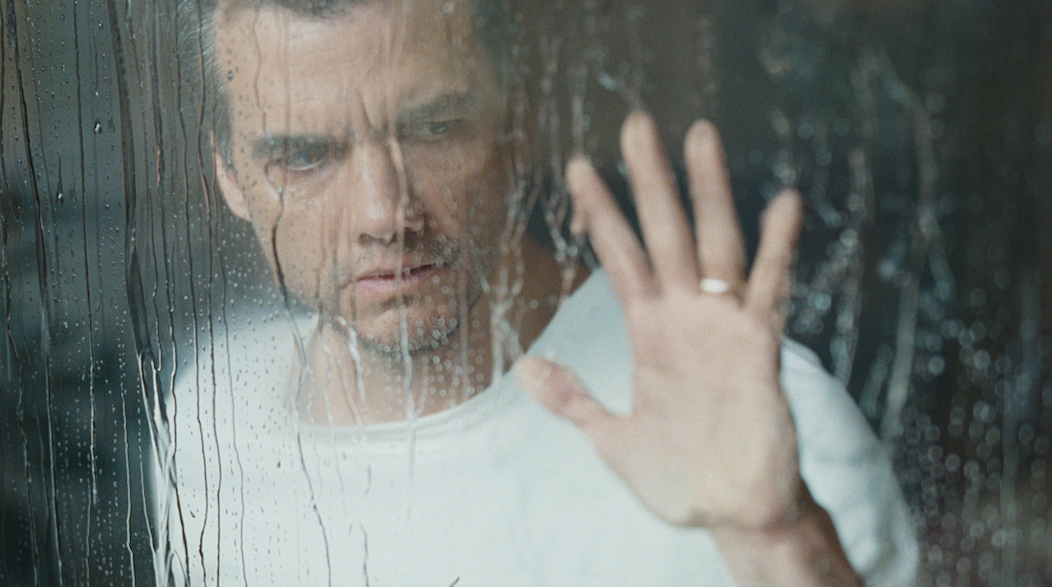
The initial atmosphere that is experienced watching the film could easily be compared to the one the world experienced during lockdown: a sense of constriction, where multiple home activities were practiced for distraction. The family enjoys a return to the analogue and manual, listening to David Bowie or The Cure on vinyl, binge-watching feel-good DVDs like Annie and Air Force One, and carrying out DIY activities. But as time goes by, the family has to concentrate on surviving, because the means of subsistence are running out.
From a philosophical perspective, Louis Leterrier seems to have transferred on reel Thomas Hobbes’ Leviathan, that serves as a metaphor of an enduring power sustained by a continuous production of loyal subjects, that relies on a form of conditioning that mechanically inscribes the principles of the state into human consciousness. At its core is a dualistic understanding of good and evil, which in The Last House is subverted because we learn to look at the alleged villain of the story with a new perspective.
At the end of the day the film comes across as a cautionary tale, that raises questions about our world and how we choose to live in it. Above all, nature’s rise against human-driven degradation, serves as a powerful warning against the unsustainable use of Earth’s resources caused by the anthropogenic depletion.
Final Grade: C+
Photos credits: Netflix