

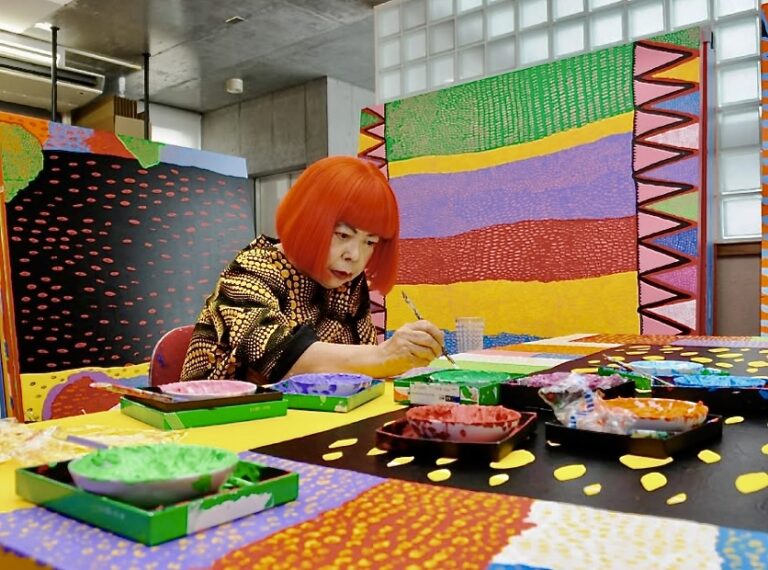
Courtesy of Yayoi Kusama Museum(Instagram)
Yayoi Kusama, one of the globe’s most revered and widely commercially successful artists, has passed away at 97, as announced on the artist’s official website.
“With great sadness, it was announced,” follows the statement, posted on Thursday, noting that Yayoi Kusama passed away at a hospital in Tokyo on August 14.
Kusama was an exceptionally popular and commercially successful figure in contemporary art, as of her death. Famed for her “Infinity Mirror Rooms,” massive installations that submerged audiences in an endless repetition of hues and light, these immersive spectacles captivated millions of gallery visitors. Her pumpkin sculptures and polka-dot paintings, notable for their style, generated millions from auction sales.
In 1929, born into a dysfunctional and abusive household, Kusama spent much of her childhood in a military factory, sewing parachutes for Japan’s imperial army. She was then experiencing vivid hallucinations, which were to later manifest as polka-dotted patterns in her artwork.
[tf-tv]
But the global recognition of her work in later years was made all the more remarkable by the difficulties she overcame to achieve it, namely childhood trauma, mental illness and years of relative obscurity.

FLOWERS THAT BLOOM NOW from「YAYOI KUSAMA : FESTIVAL OF LIFE」Photo by Nobuhiro Hosoki
Even though Kusama had a very brief stint studying the modernist “nihonga” painting style at an artistic school in Kyoto, she evidently received little formal instruction in Japanese art traditions, or showed no apparent interest in them.
Inspired by a correspondence with American artist Georgia O’Keeffe and disenchanted with life in postwar Japan, at 27, this young person migrated to America in the late 1950s, initially settling in Seattle before relocating to New York as the origins of the pop art movement were taking shape.
She radically reinterpreted the city’s abstract impressionist legacy by blending a chaotic profusion of dots, flowers and phallic shapes into a substantial body of work, encompassing not just paintings and sculptures but also surrealistic films, literature and theatrical performances.
Following 1960s counterculture, Kusama orchestrated “happenings” where she rendered naked bodies into canvases embellished with dots. She is also known to have sent an open letter to US President Richard Nixon in 1968, proposing sexual relations to end the war in Vietnam. The letter read, “Let’s forget ourselves, dear Richard, and merge with the Absolute together in the altogether (sic).”.
Nixon did not appear to have accepted the offer. (The conflict did not conclude until 1975, with Saigon’s fall.) Yet, these instances showed that, despite Kusama’s paintings being rich in joy and hue, she wasn’t shy about tackling critical areas of the time, including gender equity, gay rights, and the anti-war movement.

INFINITY MIRRORED ROOM – LET’S SURVIVEFOREVER from「YAYOI KUSAMA : FESTIVAL OF LIFE」Photo by Nobuhiro Hosoki
When viewed through a modern perspective, Kusama’s artwork was given new acknowledgment. Her long-neglected works were rediscovered during exhibitions in Western venues, with a notable retrospective at New York’s Center for International Contemporary Arts in 1989. In 1993, the international art world’s belated approval was seemingly cemented when she was asked to represent Japan at the Venice Biennale — an event that, 27 years earlier, she had essentially gatecrasher by unofficially exhibiting 1,500 mirrored balls on the lawn outside the Italian Pavilion.
A compulsive and prolific artist, Kusama, who typically did not begin paintings until they were already completed, nonetheless continued to create art from the facility and a small nearby studio.
The art establishment often drew on, if not directly copied, Kusama’s work. But it never fully embraced her. Despite counting the likes of Andy Warhol and Donald Judd as friends, she remained an outsider. The announcement of her death spread across social media, triggering numerous tributes.

With All My Love For The Tulips, I Pray Forever from「YAYOI KUSAMA : FESTIVAL OF LIFE」Photo by Nobuhiro Hosoki
[tf-tv]