

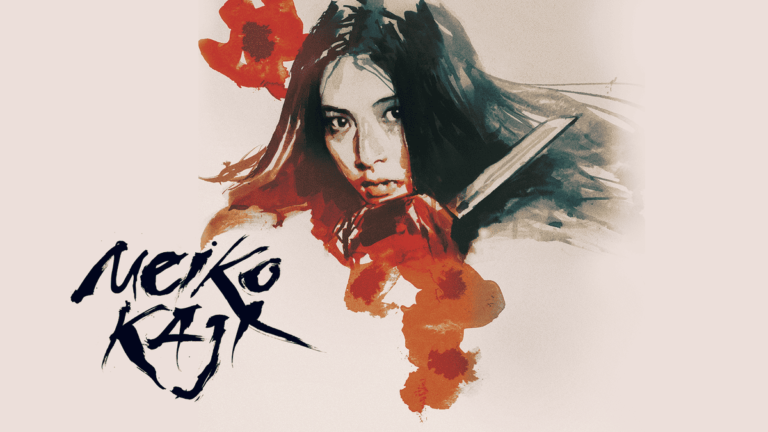
©Courtesy of Japan Society
Japan Society is pleased to announce the film series Meiko Kaji: A Retrospective, a focus on the cult actress featuring her first public New York appearance in over 40 years—running March 27 – April 4. Best known in the West as the mythic katana-wielding Lady Snowblood of the eponymous 1973 Toho picture—a violent cult work steeped in fountains of spurting blood—actress and singer Meiko Kaji remains inseparable from the image of a rebellious outlaw heroine, a cataclysmic force of seventies Japanese cinema whose characteristic steely-eyed gaze cemented her as something akin to Clint Eastwood’s Man with No Name.
Recruited at the coda of Japan’s studio era, Meiko Kaji debuted in 1965 under her real name Masako Ota as a contract player for Nikkatsu, Japan’s oldest studio. Deemed “difficult” for not fitting into the studio’s prescribed mold of modest, pure-hearted female ingénues (in the vein of Nikkatsu star Ruriko Asaoka), Kaji was soon sidelined to supporting roles until her outspoken nature proved well-suited for outsider roles, embodying the image of an outlaw figure as she moved into genre cinema with noteworthy delinquent series Stray Cat Rock, an early launching pad as well for co-star Tatsuya Fuji (In the Realm of the Senses) and Kaji’s mentor Yasuharu Hasebe. As Nikkatsu opted to shift away from mainstream film and into softcore productions to combat declining attendance, Kaji—who had assumed the stage name “Meiko Kaji” under the suggestion of chambara director Masahiro Makino (Singing Lovebirds)—left the studio of her own accord at the age of 23.
Soon sought by Toei as an ideal successor to retiring ninkyo eiga (chivalry film) Junko Fuji, Kaji would then rise to recognition as the vengeful prisoner Sasori (Scorpion) in the popular Female Prisoner Scorpion series (1972-1973) and then, during a hiatus, took on the role of Yuki in Toshiya Fujita’s Lady Snowblood (1973). Kaji willfully defied being pigeonholed by her successes—seeking instead to further her craft and artistry with filmmakers such as Kinji Fukasaku and Yasuzo Masumura, eventually going freelance by her mid-twenties. Moving from ninkyo eiga and pinky violence to yakuza pictures, arthouse productions and television, Kaji—whose piercing gaze came to define an era of Japanese cinema—transcended the confines of genre cinema; her depth and versatility extend far beyond the cult mythos that surrounds her.
Over 60 years since her film debut, Japan Society will host Kaji for her first public appearance in New York City in more than 40 years. Kicking off on March 27th with a screening of Lady Snowblood, series highlights include Kaji’s personal favorite work: Daiei master Yasuzo Masumura’s rarely-seen The Love Suicides at Sonezaki (to be shown on a rare 35mm import); seldom-screened 35mm prints of Female Prisoner Scorpion: Jailhouse 41 and Stray Cat Rock: Sex Hunter; and the world premiere of a new 2K restoration of Wandering Ginza Butterfly. Kaji will participate in introductions and Q&As during the series’ opening weekend (March 27-29).
|
||