

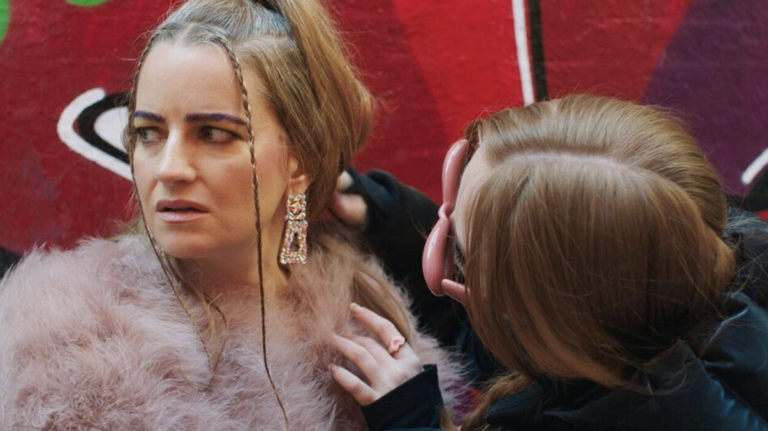
©Courtesy of Tribeca Festival
In an era where branding feels more important than fulfillment, Deepfake explores the complicated relationship between identity, validation and authenticity. The new comedy blends fashion, technology and social satire into a story that examines how easily self-improvement can become self-erasure. The film ponders when life is curated for public consumption, what happens to the person behind the profile.
Matt Eames wrote, directed and edited the movie. Jessica DiGiovanni, Sophia Lucia Parola and Jocelyn Weisman led the comedy’s cast.
The New York-set Deepfake follows Jane (DiGiovanni), an thirty-something project manager suffering through an existential crisis after a breakup. While her peers are moving confidently through adulthood with promotions and growing families, Jane finds herself stranded in emotional limbo.
Desperate for change, Jane signs up for an app that allows users to hire companionship and emotional support. Through the service, she meets Zoe (Parola), a best friend for hire who becomes invested in Jane’s quest for reinvention.
What begins as emotional support soon evolves into something much bigger and stranger. Zoe introduces Jane to London (Weisman), a social media strategist who approaches life as if it were a branding exercise. Convinced that the key to winning back Jane’s ex-boyfriend lies in constructing the perfect online persona, London launches a full-scale makeover operation. Before long, Jane’s life becomes a carefully orchestrated content machine complete with influencer partnerships, strategic posts, curated aesthetics and an ever-growing follower count.
Eames balances the film’s heightened comedy with a foundation of recognizable emotional truth. The filmmaker uses flashbacks to explore the relationship’s deterioration, showing how minor disagreements and unmet expectations steadily erode its foundation. These glimpses into the past provide important context, reminding viewers that beneath the hashtags, filters and algorithmic manipulation lies a woman struggling with loneliness and self-worth.
What makes Deepfake work so well is its ability to balance broad comedy with genuine emotional insight. The movie frequently pushes its premise to ridiculous extremes. Jane’s transformation eventually becomes so overwhelming that a woman literally appears at her door claiming she has been hired to impersonate Jane’s updated personality.
Yet even at its most chaotic, the comedy never feels disconnected from its central themes. Every increasingly bizarre twist serves to underscore the ongoing exploration of where the line between self-improvement and self-erasure ultimately lies.
DiGiovanni delivers an outstanding performance as Jane, carrying much of the comedy’s emotional weight with remarkable skill. She perfectly captures the awkward vulnerability of someone who’s desperate to feel wanted again.
Jane makes questionable decisions throughout the story, but DiGiovanni ensures those choices remain understandable because they emerge from a very real place of heartbreak and insecurity. She navigates Jane’s journey between post-breakup despair, hope, confusion and eventual self-awareness with a natural authenticity that keeps audiences invested even as the story spirals into increasingly absurd territory.
While DiGiovanni provided the emotional core for Deepfake, Weisman shone in nearly every scene she entered. As London, the latter actress created the most memorable comedic characters of the film.
Instead of portraying the social media guru as a one-dimensional stereotype, Weisman ultimately elevated the role through impeccable timing and fearless commitment. Whether critiquing Jane’s retro wardrobe choices, reacting in horror to her age or speaking entirely in branding jargon and wellness buzzwords, London becomes both hilariously exaggerated and disturbingly believable.
Weisman brilliantly embodies the hyper-curated influencer archetype. Therefore, she transforms what could have been a simple parody into a surprisingly nuanced representation of a generation raised on personal branding and digital validation. Every interaction carries an undercurrent of manipulation wrapped in positivity, making London simultaneously funny, fascinating and slightly terrifying.
Parola also shines as Zoe, providing a more grounded counterbalance between Jane’s emotional vulnerability and London’s relentless ambition. The evolving dynamic between Jane and Zoe forms one of the comedy’s strongest elements, particularly as the feature explores the concept of transactional friendship.
Jane is literally paying Zoe to spend time with her. As a result, she creates an inherently artificial relationship that gradually raises questions about authenticity, emotional labor and whether genuine connection can emerge from a commercial arrangement.
Eames demonstrates a keen understanding of modern internet culture without resorting to undeveloped generational jokes. His screenplay is filled with sharp observations about app dependency, influencer obsession and the endless pursuit of online validation. Yet the film’s satire works because it never feels mean-spirited. Rather than mocking people who seek fulfillment through social media, Deepfake examines why those platforms have become so alluring in the first place.
The project is also visually impressive. The movie’s cinematographer, Robert Bevis, captured New York City as a landscape of simultaneous isolation and performance. His photography highlights the contrast between Jane’s messy internal reality and the polished digital image being constructed around her. Whether documenting influencer photo shoots, social gatherings or quieter moments of reflection, Bevis consistently reinforces the comedy’s themes through thoughtful visual storytelling.
What ultimately elevates Deepfake above standard social media satire is its emotional intelligence. Beneath the jokes lies a surprisingly poignant exploration of loneliness and identity. The comedy understands that the desire to reinvent oneself after heartbreak is universal. That’s even true with the methods having changed dramatically in the age of algorithms and content creation. Jane’s journey reflects the modern anxiety that everyone else is living a better, happier and more successful life.
Eames effectively captures the contradictory relationship many people have with the internet. There is a recognition of its capacity to distort reality, yet a continued return to it in search of connection.. That tension drives every aspect of Deepfake, creating a comedy that feels both entertaining and insightful.
Deepfake deliveres plenty of laughs while quietly asking deeper questions about authenticity, friendship and self-worth. It skewers the commodification of human relationships, but it also offers empathy for those caught within those systems.
Funny, original and surprisingly moving, Deepfake is one of the most engaging social media satires in recent memory. Anchored by an exceptional lead performance from DiGiovanni, scene-stealing work from Weisman, sharp direction from Eames and strong visual storytelling from Bevis, the film succeeds as both a rambunctious comedy and a thoughtful examination of modern identity.
Deepfake had its World Premiere in the Viewpoints section on June 6 during the Tribeca Festival.
Rating: B+
If you like the review, share your thoughts below!