

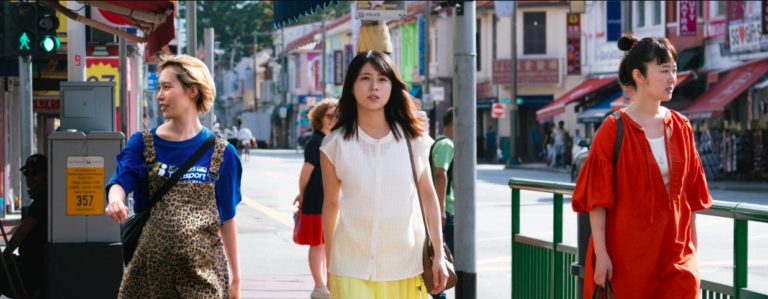
Chihiro Amano, a year after directing her film Sato and Sato, returns to cinemas with Magical Secret Tour that had it North American Premiere at the 25th New York Asian Film Festival.
This is a gold-smuggling story inspired by true events, involving housewives who were arrested for smuggling gold bars at Chubu Centrair International Airport in 2017. That year customs detected 1,347 cases with about 6.3 tonnes of gold being seised, which lead to more intensive passenger inspections and tougher penalties. Enhanced controls were established in 2025 since gold smuggling had began rising again in 2023.
In Magical Secret Tour the real story is adapted into a choral narrative that focuses on three women with one goal: emerge from penury. Wakako (Kasumi Arimura) is a mother of two, whose husband collapses from a subarachnoid haemorrhage and ends up in hospital which is where she learns he embezzled money and needs to pay off his creditors; Kiyoe (Haru Kuroki) is a postdoctoral researcher obsessed with K-pop, who is 6 million yen in debt; Mayu (Sara Minami) is an unmarried, pregnant cabaret hostess with no savings, and has a sister she wants to support and a mother who keeps squandering money with her younger boyfriends. These three wretched women happen to meet in Singapore by chance. To escape from their difficult situations, they become involved in a gold smuggling operation, that will inspire them to embrace criminal entrepreneurship.
Wakako, Kiyoe and Mayu have long lived stifled lives as society’s underdogs and they choose to take their fate into their own hands, even if it means crossing the line into crime. Chihiro Amano transforms a ‘revenge game’ in a symbolic narrative involving people who are generally seen as the weakest members of society. The illicit enterprise allows each different female archetype to be liberated by oppression. The housewife, the undervalued professional, the tween, share not only indigence, but also society’s indifference. Even their families have an adversarial role in their struggles to stay afloat. Hence, this illegal affair allows them to finally take control for some time. The operation starts off as a survival tactic and gradually bestows an addictive sensation of enfranchisement. As Wakako says in the opening scene “You make life yourself, I fell in love with living.” However the idea that “you have to cheat a little to get anywhere,” will backfire upon the female trio.
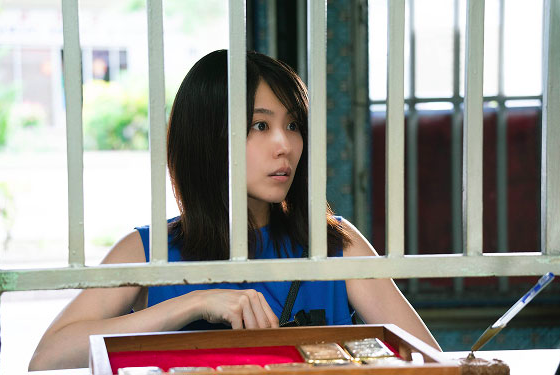
The setting acts like the illustrative metaphor of these women’s taste of freedom. They start in restrictive ambiances in their Nipponic home country and land in vibrant and breezy Singapore locations, such as Marina Bay Sands and Arab Street. Another strength of Magical Secret Tour is undoubtably the touch of farce that makes the entire dubious gig highly entertaining, as the empathetic elements of drama interweave throughout the narrative.
A characteristic of the film that undermines the credibility of the entire story is that despite Magical Secret Tour is set in the era of smartphones and laptops, it seems to take place in a world where airports don’t have metal detectors. This aspect makes the heist less plausible, even though it tries to justify the lax customs security checks as being less harsh on travellers with children (Wakako), injuries (Kiyoe) or baby bumps (Mayu). On the other hand, what screenwriters Chihiro Amano and Madoka Kumagai have delineated with utmost sensitivity is the human drama that draws these three women together. This is also thanks to the chemistry between the three brilliant lead actresses Kasumi Arimura, Haru Kuroki, Sara Minami, that counterbalance the implausible plot twists. As a result the film elicits the audience’s unwavering compassion.
Final Grade: B+
Check out more of Chiara’s articles.
Photo Credits: https://magicalsecrettour.asmik-ace.co.jp/