

©Courtesy of Japan Cuts
There are filmmakers whose careers are defined by reinvention. Then there are artists like Yoji Yamada, whose enduring greatness comes from continually refining the themes that have occupied him for decades. Tokyo Taxi, his remarkable 91st feature film, finds the veteran director returning to familiar emotional territory, yet doing so with a level of confidence and sincerity that only a lifetime of storytelling can achieve.
Produced as part of Shochiku Studios’ 130th anniversary celebrations and serving as a Japanese remake of the acclaimed French drama Driving Madeleine, the new movie is unmistakably Yamada’s own. It is a compassionate, beautifully observed drama that transforms an ordinary taxi ride into an extraordinary meditation on memory, aging, family and the quiet connections that give life its meaning.
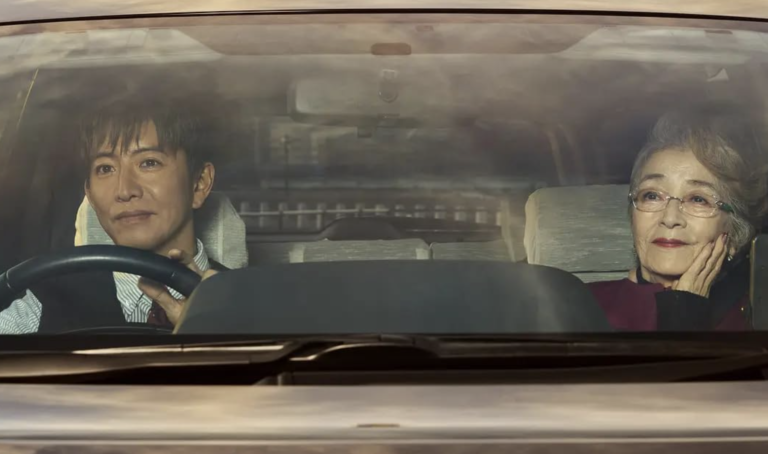
Opening with taxi driver Koji Usami (Takuya Kimura) reluctantly accepting a long-distance fare after finishing a night shift, Tokyo Taxi initially appears to follow a simple road movie structure. His passenger is Sumire Takano (Chieko Baisho), an elegant yet spirited elderly woman making one final journey to Yokohama. Before reaching her destination, however, Sumire asks Koji to make several detours through Tokyo. Along the way, she wishes to revisit places that have shaped her life.
What unfolds is far more than a sightseeing excursion. Each stop becomes another chapter in Sumire’s remarkable story, while Koji gradually confronts emotional struggles he has carefully kept buried beneath the polite professionalism expected of someone in the service industry.
Yamada’s screenplay is ‘Tokyo’s Taxi’s greatest achievement. While remaining faithful to the central premise of Driving Madeleine, the new film’s script feels deeply rooted in Japanese culture.
The scribe also shares his lifelong fascination with everyday people navigating life’s quiet disappointments and unexpected joys. Rather than relying on dramatic twists or emotional manipulation, Yamada built his narrative through conversation, allowing characters to reveal themselves naturally through stories, pauses and subtle shifts in expression. Every dialogue exchange serves multiple purposes: illuminating Sumire’s extraordinary past while simultaneously exposing Koji’s fears about his future.
One of the screenplay’s most compelling ideas lies in its exploration of emotional absence. At the beginning of the drama, Koji is consumed by financial anxiety after making promises to his daughter that he fears he cannot fulfill. His worries leave him emotionally withdrawn, hiding behind rigid politeness and professional etiquette instead of genuine human interaction. Sumire immediately recognizes this emotional distance and gently refuses to accept it.
Her persistent curiosity slowly dismantles Koji’s carefully constructed emotional barriers. As a result, what begins as a transactional relationship turns into a profound conversation between two people who are at vastly different stages of life, but are experiencing remarkably similar emotional uncertainty.
The screenplay also thoughtfully explores how identity is formed through relationships. Sumire’s recollections revolve around parents and children, husbands and wives, lovers, and families, illustrating that no life can be understood in isolation. Through these interconnected stories, Yamada quietly reflects on aging, grief, forgiveness and mortality without ever becoming heavy-handed.
Instead, every anecdote contributes to an emotional mosaic that feels deeply authentic. Few filmmakers working today possess Yamada’s ability to uncover profound truths through seemingly ordinary conversations.
The performances are equally extraordinary. Baisho delivered one of the finest performances of her distinguished career. It feels especially meaningful considering her artistic partnership with Yamada stretches back more than six decades.
Sumire could easily have become little more than a charming storyteller, but Baisho creates a woman of astonishing emotional complexity. She is witty, independent, mischievous, resilient and quietly heartbroken all at once. Every memory carries visible emotional weight, yet Baisho never overplays the sentiment. A fleeting smile, a distant glance toward a familiar street or a slight hesitation before continuing a story communicates decades of lived experience. It is a performance built upon remarkable restraint and emotional intelligence.
Takuya Kimura proves the ideal scene partner. Known internationally for performances ranging from 2046 to Blade of the Immortal, Kimura embraces understatement once again Tokyo Taxi, portraying Koji with carefully measured subtlety. His character spends much of the movies, saying less than he feels, and Kimura expertly conveys the emotional burden hidden beneath his calm exterior.
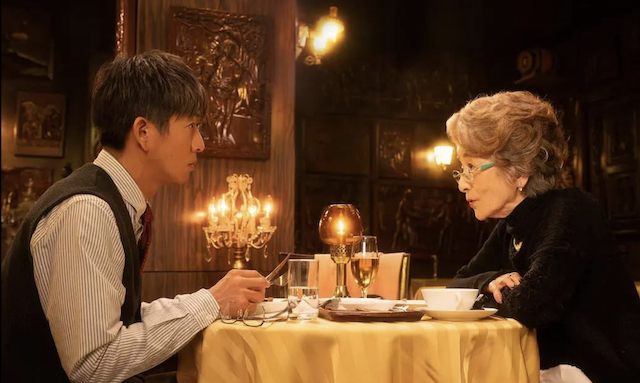
As Sumire gradually encourages him to speak honestly, the transformation unfolds almost imperceptibly, making Koji’s eventual emotional openness feel entirely earned. The chemistry between Baisho and Kimura never depends upon grand emotional declarations. Instead, it emerges through attentive listening, gentle humor and mutual understanding, creating one of the year’s most satisfying cinematic partnerships.
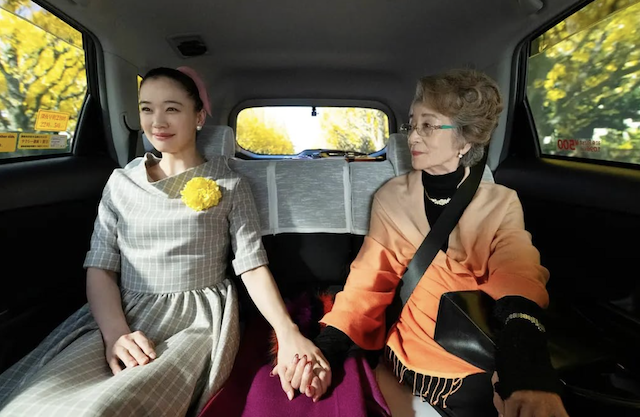
The supporting cast, including Yu Aoi, further enriches the emotional landscape without ever distracting from the central relationship. Each performance contributes to the film’s atmosphere of warmth and authenticity.
©Courtesy of Japan Cuts
Visually, Tokyo Taxi is every bit as elegant as its screenplay. Yamada adopts an intentionally restrained cinematic style that perfectly complements the drama’s reflective tone. Rather than employing flashy camera movements or elaborate editing, the cinematography favors patient compositions, extended takes and carefully observed moments that allow the audience to fully inhabit each conversation.
Tokyo itself becomes one of the movie’s most important characters. As Sumire revisits neighborhoods connected to pivotal moments in her life, the city transforms into a living archive of memory. Familiar streets, bridges and buildings carry emotional significance far beyond their physical presence.
The cinematography beautifully captures this relationship between place and memory, presenting contemporary Tokyo alongside delicate visual fragments of the past. These transitions never feel intrusive or sentimental; instead, they elegantly reinforce the film’s central observation that our lives are built upon memories that continue to exist, even after the physical world has changed.
The drama’s pacing deserves particular praise. At just over ninety minutes, Tokyo Taxi unfolds with remarkable patience, trusting silence as much as dialogue. Long takes encourage viewers to observe facial expressions and body language rather than rushing toward narrative developments. This measured rhythm mirrors the reflective nature of the journey itself, allowing every stop to resonate emotionally before moving forward. It is an approach that requires confidence from both filmmaker and audience, and the result is quietly mesmerizing.
Although Tokyo Taxi embraces many of the hallmarks that have defined Yamada’s cinema for more than half a century – gentle humor, compassionate humanism and emotional sincerity – it never feels like a filmmaker simply repeating himself. Instead, it plays as the work of an artist who understands exactly what stories he wishes to tell and has mastered the craft required to tell them with grace.
The movie acknowledges aging and mortality without melancholy overwhelming hope. It recognizes regret while celebrating resilience. Most importantly, it reminds audiences that meaningful human connections often arise in the most ordinary circumstances.
Reuniting Yamada and Baisho, Tokyo Taxi carries added emotional resonance rooted in their decades-long creative partnership. Their decades of collaboration lend every scene an authenticity that cannot be manufactured. Whether his final film or not, it ranks among Yamada’s most touching achievements.
Tokyo Taxi succeeds because it understands that life’s greatest journeys rarely involve dramatic destinations. Instead, they unfold through conversations, shared memories, unexpected kindness and the willingness to truly listen to another person. Yamada crafts a profoundly humane drama with superb writing, magnificent performances and expressive cinematography. It’s a reminder that while time inevitably moves forward, the stories people share continue to shape their lives. Tokyo Taxi is one of the year’s most rewarding and emotionally satisfying cinematic experiences.
Tokyo Taxi had its East Coast Premiere on July 8, 2026 to a sold out audience during Japan Cuts.
Rating: A
If you like the review, share your thoughts below!
Check out more of Karen Benardello’s articles.
©Courtesy of Japan Cuts