

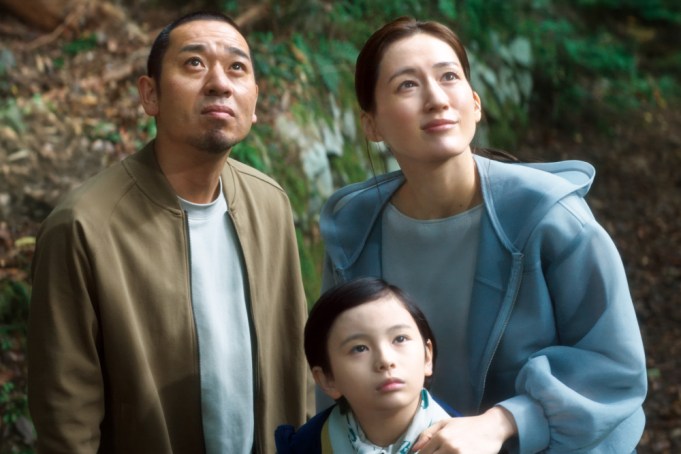
After the 2026 Cannes Film Festival, Hirokazu Kore-eda’s latest work arrives at Japan Society as part of Japan Cuts’ line-up. Sheep In The Box takes its name from a famous passage in Antoine de Saint-Exupéry’s The Little Prince, to explore the notion of resurrection through technological means.
Set in a not-too-distant future, the film follows a young bereaved couple Otone (Haruka Ayase) and Kensuke (Daigo), who welcome home an AI-powered robot built in the image of their dead son Kakeru (Rimu Kuwaki). In 2001 Steven Spielberg had portrayed little David as a creature condemned to the impossible desire to become human in his A.I. Artificial Intelligence. Just like Kore-eda, he questioned whether love and suffering make someone deserving of moral consideration. But the Japanese filmmaker chooses minimalism, rather than epic narrative, to explore this philosophical conundrum.
In 2014, Alex Garland had shown how a humanoid robot equipped with artificial intelligence, could pass as a human being. But whereas Ex Machina focused on capturing the risks of the digital age (like Stanley Kubrick had done with his supercomputer HAL 9000 in his 1968 2001: A Space Odyssey), Hirokazu Kore-eda uses A.I. as a tool to enable healing, while confronting a devastating grief. In one of the dialogues he exposes a topic that is central to the narrative: Who do the dead really belong to? Life finds meaning in the fact it is finite, so once the end has come, what are the ethics that govern the aftermath of that existence?

Hirokazu Kore-eda rose to prominence with his drama films Nobody Knows; Still Walking; Like Father, Like Son (that won the Jury Prize at the 66th Cannes Film Festival); Broker; Monster; and Shoplifters that won the Palme d’Or at the 71st Cannes Film Festival, and was also nominated for the Academy Award for Best Foreign Language Film representing Japan. Through his filmography, the question that resonates the most is what characterises the idea of family, and in Sheep In The Box the theme reaches its apotheosis. The Little Prince’s sheep is invisible and therefore it is entrusted to the imagination whether it is inside the box or not. By analogy one may wonder: Who is entitled to give the ultimate version of what form a familial love should take? The box not only becomes the body that contains a human soul, or a computer generated humanoid, but it is also cinema itself: that blank screen that tricks us into believing there’s a life through the moving images that flicker on its surface.
The allegory of Saint-Exupéry’s sheep in the box, allows to reflect on the way we attribute to generative technology the humanity we have been deprived of. The grieving parents seek their lost child, or perhaps the gentlest way to salute him forever. The film also takes this aspect a step further by portraying how children grow up and the time comes to let them leave the nest. Sheep In The Box does this through a narrative device that seems to embody the philosophical concepts of Michelangelo Pistoletto’s Third Paradise, i.e. find a dimension of coexistence between artifice and nature. In fact, the machines peacefully rebel to their role of commodities, to harmoniously rewrite their place in society, almost like the Lost Children in Peter Pan. In these regards, some have also described Sheep In The Box as a way of rereading Pinocchio in the A.I. era. But this time the substitute child does not transform into a human being, it ends up founding a new species. This makes it fair towards a surrogate for unresolved grief, whose first interaction with humans was paying for a crime that wasn’t his.
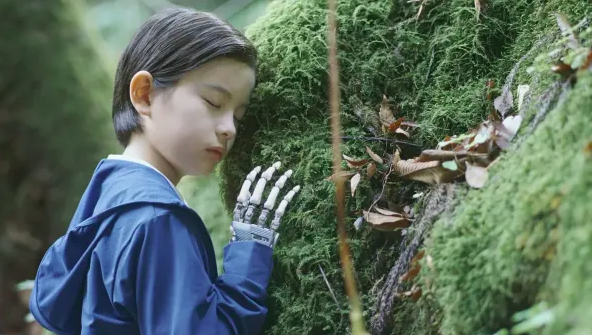
Ryūto Kondō draws us in a dimension of utter realism, paced by the steady direction, editing and script by Hirokazu Kore-eda. The futuristic setting is presented in a cunning way, because there are all the characteristics of homes and urban settings that resemble our present, but with a few additional touches, like drones delivering parcels — almost as if the myth of the stork delivering babies had been replaced by a flying service. We are not plunged in a dystopian environment. As a matter of fact, the journey towards emotional recovery reconnects all characters with Mother Nature in a utopian way, that allows them to find their true purpose.
Final Grade: A
Check out more of Chiara’s articles.
Photo Credits IMDb