

ⓒCourtesy of Neon
Exclusive Interview with Writer/Director Na Hong-jin
Q : I heard that you developed your script in a Sokcho City, and even though the film dealing with the alien invasion, a movie set in a rural part of Korea, I discovered that it is filled with primitive elements throughout. Would you mind discussing the initiation procedure?Could you tell me about the film’s original concept? I find this very primitive elements and a future element that’s quite, quite on the contrast. That’s why it really is fascinating.
Na Hong-jin : At that time, I met a friend called Yang-bae, and he was fishing. So he has no job, he just fishes all day, and I think he was a very much a primal friend. Uh, so I think I got a lot of influences from hanging out with him at the time.
Q : One of the fascinating elements in this film that we haven’t seen the actual monsters until closer to 50 minutes in, this approach kind of reminded me of Steven Spielberg’s “Jaws” film, in that approach, obviously the film focus on the actor’s performance, but you didn’t show much of background of each character, the audience really thrust into the situation like these characters in the film, how do you carefully structure the script like that way?
Na Hong-jin : That was actually, the first 50 minutes is the section of the film that everyone had told me to shorten. They said that it’s too boring and that bit should be shortened.
But after we completed all of the sound design for the film, that’s when everyone changed their mind and agreed with my decision to keep it at 50 minutes. So it’s actually, for movies of this kind, it’s a very conventional beginning and a start of the film. But most films like to keep that beginning very short, and I just had this simple desire to expand that beginning because for this movie, I really focused on density. And as I was trying to make this film more dense, I think in that process, that’s why this first 50 minutes ended up being that long.
[tf-tv]
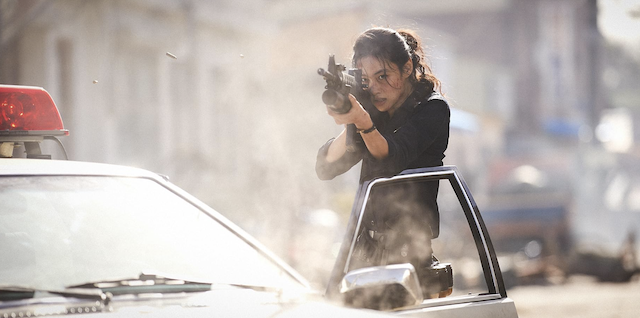
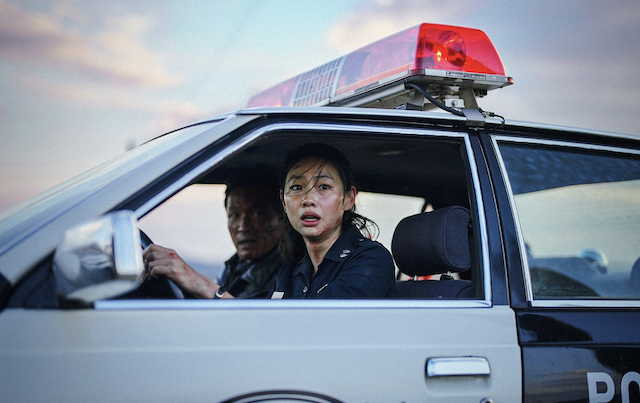
Q : You made completely perfect choice for that one. One of the fascinating sequence was that when the actress, Hoyeon appeared in the film, she shots a lots of shotgun, drive like a car racer chasing the monsters. So even though she was in “Squid Game,” I heard that this was her first feature film.What was her elements that stood out for you to ended up casting her?
Na Hong-jin : I got the idea to cast her through our actor, Hwang Jung-min, actually when I was wondering about who to cast for this character, Sung Ae and I called him, he recommended Hoyeon, and only later did I actually find out that he didn’t know her very well. He just recommended her anyway.
ⓒCourtesy of Neon
Q : Oh, really?
Na Hong-jin : But when I actually met her in person, she was just so charming and so great. She almost just felt like the character itself, and that’s when I decided to ask her to be in the movie.
Q : What’s amazing about this film that you cast international stars like Michael Fassbender, Alicia Vikander, and Taylor Russell as aliens. Unless the audiences saw end credit, it’s kind of hard to recognize them. But could you talk about how do you actually direct their performance through green screen? And I heard that you hired a linguist to create that actually alien language. So talk about those things?
Na Hong-jin : Working with the international cast was same as working with any other cast in my movie, but I think for them it was their first time working with this foreign director, so they were feeling very much nervous. So I tried really hard to relieve that tension and to make it more comfortable for them.
As for creating the alien language, I first started the approach to the language by having discussions with linguists, and we brainstormed what this language is supposed to sound like, what kind of a style it should have, and they proposed a lot of different ideas for me. And I think our first approach was to study the most ancient language that exists in human history.
Q : I heard that actor Zo In-sung took 3~4 month of horse riding lessons prior to shoot, could you talk about challenging horse chase through a Romanian forest and the car-and-horse chase, what as the most challenging elements of shooting those sequences?
Na Hong-jin : First of all, for the horse action, the actor, Zo In-sung actually already knew how to ride a horse, so that was a really big relief on my end. So he had six months of professional training with horseback riding, and he worked really hard. And it was very difficult to shoot that horseback riding scene in the forest because there’s not a lot of space between the trees.
So it was very difficult to gain speed on the horse when we were shooting that scene. So every morning before, we went into that forest, at the entrance of the forest, we set up a camp, and then they would practice and train the horseback riding there before going into the forest to shoot the actual scene. So it was really thanks to the cast and the stunt team and the crew members who dealt with the horseback riding, they had such great support and effort that went into the film. That’s the only thing that made the scene and the sequence possible.
And it was really hard to zigzag between the trees without bumping into the tree and hurting the actors. But it was even more difficult to chase those actors who were zigzagging between the trees and to shoot them while maintaining that same speed. And as for the car chasing scene, I think the road itself was such a thrilling location. I think the road’s actually closed down now.
It’s not used by people anymore, but it’s installed at what I believe is one of the highest altitudes in Korea because it’s next to this big bridge. So just standing there enough was scary for me. So to, when we were actually racing across that road, it was so much more scarier.
Q : I see. You worked with the composer Michael Abels, who has been working with the Jordan Peele’s films like “Get Out”, “Us”, and “Nope.” What was his quality that struck a chord with you to work well this time around?
Na Hong-jin : So during pre-production, I actually couldn’t end up choosing a music supervisor for our film, so we went in without one. And as I was reviewing the footages, I tried inserting different kinds of cinematic scores to see which one would fit the most, and most of the scores that ended up making the most sense was actually Michael Abels’ existing scores. So that’s why I asked him to be a part of the film while we were in the middle of the shoot. And he happily said yes, and I had a lot of fun working with him.
ⓒCourtesy of Neon
If you like the interview, share your thoughts below!
Check out more of Nobuhiro’s articles.
Here’s the trailer of the film.