

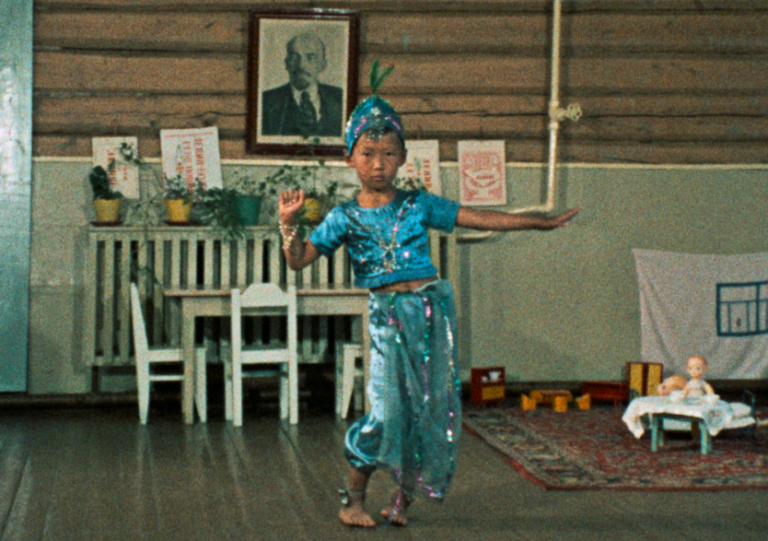
In the Out of Competition section of the 83rd Venice Film Festival IMPERIUM — directed by Sergei Loznitsa — rediscovers an unknown Soviet Union through Italian film archives.
The filmmaker born in Belarus and raised in Ukraine, is among the most critically acclaimed directors, and his films have been screened at major international festivals. Loznitsa is not simply an archivist who finds old footage and assembles it. His editing creates new arguments from existing images. Blockade, My Joy, In The Fog, Donbass (that won the Best Director Award in the Un Certain Regard section of the Cannes Film Festival), State Funeral, Babi Yar. Context and The Kiev Trial effectively turn archives into a form of cinematic historical investigation about the Siege of Leningrad, rural Russia, Nazi-occupied Belarus during WWII, war-torn border zones, the Soviet dictator’s personality cult, the remembrance and suppression of the massacre near Kyiv and the Nazi collaborators and the Soviet justice system.
IMPERIUM is the result of an operation made possible by the close synergy of three Italian archives — AAMOD (Audiovisual Archives of the Workers’ and Democratic Movement), Archivio Luce Cinecittà, and Cineteca Nazionale — that collaborated for the first time on the recovery, restoration, and digitisation of previously unseen film material, pieced together by Sergei Loznitsa. The motion picture is constructed by 482 reels of 16mm color film, for a total of nearly 60 hours of footage, much of which has been lost.
Just like in his previous films, Loznitsa connects Soviet history with the present, to demonstrate how political myths, propaganda, nationalism, collective memory and authoritarianism survive into the present. This was engrained in his upbringing, since the Soviet Union shaped his childhood while growing up in Ukraine, where he witnessed how history was rewritten to serve the interests of those in power.
In terms of the style his training as a mathematician, his work at the Institute of Cybernetics, and his filmmaking studies at VGIK in Moscow, have come together to forge Loznitsa’s style of storytelling that intersects documentary, historical memory, political cinema and fiction. One of his defining characteristics is his refusal of the conventional documentary toolkit: talking heads, omniscient narration and overt authorial commentary. He simply places the camera somewhere and allows time to pass, so that the audience may perform the interpretation.
In IMPERIUM we may observe, once again, how the filmmaker reaches out to archival images as tangible traces of what really happened, regardless of subsequent interpretations or distortions. This immersive journey spans the vast territories of the Soviet Union in the early 1970s, at the height of the Brezhnev era, preserved at the AAMOD and shot by a group of Italian filmmakers led by the renowned anthropologist Diego Carpitella (also involving in various capacities Folco Quilici, Luigi Di Gianni, Giorgio Arlorio, Giuseppe Ferrara, Rudi Assuntino, and Gianni Bonicelli). This footage chronicles the daily life, traditions, cultures, and many ethnic groups of the various territories under the influence of the USSR: from the Arctic Ocean to the Carpathians, passing through the Karakum Desert in Turkmenistan, through the Caucasian republics of Georgia, Armenia, and Azerbaijan, arriving in Uzbekistan and Tajikistan, and finally the Pacific. The mundane flows for 175 minutes portraying all types of activities pertaining to each region. Farming life, toil in factories, reindeer races, camel rides, street fairs, school activities, weddings: the settings and situations are miscellaneous. Facial features change, as does the landscape, but everything is stringed together by one common covert power, that is instilled in the minds of all those belonging to the Union of Soviet Socialist Republics from a very young age.
The meticulously crafted soundscape, created entirely from the reconstruction of noises and sounds added in post-production, enhances the authenticity of the experience. Through editing, Loznitsa conveys the tension between the centralised power of Moscow and the persistent vitality in the various republics of the Soviet Union. Thus, IMPERIUM sheds light on the mechanisms of authority and censorship, inviting us to reread Soviet history as a key to understanding the current geopolitical fractures and conflicts.
Sergei Loznitsa’s reinvention of the historical documentary constitutes his cinematic philosophy, which is the opposite of judgmental. The way collective behaviour is revealed leads to address a disturbing question: What happens to an individual when he or she becomes part of a crowd? Sergei Loznitsa rarely tells you whom to admire, whom to condemn or how to feel. Instead, he constructs situations in which the contradictions are visible and spectators draw their conclusions. This exercise in ethical intellect reaches its peak in the monumental IMPERIUM, that through its title epitomises the magnitude of the mechanisms of power under examination.
Final Grade: A
Photos credits: © IMPERIUM by Sergei Loznitsa
Check out more of Chiara’s articles.