

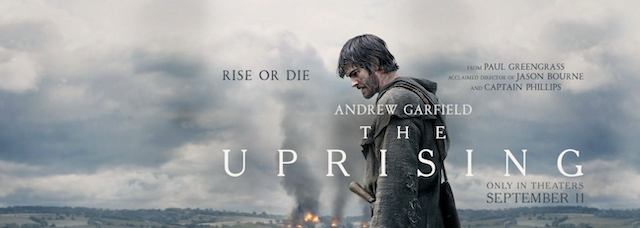
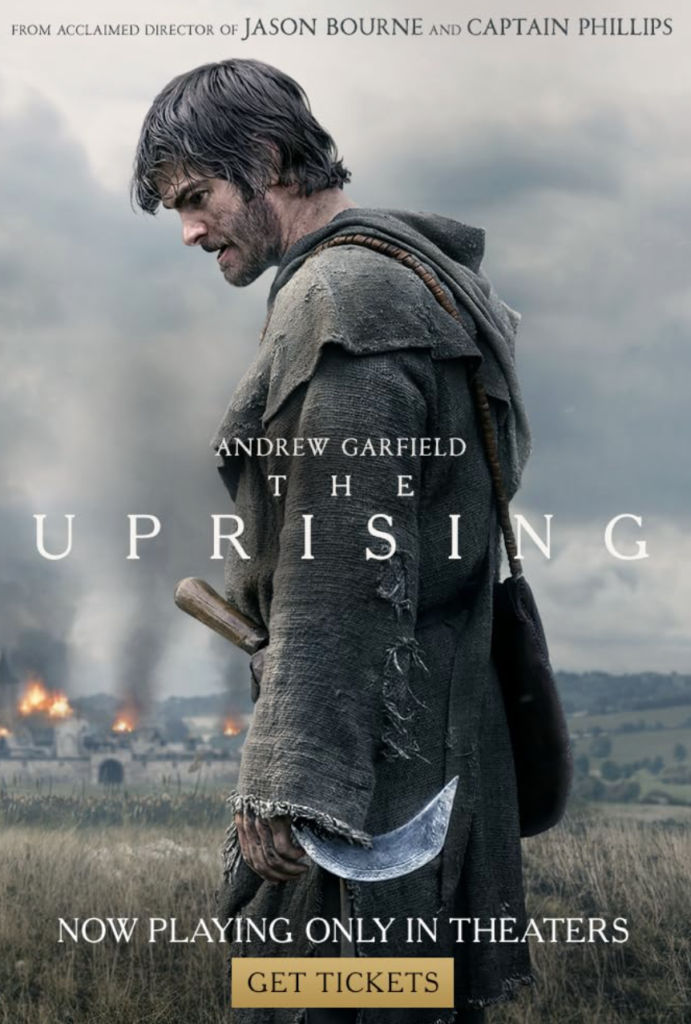
Q : Welcome everyone to the press conference for the Uprising. My name’s Anthony Breznican. I’m the moderator of the conversation today. We’re coming at you live from Los Angeles. I know many of you watching are at points around the world. Here in the States, we have our Labor Day holiday coming up, so it’s a great time to talk about workers standing up for their rights.
With “The Uprising”, even if it was almost 700 years ago. Some things never change. I wanna welcome Paul Greengrass, the director of the film, Andrew Garfield, plays the Ploughman, Thomasin McKenzie, she’s Alice, and Katherine Waterson, who is a countess, Woody Norman, King Richard II, looking very regal. And the historian historical advisor, historian and novelist Dan Jones. Thank you guys all for being here.
Thomasin McKenzie: Thanks for having us. Yeah, thank you.
Andrew Garfield: Thank you for being here. Thank you all for being here. Hello. We have no idea who we’re talking to.
Q : Paul, you’ve been living with this story for a while, for many years you’ve been trying to bring it to the screen. What is it about the Peasant’s Revolt that first caught your attention, made you wanna explore it on film?
Paul Geengrass: I wanted to do a film about English history about an English rebellion really. And I was thinking about a few ideas of Peasant’s Revolt being the main one, and then when the pandemic hit and we all obviously got locked down, on the second day I thought, “Okay, I’m gonna be here for a while, I’m just gonna write this.” So that’s when I wrote it. And the strange thing was that, I’d read Dan’s book, I’d done a fair amount of research, but you have to put all that aside really and try and write, a movie.
And what was in my mind was to try and write a movie a bit like, say, a movie like “Gladiator”, ’cause I loved Ridley’s movie, but my version of that kind of genre. And as I got into the world of 1381 and the oligarchs protecting their privileges and the corrupt court and the enraged people- The more it felt like not distant history, but our near tomorrow. So it really wrote itself.
Q : Dan, I wanna throw to you. You wrote the book on this about 20 years ago, right? But it’s it’s a history that you’ve also been living with for a long time. What is it that intrigued you about the Peasants’ Revolt?
Dan Jones : I think this is this is an event in history where you just first start to hear the voices of ordinary people. And, I remember starting talking to Paul just after he’d written the first version of the script and there was this sense that there was a rage, that there was a, a popular feeling that there was injustice deeply embedded in a system, that the law was corrupt, the agents of the law were using it to protect the privileges of oligarchical classes, and that there was a rising feeling in the aftermath of a world pandemic that something was deeply wrong with the system.
And all of those things are obviously true of this medieval story, but they provide what you could call a distant mirror on our world today. You can look… And this is when I think history works at its most effective in touching a wide audience, is when you look into the past and see something of your own life reflected, and it can give you sort of clarity on a current moment.
And I always felt that was what was present in this story when I wrote the book 20 years ago. And to see Paul working on it and bringing that brilliant cinematic mind of his and that for the shapes of stories to this is, it’s a privilege. The peasants have come to Hollywood. I’m, quite happy about that. (Lol)
Q : Haves versus have-nots is that seems to be part of the human condition no matter what era you’re in. But you mentioned the the plague, the this pandemic from 1381 that swept Europe. Obviously we had the COVID pandemic recently that we’ve all lived through and the lockdown that followed that. What is it about that type of crisis that almost serves as a blasting cap for the unrest that’s always there below the surface?
Paul Geengrass: Me and Dan?

Q : Both of you.
Paul Geengrass: Look the Black Death as, as it was called in the Middle Ages was of an order well beyond COVID, although it looked for a while that COVID was gonna be similar.
But, a million people, I think, lost their lives in the US. In Europe, plague took 50% of the population. But the result is the same. It’s just a deep dislocation, and what’s left when the grief the first pangs of grief start to fade, is just a deep, growing rage, and I think that’s what we’re living through now in your country and mine and Europe and elsewhere.
People come out of these experiences enraged at the unfairness of the world, and and that’s really what this film’s sort of tapping into. That said, it’s a movie. It’s gotta be entertaining, and as I said at the beginning, what I wanted to do was to make a big, grand spectacle movie about revolution,
Q : Dan, is it that fight or flight that kicks in when people are losing their lives, when there’s an illness that’s sweeping that compounds the anger and the frustration of the economic situation, makes the unrest possible that stirs it into a sort of a hot confrontation as opposed to a cold simmer?
Dan Jones: Yeah, I think that’s true. I think that a pandemic can really shine a light on a society, it can strip a lot away from it and when you have something like, whether it’s COVID or whether it’s the medieval Black Death it shows you what’s really there in a society. It strips a lot away, and then the reconstruction of the world after that as we’ve seen in our world today, but as we see so brilliantly in the uprising as well is full of challenges as people try to protect their position, as people feel like this should be an opportunity for a new way of living, and then have that opportunity held back.
I think that’s as true of this story about the Peasants’ Rebellion of 1381 as it is of our experience in the world today, and I think that’s one of the reasons why this movie will touch a chord with with audiences.
Q : Andrew, your character is is Ploughman. He’s not a soldier, he’s not a fighter, he’s not somebody who wants to go to war. He wants to farm, take care of his family. But he loses a lot. I don’t think it’s a spoiler to say he’s lost almost everyone in his life as this movie begins. Tell me about getting into his head and what it is that motivates him to take up arms, to raise his fist toward people who are obviously much more powerful than he is.
Andrew Garfield: Yeah. I mean it’s a beautiful character that Paul wrote that I had the honor of trying to inhabit. And I say that because it feels like where we meet him at the beginning of our story, there’s hardly any of him left. It’s like he has this little thin crust of identity that he is clinging to tooth and nail.
And through the [process of the journey he goes on that final little bit of crust gets fully cracked. And it’s like he’s more spirit than body. And there’s a kind of essential…When I read the script, it felt, I don’t know, I think as actors and storytellers and filmmakers right now, and as you said about the current cultural climate we’re in, it’s very hard to feel like you can speak directly to the moment because things are changing so constantly, and we don’t know what the truth is anymore.
It’s hard to identify where the center of the world is, ’cause there is no center. So it’s very rare to read something where you go, “Oh, this feels like a cry of the soul for this very moment we’re in.” That’s what I felt when I read Paul’s script, and particularly the journey of the ploughwman.
And he’s he’s this reluctant leader and a kind of natural leader because he does have such little identity ’cause he can actually pay attention. He can hear. He has the humility to maybe hear the wind, to maybe hear the signs in the leaves of the trees to feel who most needs a miracle, to feel who to really feel into other people’s pain and his own. He’s more pain than anything else. And there’s something beautifully transforming in accepting that pain and letting an old self die with that pain so something new can emerge by the end of our story. It’s about what it is to have a soul and to fight for the dignity of one’s own soul.
Q : Is there also a part of it, he has nothing left to lose? As you’ve said, he’s stripped away. Everything has been taken away from him by circumstance by the aristocracy. It’s almost like he’s not afraid to die and not afraid to stand up because if they take his life, he doesn’t have that much to take.
Andrew Garfield: It’s so fascinating. It’s like what happens to a person when they are squeezed to the point of saying to themselves, either everything changes or today is a good day to die.
I’m willing to fight for to set the world right. Otherwise I can’t keep surviving in this context. There’s no meaning, there’s no connection, there’s no justice, there’s no God in this. And God in whatever you choose for that word to mean.
Q : Nobody’s looking out for you, essentially, right?
Andrew Garfield: And then what’s left? It’s you and your community, and it’s you and the other people who are suffering. And it’s a fact, and this is happening around the world right now. And it’s a hero’s journey, but it’s also a kind of a journey of multiple heroes creating change together, which feels quite hopeful, I think, for an audience.

Q : Thomasin, Dan mentioned earlier that this was one of the first instances of of the every man rising up. But you play Alyce, who’s an every woman in this story. Tell us about her, what you found interesting about her, and similar to this question of why the Ploughwman stood up, what is it that you think gives her courage and makes her be willing to risk her life to to take up arms, to speak out?
Thomasin McKenzie: I think we find out later on in the film, at a really pivotal point where Ploughman is deciding whether to stay or to go, that we find out about Alyce’s history, that she had been a part of the church, and she was taken advantage of and then cast away, completely betrayed by the people who were supposed to protect her and were betrayed by her family in a way.
And so her uprising is a result of that betrayal and just deep rage and brokenness. So throughout the entire film from the beginning until the end, she’s driven by a very strong force to find to seek revenge. And then at the end, she’s left at a place of, “Okay what’s next?” Because that’s what’s been driving her for so long.
Q : There’s something about human nature. A person can break basically one of two ways in those situations when they’ve been horribly treated. They can either become hardened and treat others that way. “Why should you get a break if I didn’t get a break, if no one looked out for me?” And then there are other people who say, “I wanna make sure no one else experiences what I had to go through. I wanna protect them.” Why do you think she broke one way and not the other?
Thomasin McKenzie: I think she did break in the way of wanting to cause harm to those who harmed her. And I think there’s a real connection between Ploughman and Alyce. They see each other and they both have suffered great grief and are processing that grief in different ways.
Alyce is a much more charged person and Ploughman is a thinker and a kind of listener and learner. I think they’re approaching their grief in different ways. But I think her connection with Ploughman kind of softens Alyce and makes her realize the need for maybe forgiveness and connection.
Q : Dan, how much record is there of women in this revolution? Sometimes they get overlooked by historians from that era, and makes it hard for historians of this era to track what might have… what their involvement might have been.
Dan Jones : Yeah, one of the features of doing any historical research, particularly on the medieval period, is that men touch the records of history more than women in this period.
That doesn’t mean to say that women were doing absolutely nothing. And then, and one of the big focuses of historical research that’s going on at the moment, academic research into this time, is to shine a light on the experiences of women. And and I think that’s certainly reflected in the Peasants Revolt.
There’ve been lots of instances of people identifying within the real history of the rebellion, women having critical roles at various moments, whether that’s from the aristocracy and the court right down to the rebellion itself. And making a movie has a relationship to history, but it’s about personalizing these, these bits of historical research, and I think that’s what The Uprising manages to do, is to take all of these sort of strains of whether it’s oppression, whether it’s injustice, whether it’s victimhood, and give them to human characters.
And in the Plowman and in Alyce you see it, the… in both of these characters, the expression of really complex historical things that are given to a soul, that are given to an individual. And both of your characters, I think, speak brilliantly to the complexities of what it was like to be a human alive in that world.
There aren’t moral simplicities here. You can feel rage and violence and a desire for revenge at the same time as wanting to make a better world for other people. And that’s why I’ve always loved Paul’s films, because he exists in that area of moral complexity, while at the same time making a really exciting movie.
This is an incredibly exciting on the, on-the-edge-of-your-seat film. And that’s why as a historian, for me, it’s a pleasure to engage with it.
Q : Katherine, now this is another woman who’s existing on the other side of this conflict, but the countess is so interesting to me. She’s a woman living in this rigidly patriarchal structure, but she wields a lot of power, soft power, influence over her son, the king. And so much plays across your face and goes unspoken. I feel like this is a character who has to hold her tongue a lot, but you’re still projecting to us the viewer, what’s in her heart or what’s in her mind.Am I reading what you were… what the complexities of playing this character?
Katherine Waterston: Yeah. I think this got back to you, and maybe I heard that it made you feel bad, but in the makeup trailer one morning, I said, “Queen and not heard.” But actually, I really wasn’t complaining. It was it was one of the great treats of the character that she’s there and unable to speak, and what that communicates and what it accurately, I think, portrays about the period.
And sometimes today, in an effort to give women more to do in historical stories, we give them a reality that was not theirs. And I loved her silence in this film and what I was a- allowed to then explore within that. And how sophisticated she had to be in order to try to influence in a situation where the verbal wasn’t always available to her. And I could see..
Q : You almost telepathically trying to communicate with her son.
Katherine Waterston: And I really felt the frustration of not having the line, not me, the actress, but in the role and really felt the sort of plight of that.
And what I’ve been thinking about a lot, just listening to everyone this morning, is how obviously a pandemic with that kind of national, and in this case, international loss, where so many people have suffered it, basically everyone has lost someone very dear to them, it is disorienting and all sorts of complicated things that have been touched on here, but it is also very uniting.
And I really remember that during the pandemic, that feeling that instantaneously I had something in common with every single person I passed on the street. And and I really felt that in the script too, that among the storytelling about the commoners, but also in between us that we immediately had something that put us on the same level-… rather than the social divide that had that we lived within. But and it there’s so much beauty in the story that my God blink and you’ll miss it because it moves at such a clip, this film. But it’s imbued with that and was such a treat to play with or without language.

Q : But did those restrictions, within the story of what she was able to say, give you room to interpret? Because I felt that she was saying that..
Katherine Waterston: Again? Sorry, I just had a baby.
Q : Did the restrictions that were on her inability to really speak freely, did that give you, as a performer, room to interpret how she was really feeling?
Katherine Waterston: Yes, I’m a real nerd, and I love doing the research. And one of the treats of this problem of how history has been told is that I had a lot of room to imagine what she might be, and not as much perhaps of a pressure to try to do something accurate because there’s so much mystery around who she was.
But the things we do know were fun to play with. I know that she was by the kind of fluke of circumstance a landowner, a significant landowner, and that allowed her to wheel and deal a bit with the council in order to get them to do her what she wanted for her son. So there were ways that she was able to- that obviously it’s not in the story, but it was something that I carried with me, a knowledge of what her power looked like that helped-
Paul Geengrass: She’s the king’s mother, so-
Katherine Waterston: Hell yeah, that may have applied and she would’ve been the queen. Her husband was going to be the king, and he died young, so she’d been ready for this role. And yeah, so I don’t know if that exactly answers the question, but I definitely felt that power and had a great time trying to navigate how to communicate it.
Paul Geengrass: She does have some lines too.
Katherine Waterston: I do. I know she does. She has to accept rather than an underrated thing to not have much to say in a film. It is such a, it’s a visual medium, and it is, there’s so much you can do. And, some of my favorite performances have been quite silent like that. Tilda Swinton talks about it a lot, and she did that film, the remake of “La Piscine“(Jaqcues Deray’s 1969 film), the Luca Guadagnino film. And and she lost her voice the first half of the film. And with a great filmmaker and that is such a big part of it… Paul was always following her narrative. And it doesn’t feel any different. It still feels like you’re playing the scene.
Q : I think the thing I was grasping at is, I felt, and maybe this is me projecting onto your performance, I felt she had empathy for these commoners, for these workers, and didn’t want to see them betrayed, didn’t want to see them crushed. She had her side. She lived at her, in her class
Katherine Waterston: She knows something of oppression.
Dan Jones : Yeah, and sorry. This is a film that’s about power in many ways. And it’s what kind of power do you have and what kind of power don’t you have?
So you can have wealth, privilege, land, beautiful dresses. The son is the king. But because you’re a woman in this world, you don’t have a voice. Here’s the ploughman. You can have ostensibly nothing, no family. That’s been taken away. No, your dignity is almost close to zero, but you have this inner strength and a belief and a purpose and something that other people don’t have.
You have Alyce who has this sort of burning rage and doesn’t have power in other ways because it gender decided. Or you can have Woody, you can have the king who has ultimate power, but not age. And so it’s like all of these people are navigating worlds in which they have some power, but not complete power.
Thomasin McKenzie: I definitely felt when we were filming that although Alyce had rage and purpose, being a woman, she was still on the outskirts somewhat, and there was a lot of watching and observing and inner turmoil. And that was like, I don’t know, I guess that just what it may have felt to be a woman then and what it feels like to be a woman now.
Dan Jones : That I can’t comment on but…
Q : Is there power in being underestimated
Thomasin McKenzie: I think Ploughman is surprised by Alyce when we first see Alyce enact violence on a priest, taking out her anger on on a man who was in a similar position or the same position as the man who abused her. There is yeah, I felt surprised by her.
Paul Geengrass: It was an excellent slap, wasn’t it?
Thomasin McKenzie: My arm hurt for days.
Q : Woody as King Richard II, I had such high hopes for him. I thought he was gonna cast off these corrupt aristocratic advisors and become a man of the people. He goes through quite a journey from sobbing in his opening scenes and being clearly afraid.
Woody Norman: And in the last scene.
Q : And tell me about the journey that he goes on from boy to whatever he is by the end.
Woody Norman: I think, as someone who is going through my teenage years I feel that need for finding my own power in my life and dealing with my own ego, and he was in a very different situation ’cause he was incredibly mentally ill, and he was the King of England. So his way of power was murder. But I find I can relate to that. I don’t kill people all the time. But he was used.He was used, and he was not to rhyme, but abused as well. And he realized that through the Peasants’ Uprising.
He knew that they were coming after him and that his men were good to blame for it, so he did. But I think it’s all just him looking for a way to deal with his own power and to find his own ego and, at the time, the king was second to God, and he believed that.

Q : When I said I had high hopes for him, there were times where I felt like he was susceptible to love, that he wanted the commoners, his people, to embrace him as king, not just dominate them. Do you think that was a part of him, at least for a while, within this actual historical revolt, that he actually did want them to be on his side for a minute?
Woody Norman: For sure. Who doesn’t wanna be loved by people by the
Q :Paul, you were nodding. Is that a good interpretation?
Woody Norman: Who wouldn’t wanna be loved by everyone in the country,
Paul Geengrass: You liked it.
Woody Norman: I loved it.
Paul Geengrass: You come on set, and we’d all have to bow down.
Woody Norman: Do you see what I’m wearing now? I clearly took influence.
Paul Geengrass: Very regal.
Woody Norman: Yeah. But it was such a joy to play, and it was such a weird character. I got to play a cartoon. You know what I mean? He was so over the top. And I think we kept the bits that were a little bit toned down. But there’s definitely a lot that was a lot bigger and a lot more mad. You know what I mean?
Paul Geengrass: This story of Richard II, it’s not one of the first-rank kings that everybody knows about, but they should ’cause this is one of the most insane characters in the whole of English royal history, what you’re… I stand by it. What you feel this, “I had such high hopes for you,” was what an entire country felt when this boy came to the throne. The whole country, and it was way too much. They invested all of their hopes in a single leader who turned out to be psychologically not the right person to do that to and becomes a monster.
Now, that is a real historical story that’s captured in its essence and its element in the uprising, and it’s also a story which I think we can all relate to on some level looking around the world today. Yeah.
Q : Part of being loved is being vulnerable. Even when we’re talking in sociopolitical terms. Do you think that vulnerability is what made him recoil from it and turn against his word?
Woody Norman: I didn’t know him..
Q : You were inhabiting him…
Woody Norman: I tried my best to humanize him, but he was such a bad and evil person that it was hard to do that, even when I was playing him. I hate him.I really, and I think you should..
Paul Geengrass: I felt you gave him vulnerability, for sure. You felt this boy who’d been brought in as a child and told, “You are the Messiah.” Literally, that’s what they said to him. He was brought up to be the Messiah. What does that do to your head..
Thomasin McKenzie: I felt sorry for him. Oh, yes. It’s a lot of pressure.
Dan Jones : The end point of this is Shakespeare’s Richard II, and this, like the monster who reverts in the end to self-pity. “For God’s sake, let us sit upon the ground and tell sad stories of the death of kings,”this guy who’s crested the absolute height of absolute power.
And this moment in the Peasants’ Revolt is the first time he tastes it. He’s a child. He’s the king. He’s told, “You’re everything. You’re next to God.” And then this sight of the whole country out before you clamoring for you. Is that’s not a good thing to do to a, a child developing psyche, I think. And what you end up with is the monstrous Richard who has this tragic end.
Katherine Waterston: And the pressure on him is to be a great leader. Yeah. Do you know? That’s on him from age 10, right? So then, when we have that scene together, and he’s “Did I do good, Ma?”And it’s a reaction to the thing that is being demanded of him.

Q : What’s the mother’s perspective on him? Everybody has these expectations for him, but she’s his mother.
Katherine Waterston: That’s one of the really fun things about the dynamic is that he is my king, and I am his mother. And there is that kind of tension there where I have to defer to him, but I’m also have a responsibility to raise him into being the right sort of leader.
Q : I felt one of the tragedies was seeing a mother fall out of love with her child. That she became quite frightened of him..
Katherine Waterston: she’s failed him, she’s failed and that’s actually every parent’s great fear. Of course. And,
Paul Geengrass: You feel it…
Katherine Waterston : Yeah, that’s a very interesting scene, because is she disgusted by him? Or again, in her sort of powerlessness, is showing disgust to him the strongest thing that she can do as a parent to try to tame him?
Dan Jones : And what a task to be asked to do as well, to be the portal to his father, his dead father…
Q : Andrew, do you see Ploghman as the sort of polar opposite of a king? He’s not a fortunate son by any means. He has none of the resources, none none of the advisors. How do you think he relates to this being that is close to God in the minds of his his country?
Andrew Garfield: God, it’s such a rich tapestry, this film, and it has my neurons firing on so many levels, because I feel like as far as made as this story being contemporary I’ve said this a couple of times previously in interviews, but I feel like the system is serving no one. The system in this film and this era, just like the system that we are living in now, is maybe serving the people at the top the least.
They may be the most soul sick and in need of a miracle out of everybody, the emperors, the kings, the ones who are hoarding their wealth, who are hoarding their billions, who are hoarding their power. They may be the ones most in need of healing. I think it’s arguable that they are the ones most in need of healing, and the trickle-down s-
Q : Not in terms they don’t need the most sympathy, but they do need help to change.
Andrew Garfield: I don’t know, man. I’m listening to a mother talk about failing a tyrant king’s son, and I’m feeling terrible compassion as I imagine what that experience must be like, and I’m listening to a 10-year-old boy being given too much responsibility, too much power, too much pressure, and what do we expect is gonna happen, in the same way a young pop star in our culture right now or someone that we vote into presidency right now?
What do we expect? It’s a strange time. Anyway, I that being said, yes, I think there’s something, yeah, he’s the opposite. The Ploughman is so disempowered within the system the context that he lives in, but there’s some strange upside down gift in that where because of that disempowerment, because of that because it destroys him ultimately, that he gets to be reborn by the end of our story into maybe the utmost freedom and power.
So strangely he gets this kind of initiation, this awakening into a natural wisdom, a kind of a connection to what’s left when everything else is gone, when everything else has been taken. You have your connection to the soil that you stand upon, and no one can take that away from any of us.
No one can take away our connection to the trees, to the forest, to the sky, to the non-human life on this planet.
Paul Geengrass: And to justice.
Andrew Garfield: And to justice itself. And something that Paul and Dan were talking about yesterday was that justice comes from God, but laws come from man.
Corruption of that justice comes from man, and I think that’s one of the themes that this story is dealing with, and I think what he understands by the end is that he needs to become an instrument of true justice, natural justice, soul justice, rather than the laws of man or the laws of a kind of bastardized Christianity. So he achieves ultimate power, ultimate freedom by the end of our story, which is, I think, what we’re all desperately seeking in our lives.

Q : That’s a good segway to something I wanna talk about. Without giving away too many spoilers about the end of the film, but Paul, there’s an intimation that this is not necessarily a Robin Hood origin story, but maybe the origins of one of the legends that inspires the Robin Hood folktales.Tell us about the connection with that sort of famous, and some people might wonder, is Robin Hood a historic figure, Dan?
Paul Geengrass: Dan will speak to that, but no, there was no person called Robin Hood. Robin Hood was a moniker. It was prior to the Peasant’s Revolt, it basically meant criminal or outlaw. You called someone Robert the Hood or Rob Hood or something like that. It just meant a common outlaw. After the Peasants’ Revolt and people told stories about common outlaws. But after the Peasants’ Revolt, one of the ways in which the spirit of the revolution stayed alive was that people told stories about outlaws, in particular the character we now know of as Robin Hood. He became the most prominent legend in the medieval world. Now, that Robin Hood is very different to the Robin Hood we know of today. That Robin Hood, the sort of Robin of Loxley, the dispossessed aristocrat…
Q : The fox from the Disney film.
Paul Geengrass: The fox, exactly. That’s all very distant. The original legend of Robin Hood is rooted in the outlaw stories that were told in the aftermath of the Peasants’ Revolt as a way of keeping alive the dreams of fairness, the dreams of justice, a character, an outlaw character who dared to stand up to the authorities. So in telling the story, given that fact, it felt appropriate for Ploughman to end up as an outlaw. That in a way is both true to that character, true to our movie, but also true to the way history was at that time.
Q : That notion of taking from the rich and giving to the poor, that’s a sort of a mini revolution in and of itself, isn’t it?
Paul Geengrass: Yeah, it sounds cute now where I say it. Those original ballads were… he was a rough hewn yeoman, and he was an outlaw. It was like Depression Era in America where you had the Bonnie and Clyde legends. Outlaws become our heroes.
Q : Different times. We have a we’re coming up on our time, but we have two questions from from the journalists who are out there. It’s a question for Katherine. If you can talk about the countess existing in this structure where the king has many advisors and a whole court around him that’s trying to guide his hand. How do you think she navigated it, and how did you navigate playing her, weaving within these sort of obstacles, these other powerful figures, to have an influence over her son?
Katherine Waterston: I think it was important for me when I started working on it to feel that…though there were sort of structures in place that didn’t allow me to have a voice in certain meetings and gatherings of the council, that I had power in those rooms, and that I was the mother of the king.
And people really believed at this time, really believed that we were chosen by God. Really believed that, and it was such a leap of my imagination, to ask myself to go to that kind of way of thinking about things. So though on the sort of human plane, there were men who had maybe a greater freedom than my character, that she also possessed this status in a way that was above them.
And obviously it’s really fun when a character has a kind of tension within them, that I both was below them in ranking and above them in ranking. And so I think a key thing for her was trying to keep a private council with her son, trying to keep a private influence with him and an intimacy so that I could potentially steer, ideally in a way that he doesn’t realize that I’ve done him away from some of their poor judgments.
Paul Geengrass: As you do with Ploghman too. I think it’s- Yes … some of the same thing, That’s the nature of that..
Katherine Waterston: Yes, you have to be very sophisticated when you’re in a dynamic like that. Yeah, I don’t know.
[tf-tv]
Q : The Plowman is driven by both political anger and deeply personal loss. What did you find more valuable in bringing the character to life? Tapping into his anger or tapping into his grief?
Andrew Garfield: I think they are the one and the same. It feels to me they are enmeshed and interrelated. And I think they’re both very healthy and necessary and animating. And it’s it was a privilege to try to imagine what that level of loss and injustice and a sense that the world is missing the mark and something is out of joint will do to a human soul. And obviously there are people around the world who are dealing with that pressure as we speak.
And yeah, it’s a privilege, I think, for us as storytellers to try to get to the core essential need or what it is to be a human being, and I feel like what Paul has done in this film is he’s reaching as deep as I think we can reach. And yeah, so the, the grief is animating, the rage is animating, and I think it’s a strange thing that unites a movement.
I think without a kind of collective woundedness, like what you were saying about a pandemic that change never will be able to happen unless there is a kind of a uniting in grief, a uniting in rage, a uniting in pain, and t there’s a beautiful moment kind of at the beginning of our story where Thomasin’s character, Alyce is singing around a campfire, and the Ploughman sees her across, and it’s like he’s being…It’s very moving to think about.
He’s being beckoned back into life by this community of people who he wasn’t really aware before share the same wound that he shares, and there’s something so beautifully spirited about that and hopeful about what it is to be human and what it is to be a kind of pack animal as a human being and to move together, to sing together, to dance together, and to grieve together, and to make change together. Anyway, it’s quite a beautiful thing.
Q : Amid all the sorrow and grief and anger, there has to be joy, too, doesn’t there?
Andrew Garfield: Totally, totally. That’s what that relationship is. Particularly with people who are oppressed, the amount of singing and dancing that has to go on. You look at any group of people, any country right now or in history, those people can dance, man. You know what I mean?
Q : Thank you all for answering my questions, answering the journalists’ questions. The Uprising, it’s a powerful film. It sheds a light on history. I think it sheds something, sheds a light on who we are now, too. So thank you all for being here. Thank you all for watching at home.

If you like the press conference, share your thoughts below!
Check out more of Nobuhiro’s articles.
Here’s the trailer of the film.