

ⓒCourtesy of The Toronto International Film Festival
In Japan, manga can be a way for girls to express themselves, find an identity and, ultimately, connect with another person. In Hirokazu Kore-eda’s latest film, “Look Back” drawing gives two very different girls a way to express who they are and understand each other. What begins as a shared love of manga grows into a deep friendship that changes both their lives. “Look Back” somehow brings Kore-eda back to the intimate cinema of his earlier work. Gentle, warm and deeply moving, it is a pure delight to watch.
The film, which had its world premiere at the Venice Film Festival where it won five prizes and is now screening at the Toronto International Film Festival, is based on Tatsuki Fujimoto’s acclaimed one-shot manga, which was already adapted into an animated film in 2024, directed by Kiyotaka Oshiyama. Kore-eda now brings the story to live action, following the girls from childhood into their teenage years and beyond.
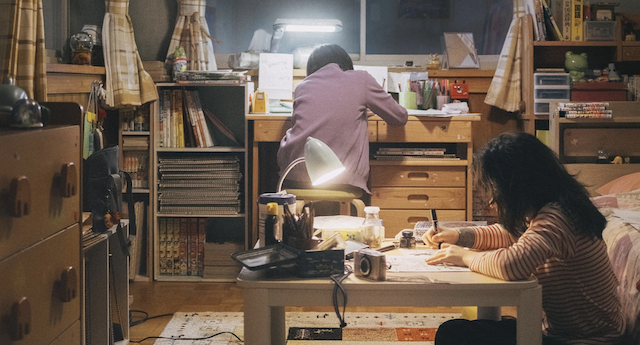
The story begins with Fujino (Furi Nanase), a confident elementary schoolgirl who loves drawing manga and seems naturally gifted at it. She publishes her comics in the school newspaper and is proud of her talent. Then she discovers that another girl in her class, Kyomoto (Rokka Okada), is also drawing manga and is a huge fan of Fujino’s work. The two could hardly be more different. Fujino is outgoing and popular, while Kyomoto is shy, has difficulty speaking and spends most of her time at home. When their drawings bring them together, an unexpected friendship begins. We follow them into their teenage years, now played by Natsuki Deguchi and Aju Makita, as they continue to draw together and eventually turn their passion into a profession.

ⓒCourtesy of The Toronto International Film Festival
At the heart of the film is the relationship between Fujino and Kyomoto. Friendship and companionship are central themes, but Kore-eda approaches them with characteristic simplicity and restraint, observing the girls and the gradual development of their bond in small, precise brushstrokes. Adults are largely absent from the film, creating the sense of a world experienced almost entirely on the girls’ own terms. Though very different in temperament, they find a common language through drawing. What begins as a shared interest develops into a close and formative relationship, as they influence, challenge and inspire one another. Their connection is conveyed not through grand declarations, but through the quiet growth of shared time and experience. Kore-eda treats their intimacy with considerable tenderness yet avoids sentimentality. When the story takes a darker turn, loss and grief cast their relationship in a new light, deepening the film’s exploration of friendship, absence and the lasting impact one person can have on another.
At its heart, “Look Back” is also about the joy and need to create. It could be manga, painting, music, writing or any other form of art. Creating something can be a way to find out who you are and what matters to you. For Fujino and Kyomoto, drawing is more than something they enjoy. It gives them a sense of purpose and a way to express themselves when words are not enough. They draw because they love it, but also because they feel they have to. Kore-eda shows how creating can give us a place in the world.
Kore-eda gives the film a gentle rhythm and a calm pace that suit the story. There is no rush. We have time to watch the girls draw, walk, talk and simply be together. The film moves quietly through the years, allowing us to feel the passing of time. Small moments are often as important as the bigger ones. The cinematography, by Senzo Ueno, is just as simple and beautiful. Soft light, careful framing and everyday details create an intimate feeling, making us feel close to the girls and their world. The camera does not call attention to itself. Instead, it lets the story and the characters take the lead.
With “Look Back”, Kore-eda returns to the kind of intimate, human storytelling he does best. The film recalls the quiet observation and focuses on relationships that have marked films such as “Still Walking” (2008), “Like Father, Like Son” (2013) and “Our Little Sister” (2015). As in much of his work, time, memory and the small changes in people’s lives become part of the story. There are warmth and sadness, but also plenty of joy. He never forces the emotions or tells us what to feel. Instead, he gives the characters space and lets the small moments speak for themselves. “Look Back“ is gentle, moving and full of life. This is Kore-eda at his best.

ⓒCourtesy of The Toronto International Film Festival
Grade: A-
If you like the review, share your thoughts below!
Check out more of Niclas’ articles.
Here’s the trailer of the film.