

© Schubert, ROW Pictures, Walker+Worm Film & Gerald Kerkletz
They say casting is everything. Before Austrian filmmaker Markus Schleinzer sat in the director’s chair, he spent years as a casting director for auteurs like Michael Haneke, helping cast “The Piano Teacher” (2001) and “The White Ribbon” (2009), films full of astonishing performances. That eye for talent hasn’t left him. For his third film, “Rose”, set in 17th-century Germany after the Thirty Years’ War, Schleinzer landed Sandra Hüller, one of the world’s greatest actresses, to play a woman who has lived for years disguised as a man. The film had its world premiere at the Berlinale earlier this year, where Hüller won the Silver Bear for Best Actress, and is now screening at the New York Film Festival. It is a knockout performance in a splendid film.
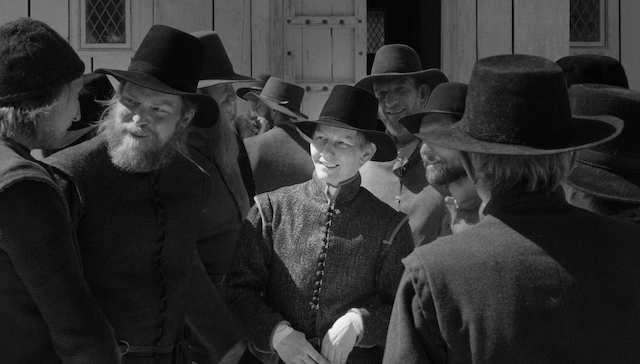
The film opens as Rose returns from the war with a bullet wound across her face and arrives at a small, isolated village. She claims to be the long-lost heir to an abandoned farm. The villagers are suspicious at first, but they slowly accept this quiet, hardworking stranger. Rose settles in, marries Suzanna (Caro Braun), all while carrying a secret that could destroy everything if it comes out.
Schleinzer shares Haneke’s chill. The camera keeps a cold distance, watching the village and its people with suspicion, never quite comforting. “The White Ribbon”, with its similar sense of doom and beautiful black-and-white cinematography, looked at a German village right before World War I, showing how violence and rigid discipline take root under a calm surface. “Rose” looks at a German village centuries earlier, right after the Thirty Years’ War, when survival has already hardened people into something harsh and closed off. Different eras, but a shared question: what fear and rigid discipline do to a closed community, and what that community does to anyone who doesn’t fit.
© Schubert, ROW Pictures, Walker+Worm Film & Gerald Kerkletz
Rose is the outsider. The film is inspired by real cases of women who lived as men in Europe at the time, like Catharina Margaretha Linck, a German soldier who married a woman under a male name before being exposed and executed in the early 1700s. “Rose” also echoes the story of Martin Guerre, the French peasant whose identity was stolen by an imposter, later turned into “The Return of Martin Guerre” (1982) and remade as “Sommersby” (1993), with Richard Gere and Jodie Foster.
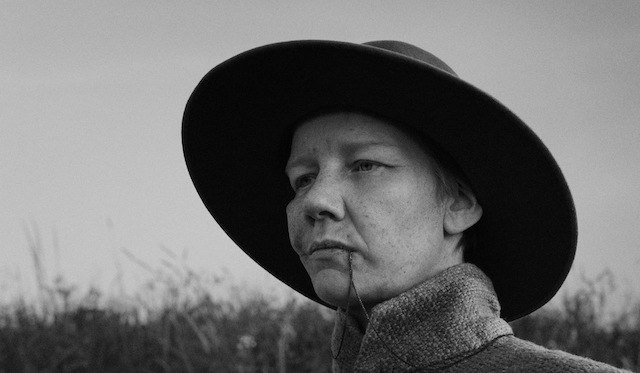
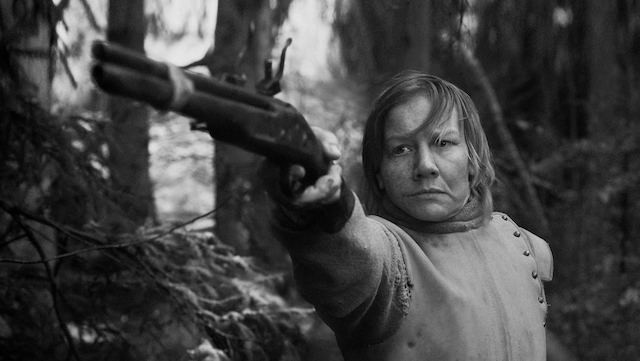
Rose carries the war on her body. A scar from a bullet cuts across her face. She never explains it and never hides it. She wears rough, worn soldier’s clothes. Her voice is low. Her movements are careful, like someone who has spent years making sure nothing gives her away. Hüller plays her with a kind of stillness, small gestures and guarded eyes. Every detail tells us this is someone who has learned to survive by disappearing into a role.
Role becomes a performance inside a performance for Rose. She plays a man to survive, but the film also asks what she gains by doing it. In this world, being a man means land, respect, and freedom a woman could never have. The mask protects her, but it also opens doors. Naturally cinema has explored this kind of gender-crossing before, most famously in “Orlando” (1992), where Tilda Swinton’s character lives for centuries, first as a man and then as a woman, and discovers how differently the world treats each version of the same person. The film has long been widely discussed as an early exploration of gender fluidity on screen. But Rose isn’t shifting identities out of wonder, like Orlando. She does it out of necessity. One wrong move, and the mask could cost her everything.
This isn’t the first time the director Schleinzer has picked a difficult subject. His debut, “Michael” (2011), followed a man who keeps a young boy locked in his basement, told in a cold, quiet style that never looks away. His second film, “Angelo” (2018), told the true story of Angelo Soliman, an African boy abducted and brought into early 18th-century Viennese high society, only to be treated as a curiosity his whole life. With “Rose”, Schleinzer turns to gender and disguise. Across all three films, he keeps returning to outsiders, people who don’t quite fit.
“Rose” is a quiet, confident film that never rushes to make its point. Schleinzer trusts his images, his cast, and his silences. Hüller carries the film with a performance that says more in what she holds back than in what she shows. The black-and-white cinematography, shot by Gerald Kerkletz, alone is enough to blow your mind, giving every frame a strange, haunting beauty. In the end, “Rose” is about the people history leaves behind, the ones who never got a say in their own story. It’s a story about how far a person will go to have a place in the world, and what that costs.
© Schubert, ROW Pictures, Walker+Worm Film & Gerald Kerkletz
Grade: A-
If you like the review, share your thoughts below!
Check out more of Niclas’ articles.
Here’s the trailer of the film.