

©Courtesy of TIFF
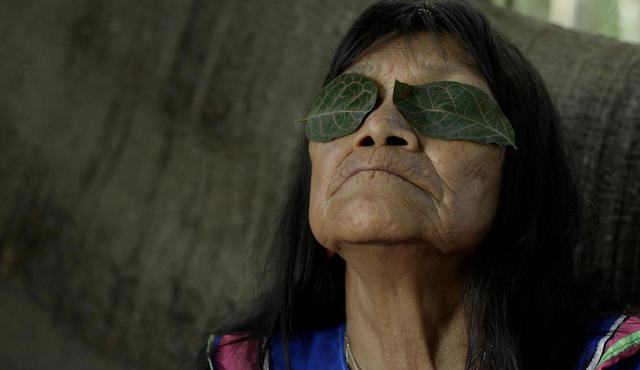
In the new documentary, The Hummingbird Paints Fragrant Songs, celebrated Indigenous Shipibo-Conibo artist Sara Flores confronts the excesses of Western culture. As her visibility grows, she also finds herself increasingly engaged with environmental destruction and the struggle for Indigenous land rights.
Èlia Gasull Balada and Matteo Norzi wrote and directed the film. They also produced the movie with Maria Altamirano. Gasull Balada also went on to edit the documentary.
The Hummingbird Paints Fragrant Songs showcases how Flores, a visionary practitioner of kené — the design system of the Shipibo People — who hails from the Peruvian Amazon spent a lifetime with little recognition. However, she found herself, in her 70s, suddenly embraced by the global contemporary art world.
As gallery invitations, a Dior collaboration and international travel transform her family’s fortunes, Flores struggles to reconcile her simple way of life with the excesses of the West. When her body begins to fail, medical tests offer no clear answers. An ayahuasca ceremony reveals aspiritual cause tied to both the evil eye of a neighbor and the Amazon’s environmental crisis.
On the day of her 75th birthday, Flores opens up in a stream of thought to her pet monkey, expressing a new awareness of her mortality. It’s a political awakening that leads her to join a group of young land defenders fighting to reclaim Shipibo ancestral territory.
After a trip to the United Nations in New York alongside the group’s leader, Flores comes up with an idea on how to turn her art into activism. She decides to use the commission for her first museum exhibition in Lima to address the Peruvian state. She also begins a new body of work centered on the dream of Indigenous sovereignty: a flag for her Indigenous Nation.
The Hummingbird Paints Fragrant Songs had its World Premiere on Saturday, September 12 during the 2026 Toronto International Film Festival (TIFF) in the TIFF Docs section. In honor of the movie’s premiere, Balada and Norzi generously took the time before the feature’s initial TIFF screening to talk about writing, directing and editing the project.
Q: Together, you wrote the biographical documentary, The Hummingbird Paints Fragrant Songs. What inspired you both to make the film together?
Matteo Norzi: The main motivation was feeling that we had found a treasure with Sara. We felt privileged to have met her and known her so well.
We had collaborated with her long before the film existed as an idea. That access and intimacy gave us a sense of responsibility.
We wanted to find a way to share this incredible person with more people. That became the starting point for The Hummingbird Paints Fragrant Songs.
Q: How did you first discover Sarah’s work?
Matteo Norzi: About 15 years ago, I was working on another film in the Peruvian Amazon. I encountered Sara’s work in a local market.
I was immediately struck by its beauty, precision and vibrational power. For a long time, I only knew her initials. She signs her work with three initials representing Sara Flores Valera. I went down a rabbit hole trying to find her.
Eventually, I found her and knocked on her door. I will never forget when she opened it with a big smile. I am a very tall man, while she is a very small woman.
Nevertheless, she welcomed me into her studio. Somehow, without difficulty in cultural translation, we became very good friends.
Q: Èlia, how did you eventually meet Sarah?
Èlia Gasull Balada: I was the editor on a film Matteo co-directed between 2014 and 2015. The film premiered in 2016 and was already set in the Amazon.
It was a fiction film featuring Western actors. The Shipibo-Konibo participants included nonprofessional actors, shamans and families.
Working on that film introduced me to the region and its people. I became familiar with the culture through the footage and ceremonial songs.
The first time I took a trip to Pucallpa was in 2019. I began working there as a visual artist and continued returning frequently.
While there, I was developing a project with Shipibo women who experienced forced sterilization during the Fujimori dictatorship. That work brought me closer to the community.
I met Sara during one of those trips. She greeted me with a big smile while eating watermelon with her monkey. I immediately thought she had incredible charisma. At that point, however, I never imagined making a film about her.
Q: When did you realize Sarah’s story could become a documentary?
Èlia Gasull Balada: The following summer, Matteo told me Sara had several shows coming up. Dior had also contacted her about a collaboration.
We already knew the region and understood its political and territorial struggles. Understanding Sarah’s role within those conversations was important to us.
We realized there was a film to be made. Since we had already spent significant time in Pucallpa, we could begin immediately.
We put other projects aside and started making this film. We eventually spent three years traveling with Sara around the world.
Q: How did traveling with Sara help influence the way you crafted the documentary’s structure?
Matteo Norzi: The film is built around contrasts. Sara can eat fish with her hands in one setting and experience luxury in another. She can sit on the floor and prepare a plant tincture. Later, she can appear within highly formal art institutions.
By accompanying Sarah through these unlikely situations, we saw an opportunity. Those changes in context became the backbone of the film.
We wanted to create a visual language through those contrasts. The journey needed to communicate something meaningful to the audience.
Q: How did Sara’s overall international career also influence your approach to making The Hummingbird Paints Fragrant Songs?
Èlia Gasull Balada: Sarah gave us access to extraordinary settings. We would never have entered many of those places without making this film.
The Dior runway show is one example. I doubt I would have attended such an event without being there with cameras. Sara was invited to the first row, which allowed us to capture that experience.
There were many other surprising situations throughout production. For me, the idea of a mirror became important. We were capturing Sara’s presence while also observing ourselves.
Sara has a striking presence in the world. Her way of being made me reflect on how we are present ourselves.
That became particularly relevant when considering Western culture. I began thinking about excess, choices and the essence of life.
Q: What questions did those experiences raise for you?
Èlia Gasull Balada: The film became a way to reflect on how we live. It asks us to consider how we occupy the world.
Sara’s presence allowed us to observe contradictions that might otherwise remain invisible. Those contradictions became important to the film.
We wanted audiences to reflect on what they were seeing. We also wanted them to consider their own choices and assumptions.
The mirror became a way of encouraging that reflection. The Hummingbird Paints Fragrant Songs therefore looks beyond Sarah’s artistic career.
Q: Johan Carrasco Monzón served as the cinematographer on the film. How did you work together with him to create the movie’s visual style?
Èlia Gasull Balada: We wanted to develop a quiet gaze. The approach needed to remain simple, understated and connected to Sarah’s personality.
We did not want to impose our own gaze on her. Having the images and her presence speak for themselves was important to us.
We had many conversations with our cinematographer about achieving that balance. The images needed to feel respectful while remaining cinematic.
The film has no talking heads and no traditional interviews. Everything unfolds through verité filmmaking.
We learned throughout production how to capture contrasts and play with scale. Sarah’s figure could become particularly powerful against institutions with long histories.
Q: How did you divide the responsibilities of being co-directors during The Hummingbird Paints Fragrant Songs’ production?
Matteo Norzi: Èlia was more involved with directing on set. I was more involved as a creative producer.
My role included making sure circumstances in the real world unfolded for the camera. We approached our responsibilities differently during production.
Later, things changed in the editing room. Èlia was also the editor, which allowed me to take a step back.
I could then look at the material from a greater distance. We tried to integrate our skills instead of overlapping them.
Q: What were some of the biggest production challenges?
Matteo Norzi: The production itself was a significant achievement. We made the film within a nonprofit organization. That is unusual for a project of this magnitude.
We initially explored public funding and international co-productions. However, events were unfolding too quickly to wait for lengthy bureaucratic processes. We needed another way to keep production moving.
We used the organization as a fiscal sponsor and approached philanthropists. That allowed us to secure funding and continue the project.
Our existing relationships were equally important. We already had strong connections with Indigenous people and organizations.
We also had relationships with art institutions through previous exhibitions and cultural projects. Those connections made many aspects of the film possible.
Q: Èlia, you also served as the movie’s editor. How did you approach putting the final version of the documentary together?
Èlia Gasull Balada: We felt it was important to keep the edit within ourselves. We had experienced the place so deeply.
The sounds and feelings were so familiar to us. We knew what it meant to be there during intense humidity and prolonged rain. That knowledge can be difficult to communicate to someone who has never visited. But that doesn’t mean another editor could not make the film.
However, our bond with Sarah and her family made this particular approach important. So we decided to edit the film.
It was exciting to work with footage we had filmed and imagined during production. Our cinematographer gave us extraordinary material with endless possibilities.
Sound also played a huge role in structuring the edit. It helped us establish rhythm and discover the film’s ellipses.
Sara appears in almost every shot. Yet the film doesn’t always use complete scenes.
Sometimes we placed individual moments next to one another. Each moment could have its own character, sound and rhythm.
Sara’s agency was incredibly informative throughout that process. Her presence helped guide us toward the final cut.
Q: Èlia, you just mentioned that sound also played a huge role in structuring the film’s edit. How did you craft the score for the movie?
Matteo Norzi: We decided not to use a traditional score. The emotional musical material was recorded during an ayahuasca ceremony.
We recorded the songs during one night lasting approximately three hours. The beauty of those songs was extraordinary.
We used the icaros, or ceremonial songs, to give particular moments different emotional qualities. The ceremony also influenced how we thought about sound.
We became interested in the idea of synesthesia. That involves a crossover between different senses.
We wanted sound to function as an infrastructure for the images. Sound could sometimes feel as though it had agency over the image.
That approach became central to The Hummingbird Paints Fragrant Songs. It helped us build an experience rather than simply illustrate events.
Q: The Hummingbird Paints Fragrant Songs (had) its World Premiere at the Toronto International Film Festival. What does it mean to you that the documentary screened at the festival?
Èlia Gasull Balada: It has been an honor to be selected by (TIFF’s lead documentary programmer,) Tom Powers for the Toronto International Film Festival lineup.
We (were) surrounded by incredible filmmakers, so the experience (felt) thrilling and humbling. Finishing the film took extremely hard work. But we wanted the film to be ready as soon as possible.
We also wanted Sara to join us for the journey. We traveled around the world for three years. Then we completed the edit in slightly more than eight months.
Reaching Toronto after that process feels like a major accomplishment. The festival (provided) an important launching platform for the film.
Matteo Norzi: We are especially excited that the premiere (happened) in Toronto. Canada provides an important platform for Indigenous issues and Indigenous cinema.
We are based in New York, so Toronto feels connected to our North American sphere. We understand how competitive the festival world can be. That makes this opportunity particularly meaningful. We are grateful to (have) premiered The Hummingbird Paints Fragrant Songs at such an important festival.
If you like the interview, share your thoughts below!