

©Courtesy of Neon
©Courtesy of Neon
Exclusive Interview with Actress Virginie Efira
Q : Writer/Director Ryusuke Hamaguchi has loosely based his screenplay on a 2019 book titled “You and I – The Illness Suddenly Gets Worse,” a collection of letters between the anthropologist Maho Isono and the terminally ill philosopher Makiko Miyano, have you read the original book, What’s your impression on that? And how does it differ from the book?
Virginie Efira : So yes, so this book, which the English title was “All of a Sudden” and the Japanese title was provided so. So it’s a book of correspondence between this philosopher and this medical anthropologist who are having this intimate epistolary relation. And this book was provided to all of us in the film crew and was really the basis of the work in that they discuss such things as risk and chance and the question of relation.
And so this was the base material for Hamaguchi’s script writing, but he did add a lot of things, including the things around Humanitude(Humanitude is a care methodology developed by Yves Gineste and Rosette Marescotti, aimed at improving the quality of life for individuals with dementia through techniques that emphasize respect, empathy, and connection. This approach fosters dignity and enhances the caregiver-patient relationship) and care at large. And so even though the basic ideas were drawn from philosophy and the notion of an encounter, everything that happens in the nursing home is his own addition.
[tf-tv]
Q : So once you read the script and you showed your enthusiasm working with Hamaguchi and he actually saw your work “Benedetta” with director Paul Verhoeven and he was a really impressive of your work and offered your role. But this role wasn’t easy to tap into, because you have to learn Japanese, which is in order to read Japanese, you have to learn hiragana, katakana and kanji, which is really a hard work. So, could you talk about Japanese lesson that how did you approach to speak in the film?
Virginie Efira : Yes. So I found that I needed to learn Japanese in about two months. At this point, when we began, the only thing I could say was Arigato Gozaimasu!(which is “Thank You” in Japanese) And so of course there was a long way to go.
He asked me to begin by learning to read, so that I could understand the symbols and the sound from this perspective first. And so I had several teachers, which was very interesting. But of course, I had some amount of fear that I wouldn’t have the time to first learn to read and then assimilate the amount of text that needed to be learned.
Not only my text, but the text of the other actors. Because of course I needed to understand what was being said, so that I can be honestly present and reactive to it. But I believe that once somebody is so lucky as to be part of a project like this one, and who is so lucky as to be invested with the faith that Hamaguchi put in me, that really deploys the possibilities of one’s capacity. So it was as much learning about the pronunciation than it was learning about the way that the emotion travels in Japanese. Because of course Japanese language is a reflection of the culture, which has more reserve, which has some kind of inwardness that I needed to learn. Because it was from there that I could really understand what the dynamic, what the dynamics of a sentence would be.
Q : You really made a wonderful approach, and it really captured the essence of Japanese language throughout the film. Let’s talk about your character Marie-Lou Fontaine. She’s actually a director of experimental group program for the Alzheimer patients. But they really did experimental approach, such as patients with the group foot massage. I’m curious to know what kind of research did you do in order to tap into your role? Because they have a really engaging and fascinating approach for Alzheimer patients with humanity.
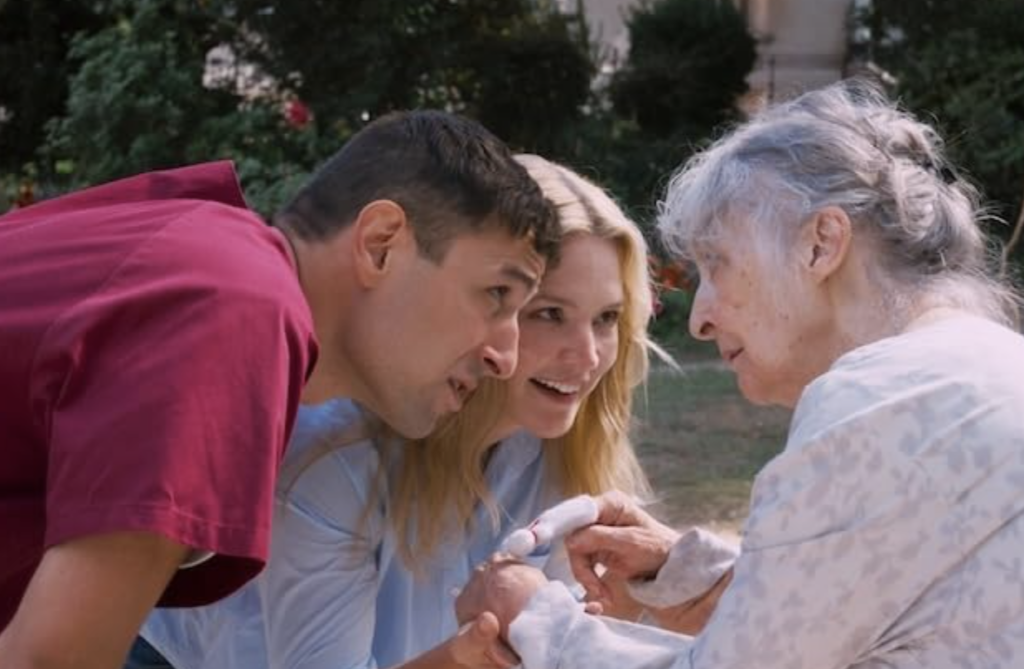
Virginie Efira : So first of all, all of the people in the film, all of the actors and non actors who were involved with Humanitude were made to follow Humanitude training proper with the people who initiated this care philosophy in the French landscape. I think it’s interesting to know that it was not all actors who followed these Humanitude trainings, but the ones who in the film would play those that were involved with this technique.
And then because we were filming in a nursing home, that is an activity, and we were rehearsing there, we were interacting with a crowd of patients, some of whom would sometimes come and interrupt some of the scenes. And so reacting to these supposed interruptions, I first noticed in myself a kind of timidity, a kind of fear that I would be interacting wrongly, that I didn’t have the know how. And Ryusuke was really important in showing us a different way because he had already bathed in Humanitude, so much so that he showed us how to interact and he showed us how to lose this fear that we didn’t have this, this know how.
And it was really a bit like learning a new language because it might seem very obvious to say one should look humanely upon other people and look at them in their eyes and touch them a certain way and be present with them a certain way. But there is something that still needs to be learned for it to really comes into effect. And so this whole process definitely changed a lot of the things in terms of how I understand things and how I look at.
©Courtesy of Neon
Q : Hamaguchi is the one of those filmmakers that very much listening to the actors, and exploring some of the different direction to take it in from the actors. After working with him, what was his direction that stood out for you as you compare to other directors. His directional approach is kind of reminds me a little bit of a French New Wave in a certain aspect, particularly exploring the options aspects. So, could talk about his direction that stood out for you.
Virginie Efira : I think that Hamaguchi is part of category of filmmakers who understands that for his film to become what it can be, the people who are involved in it are going to have to leave something of themselves. And so this shedding, this leaving, this contribution is worked up to in the preparation.
And the preparation means a lot of different things. For one, of course there is the learning of the text and really the assimilation of the text in an ultra precise way, so that it really could become embodied. But then there’s also a lot of theoretical documents that we will receive that allows us to build a background for our characters. For example, there’s this questionnaire of 17 questions for the character.
And these questions have nothing to do with the content of the film. They really are addressed to the characters that we are each playing. And they teach us the actors about what sort of things the character will conceal and which sort of things the character will be upfront and truthful about. It teaches us about the characters subconscious in a way.
And then it which means that ahead of time, he puts together conditions, so that we may be ready to enter together in other world, which is the world of fiction, but to arrive in that fictional world in the real estate way possible. And from that point on, you could say that he does not direct.
Usually on the film set, there’s a lot of technical things and that are put in place that doesn’t prevent reality from peeking through, which prevent something true to come about. And he really works with truth to remove all these things that prevent these things from coming about because he has that magic. And he has that magic as much with his actors as with his crew members. And he puts everybody in a kind of state which makes certain things possible.
[tf-tv]
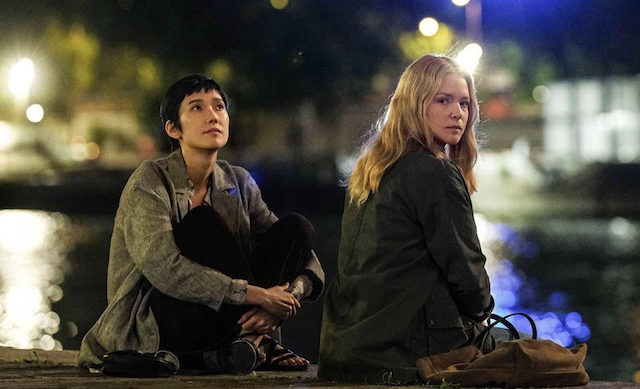
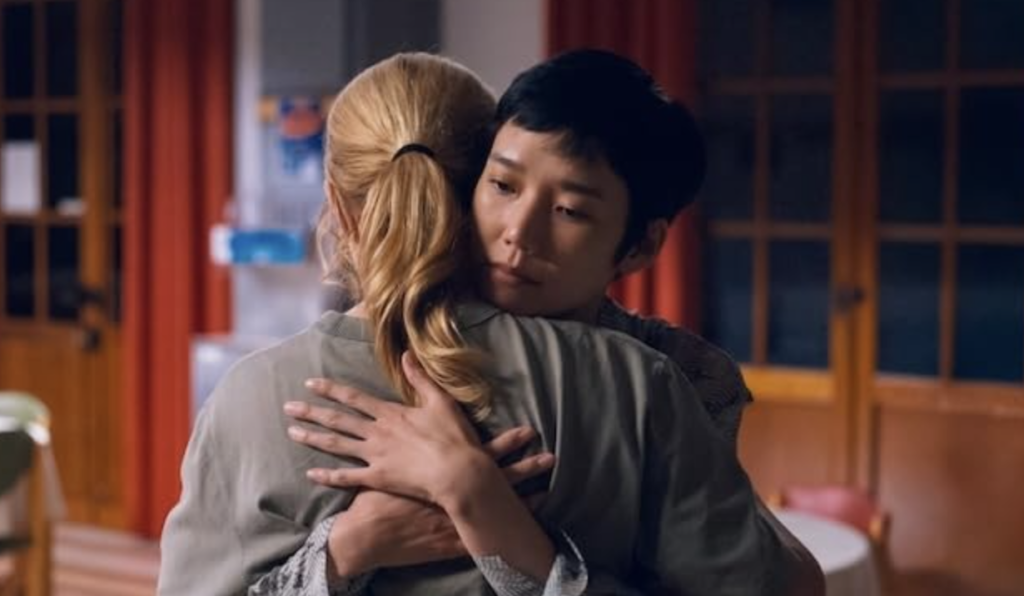
Q : The film really explore the female friendship to another level. So, during the process of acting together with actress Tao Okamoto(who plays Mari), what are the the things that you actually develop with Tao Okamoto in order to create such a dynamic friendship? Just going through emotional ups and down and also understanding their views for each other. So, Could you talk about what kind of conversation you had with Tao Okamoto in order to create such a dynamic relationship?
Virginie Efira : Her and I met and encountered each other at the beginning of this process in such a way that it was truly my curiosity about this actress. And her curiosity told me that sort of started to create and format what would be the relationship between the two characters too. And so it was about being interested by her as a person, as an actress, interested in her doubts and interested in some of her certitudes. And so we’ve begun to really sincerely look at each other. And so we never elaborated anything in the way of an emotionality that was pre-planned. It really was grounded in the fact of the beginning of this friendship for all parties involved.
And so we worked on things together, but only ever technically, we never sort of rehearsed emotions together. We would work on the text, we would, we would sort of work on the craft of it. And that’s really where the interest being interested in Tao was the same thing as being interested in Mari. It was it was first encounter with both. As it is true for the characters, it was true for us that we were just meeting in that moment and that this experience would have a definitive ending for different reasons than in the film. But that also gave an urgency to this encounter.
©Courtesy of Neon
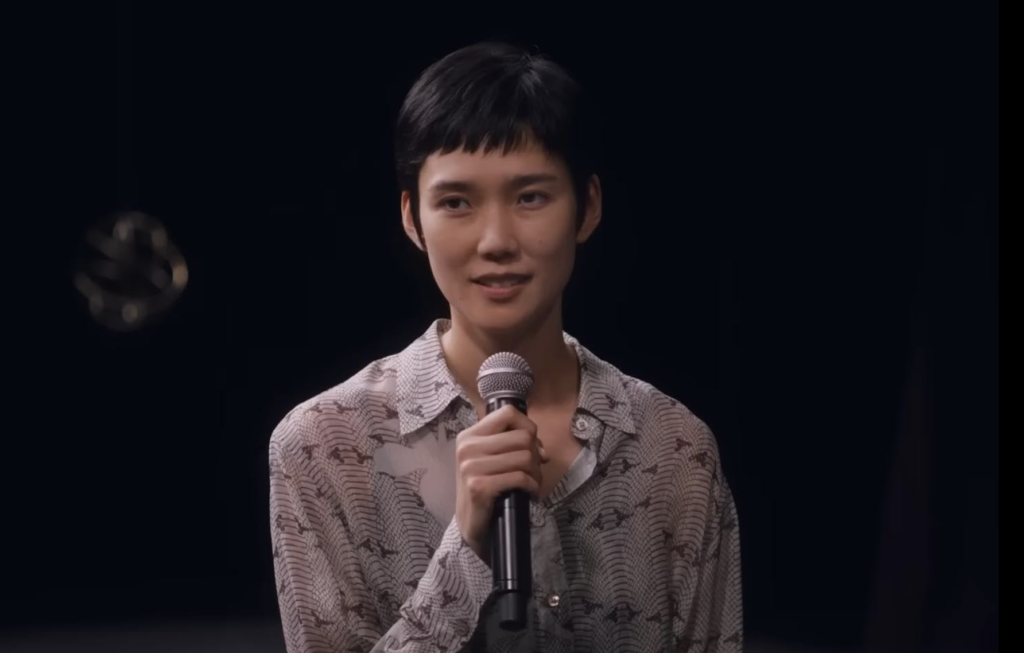
Q : OK, there’s a scene in the film that when Marie-lou went to see the Mari’s play which Goro(Played by Kenzo Nagatsuka) is a lead character, and your character Marie-Lou explain all the things about how she felt about this play in Japanese. But right before Mari(Played by Tao Okamoto) was about to explain what Marie-Lou said in French, Goro stopped Mari to translate into French, because it’s all about the emotion and expression of her face through Japanese says everything, Goro thought it didn’t need to translate that, which means that all the expression, all the feeling, that’s really important about that.
But there’s another element in the film, which is when Marie-Lou explains about all the capitalism and government in whiteboard, which is very much explanatory, which is quite different from expression and emotion. How did actually Hamaguchi direct those two different sequences on the set? Because I’m curious to know how he approach about expression and explanatory elements in this film, I’m curious to know how he processed those two sequences.
Virginie Efira : The fact is, for example with English, which is not my first language. To understand English, I have to lean into you. I have to look at you and the kind of attention that I have to give to you makes me notice different things than I would if we were speaking the same language. And in some way, to give the attention to other people is better and more astute when we’re not speaking the same language.
And he’s also a filmmaker who’s very focused on the voice and a question of the texture of the voice. It’s almost as though he has the perfect pitch and comes to know when an experience is really Incarnate. In part, because we work on the text like they do and “Drive My Car”by doing purely flat readings of the text.
We’re reading it out as though it was a sequence of numbers, and then eventually it comes together where he can hear when the experience has been had from within. And that’s what’s being repeated in that scene that you speak of when the translation is interrupted by saying, just by their voice, you can hear that they said something important to each other.
You know, he really put together the conditions that this may be the case. For example, we filmed these scenes in the film in order. And that meant that was my first time speaking Japanese on set. And I had already started to build a relation with Tomoki(Played by Kodai Kurosaki) and I was going to be expressing myself with a certain fragility because it was my first time speaking. And I think that even this fragility added to what the scene was going to be. And so after three or four times he said it’s good we got it and we need to post synchronize it afterwards, which you know, I was quite glad for. And so that all of the elements of the making sort of strengthened all of the things that we were trying to express.
So that with the capitalism scene on whiteboard, I believe that the way that he works with actors is in such a way that he’s really trying to collaborate to solve something. And so in that way, he’s really letting the actors participate in that elucidation in a way. And because of his directing, what happens between the two characters in that moment isn’t a didactic kind of top down class being given. Somehow this explanation of all-encompassing political global system comes to resonate personally.
And it’s a bit of a cliche to say that everything intimate is political and everything political is intimate. But in this case, it’s true that understanding these things that have an effect on a much more macro level start to illuminate some things about the with the internal core of the character. And it has this relational resonance where we really start to be in connection with each other. And for example, when she takes out the whiteboard, if it makes me laugh because it’s true that it’s a bit of a, an intense gesture, he lets us laugh. And the coffee that’s boiling on the pot is really coffee that I’m really about to drink.
Q : Well, that’s it. Thank you so much your time, Virginie. I appreciate it making the time with me and thank you so much.
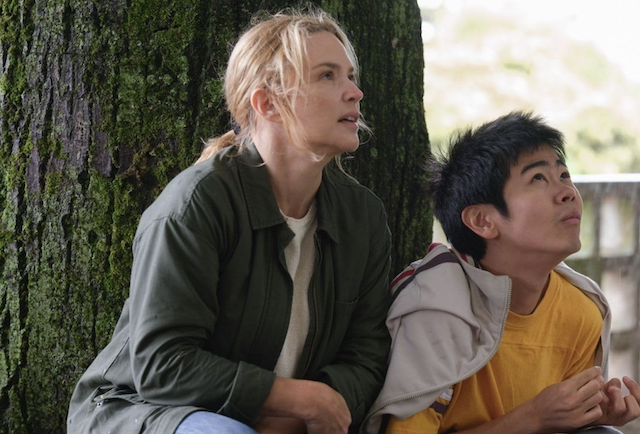
©Courtesy of Neon
If you like the interview, share your thoughts below.
Check out more of Nobuhiro’s articles.
Here’s the trailer of the film.