

The 17th edition of DOC NYC includes in its line-up an extraordinary cinematic account that defies racism.
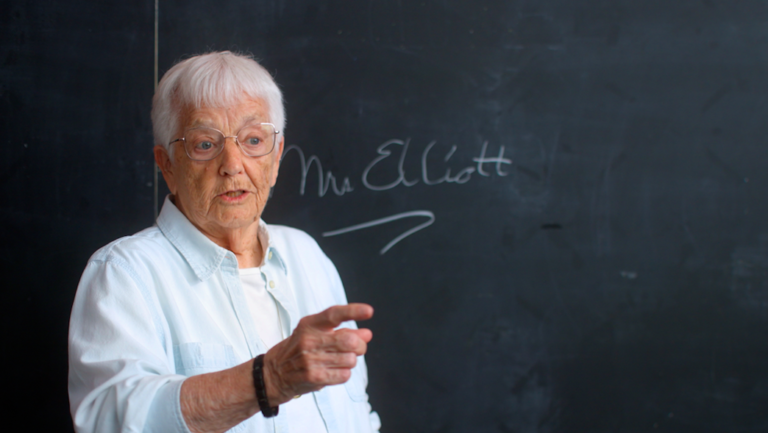
Jane Elliott Against The World, directed by Judd Ehrlich, retraces how in the morning following the assassination of Martin Luther King Jr. in April 1968, Jane Elliott, then a third-grade teacher in the small town of Riceville, Iowa, devised an exercise that would change the course of her life. Facing an all-white classroom, she divided her pupils according to eye colour, treating one group as superior and the other as inferior. By creating a miniature version of a discriminatory society within the classroom, she wanted her students to experience first-hand the mechanisms and emotional consequences of racism. What began as an unconventional teaching exercise soon became one of the most influential and controversial educational experiments in modern American history, turning an unknown schoolteacher into a national figure and a lifelong activist. Nearly sixty years later, at the age of 92, Jane Elliott remains as outspoken, uncompromising and combative as ever.

Filmmaker Judd Ehrlich follows the veteran educator as she takes on a new battle against censorship and restrictions on teaching race and American history in public schools. Through her involvement in the fight against educational restrictions in Temecula, California, the documentary establishes an unsettling parallel between the climate of 1968 and contemporary America, suggesting that the lessons Jane Elliott introduced more than half a century ago remain painfully relevant.
Jane Elliott Against The World moves between archival footage of the original classroom exercise, interviews with Elliott in the present day, and intimate encounters with her family. This structure allows Ehrlich to explore not only the extraordinary reach of her work, but also the personal cost of a lifetime spent refusing to remain silent. From her first appearances on The Tonight Show Starring Johnny Carson to her subsequent invitations to The Oprah Winfrey Show, Elliott’s influence extended far beyond the classroom. Her exercise was replicated and adapted in different settings, reaching adults as well as children. In 1985, she even conducted it with a group of adults, whose reactions demonstrated that age and education offer little protection against the humiliation and hostility generated by discrimination.
The choice of eye colour was particularly incisive. Like skin colour, it is a physical characteristic over which individuals have no control, yet it can be arbitrarily transformed into a marker of social hierarchy. By assigning superiority to one group and inferiority to another, Elliott recreated the dynamics of an oppressive society in a matter of minutes. The consequences were immediate: children who were told they belonged to the superior group became more confident and performed better academically, while those subjected to discrimination lost motivation and struggled to participate. Particularly revealing was what happened when the roles were reversed. Having experienced exclusion themselves, the previously privileged children did not retaliate against their classmates with the same degree of hostility. The exercise demonstrated how quickly prejudice can be internalised, but also how experiencing injustice can foster empathy.
For Elliott, education has never been merely about memorising facts and figures in preparation for a final examination. She draws a distinction between being a teacher and being an educator: the former transmits knowledge, whilst the latter has the responsibility of leading people out of ignorance. Her approach is deliberately unconventional and multi-sensory, because she believes that knowledge becomes meaningful when it is experienced rather than simply explained. As she puts it, “racial prejudice is an emotional commitment to ignorance.” Her conviction is that future generations must be taught the truth about history if they are to avoid reproducing the mistakes of those who came before them. After all, the perpetuation of evil depends not only on those who actively commit it, but also on the inertia of those who choose not to intervene.
Throughout Jane Elliott Against The World, Elliott reinforces her arguments by recommending books and encouraging people to undertake the difficult work of dismantling their own prejudices. She also challenges the language used to discredit her, reclaiming disparaging labels through playful, empowering acronyms such as “Being In Total Control Honey” and “Octogenarian Living Dangerously”. Her humour and sharp tongue remain integral to her public persona, although they also help explain why she has become such a polarising figure. Today, she is among the authors and speakers whose work has faced restrictions and bans in parts of the United States, a development that gives the documentary’s contemporary storyline particular urgency.

Judd Ehrlich also takes care to look beyond the public icon. Born in 1933, Jane Elliott recalls feeling like an outsider from an early age, partly because her parents had hoped for a boy. Through childhood footage and personal recollections, the film explores the formative experiences that shaped her character, including the death of her younger sister and its impact on the entire family. These intimate moments complicate the image of the formidable educator who has spent decades confronting others without hesitation. Elliott’s family, including her daughter and grandchildren, becomes an important counterpoint to her public life. She experienced the loss of her son to cancer, and the documentary reveals how her uncompromising commitment to activism has affected those closest to her. In fact, the film does not shy away from the controversy surrounding her methods, nor does it present her as an untouchable hero. Instead, it allows us to encounter a more complicated individual: a woman who has spent her life asking the world to change and who, in the final chapters of her life, is still learning that change must sometimes begin at home.
The documentary also touches upon the historical and scientific foundations of Elliott’s teaching. She challenges the notion of race as a biological category, emphasising the common origins of humanity and the social construction of racial hierarchies. Her wider message is that divisions presented as natural or inevitable are, in fact, products of historical and political processes. She also distinguishes between love and justice, reminding viewers that good intentions alone are insufficient when people fail to take responsibility for how they treat others.
Ultimately, Jane Elliott’s greatest lesson is perhaps the simplest: there is only one human race. Yet this seemingly straightforward principle requires more than passive agreement. It demands awareness, accountability and the willingness to challenge injustice, even when doing so is uncomfortable or unpopular. At a time when the teaching of race, discrimination and American history is once again being contested, her legacy feels particularly urgent.
Final Grade: B+
Check out more of Chiara’s articles.
Photos Courtesy of DOC NYC