

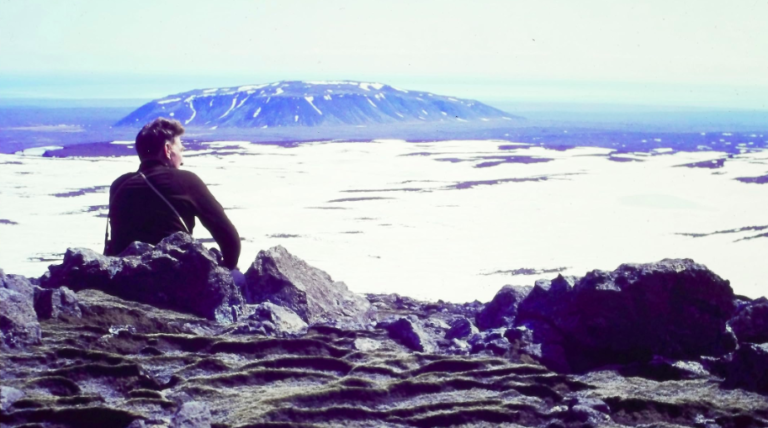
How do you write a eulogy for a glacier? In 2019, Icelandic writer Andri Snær Magnason posed this question in an article for The Guardian, contemplating the death of Ok glacier, which in 2014 became the first glacier in Iceland — and the first in recorded history — to lose its status as a glacier due to climate change. Five years later, in August 2019, a funeral commemoration was held in its honour, the first of its kind in the world.
The article caught the attention of filmmaker Sara Dosa, whose latest documentary, Time and Water, grew out of this encounter. Yet what begins as a requiem for one glacier gradually expands into something much larger: an elegy for a vanishing world, and an intimate meditation on the fragile relationship between human memory and geological time. What happened to Ok is happening across the planet, from Antarctica and Greenland to the Himalayas. The disappearance of ice is not an isolated tragedy but part of a planetary transformation, one that threatens to erase landscapes that have existed for millennia.
Sara Dosa, the Academy Award-nominated filmmaker behind Fire of Love — about volcanologists Katia and Maurice Krafft — finds in Magnason’s reflections an invitation to explore another kind of elemental love affair: that between people, their land and the natural world that has shaped their existence. For Magnason, the question of what disappears with the glaciers is inseparable from the question of what disappears with the passage of a human life. As he confronts the death of his country’s glaciers and the loss of his beloved grandparents, he turns to the family archives, assembling an extraordinary time capsule of photographs, 8mm and 16mm film reels, interviews with scientists, personal recollections and fragments of family history. This material would become his book On Time and Water, which Dosa transforms into a transcendent cinematic experience.
At the heart of the film is a family whose memories are deeply entangled with Iceland’s icy wilderness. Grandpa Jón, Grandma Disa, Grandma Hulda and Grandpa Áni have bequeathed to Andri not simply stories, but an entire way of inhabiting the land. Their lives seem to belong to a different temporal order, one in which the mountains were an extension of childhood, adventure and everyday existence. There is Grandma Hulda, the first woman to fly in Iceland, whose name is shared by her granddaughter, an eleven-year-old girl at the time of filming in 2019. And there is Grandpa Áni, among the first to explore Iceland’s glaciers. For that generation, the mountains exerted an almost irresistible pull from an early age. Their relationship with the ice was intensely physical and sensory: the exhilaration of its scent, the thrill of ascending to high altitudes, the experience of sleeping in tents for days beneath an immense sky. Vatnajökull, Iceland’s largest glacier, was their great stage of adventure.
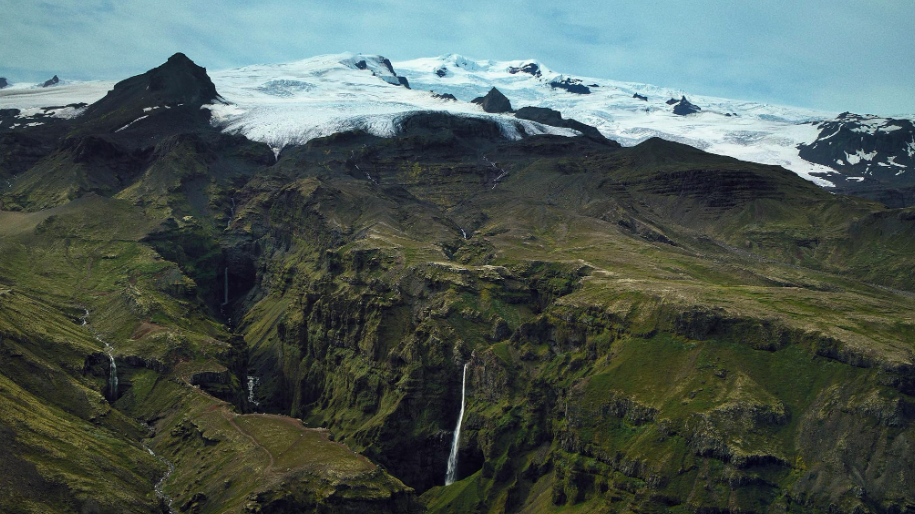
Such recollections give the film its emotional warmth. The glaciers, in the grandparents’ memories, were never static or predictable. A path walked before could suddenly reveal a crevice. The ice was always changing, always moving, always alive. Its apparent permanence concealed an extraordinary restlessness.
Dosa has long been interested in the ways humans seek meaning through their encounters with the more-than-human natural world. Her filmmaking frequently draws upon allegory, metaphor and myth, exploring the different temporalities that bind human existence to larger ecological systems. In Time and Water, this sensibility finds perhaps its most poignant expression. In fact, the film is, as Dosa describes it, polytemporal: a work existing across several timescales simultaneously. Human lifespans, ancestral memories, seasonal rhythms and geological epochs coexist within the same cinematic space.
The editing by Erin Casper and Jocelyne Chaput is instrumental in creating this sensation. Archival footage, family photographs and newly shot material are collaged into an associative flow that bends and folds time, much like memory itself. Images from different decades seem to converse across generations, while the present is constantly haunted by the past and shadowed by the future. The result is a cinematic language that evokes the very nature of glaciers: layers of time compressed into a single physical body, each stratum preserving traces of what came before. Just as ice holds the frozen imprints of planetary history, the family archive becomes a repository of lives that would otherwise slip beyond reach.
The cinematography by Pablo Álvarez-Mesa deepens this dialogue between memory and matter. Working with both digital and 16mm formats, the film establishes a visual language, creating bridges between past and present. Water becomes its recurring protagonist, appearing in its many forms: glaciers, fog, rivers, melting ice and the sea. It is at once a physical substance, an allegory for the passage of time and the medium through which life remembers itself.
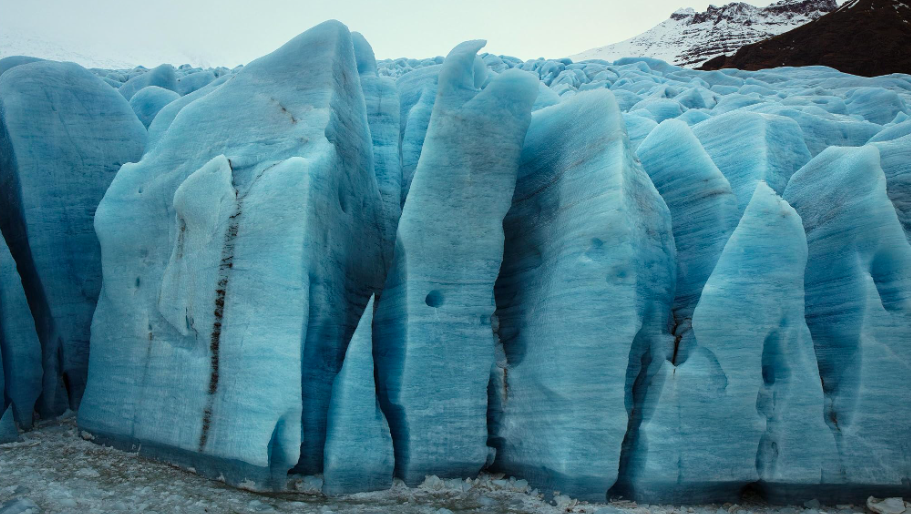
There is something almost otherworldly in the film’s rendering of glacial interiors. The ice reveals itself in intense shades of blue, sometimes traversed by red veins, as though it were a living body with its own circulatory system. The deeper the blue, the older the ice, the longer the span of time it has travelled through. Centuries and millennia are held within its colour. And yet, perhaps the most extraordinary revelation comes not through sight but through sound. We hear the pitter-patter of water droplets, the gurgling of glacial streams, the fizzing and squeaking of shifting ice, the release of trapped air bubbles and the deep, almost subterranean groaning of ice slowly creeping forward. These are the sounds of glacial life — and, increasingly, of its death.
The glacier seems to breathe, to murmur, even to snore. Its low, resonant sounds resemble those of a sleeping creature, while its shifting interior reveals a hidden vitality. The film invites us to listen closely to a world we have perhaps taken for granted, reminding us that nature is never silent, even when its movements escape our perception.
The visual and sonic dimensions of Time and Water are further enriched by the extraordinary paper-cut animation of Lucy Munger. Through historical illustrations, ancient manuscripts and archival photographs, she brings Icelandic myths and folklore to life, giving shape to stories that cannot be recovered through documentary footage alone. The effect is at once magical and haunting, as though the film were opening a secret passage into the collective imagination of a nation. One particularly striking sequence depicts Jörmungandr, the Serpent of Midgard, whose scales are composed of actual words from the Eddas, the ancient texts of Norse mythology. These primeval stories seem to emerge from the very archives that preserve them, reminding us that cultural memory, like geological memory, is passed down through layers of time.
The original score by Dan Deacon further elevates this sense of love and wonder. His experimental electronics, playful melodies and propulsive rhythms give the film an unusual emotional energy, resisting the temptation to turn ecological grief into unrelieved solemnity. Icelandic folk songs, particularly rímur — song poems transmitted orally across generations — add another layer of cultural continuity. Working with renowned Icelandic singer Ólöf Arnalds, the production team also recorded an original version of the film’s anthemic ríma. These songs seem to carry within them the voices of generations, their melodies travelling through time much like the stories of the grandparents.
Time and Water is permeated by solastalgia: the emotional distress of witnessing the destruction of the natural environment that gives us a sense of home. It is a grief that arises not from leaving a place, but from watching the place itself change beyond recognition while we remain in it.
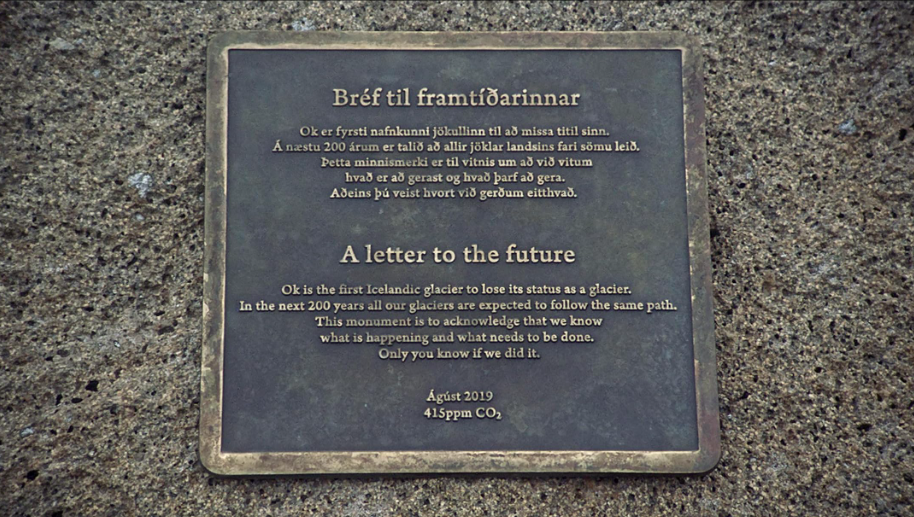
For Andri Snær Magnason, this grief is collective. He reflects on the name “Ice-land” itself, wondering whether, in two hundred years, the name of this nation will summon the ghost of something that no longer exists. This musing takes us back to Ok glacier and the plaque commemorating its death. Its a letter to the future that serves both as a warning and an act of faith in the possibility of a different future. Addressed to people who do not yet exist, it leaves the ultimate judgement to generations still to come.
The motion picture presented by National Geographic Documentary Films asks us to reconsider our relationship with time, with nature and with the very idea of permanence. We have coexisted with ice for thousands of years, yet have scarcely begun to comprehend the immensity of its history. Glaciers are not simply frozen landscapes to be admired from a distance. They are living archives, bearers of ancient seasons and witnesses to the changing conditions of the planet.
Sara Dosa invites viewers to look, to listen and, above all, to remember. It asks us all to recover a sense of reverence for the natural world, not as something external to human existence, but as the very fabric of it. Through the stories of elders, the whispers of ice and the songs passed down through generations. Time and Water reminds us that the earth is not an inert backdrop to our lives. We are merely temporary guests in a world whose history stretches far beyond our comprehension.
Final Grade: A
Check out more of Chiara’s articles.
Photo Credits IMDb