
©Courtesy of GKIDS
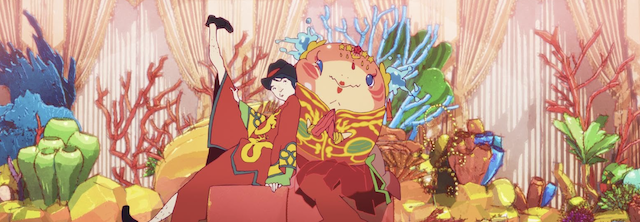
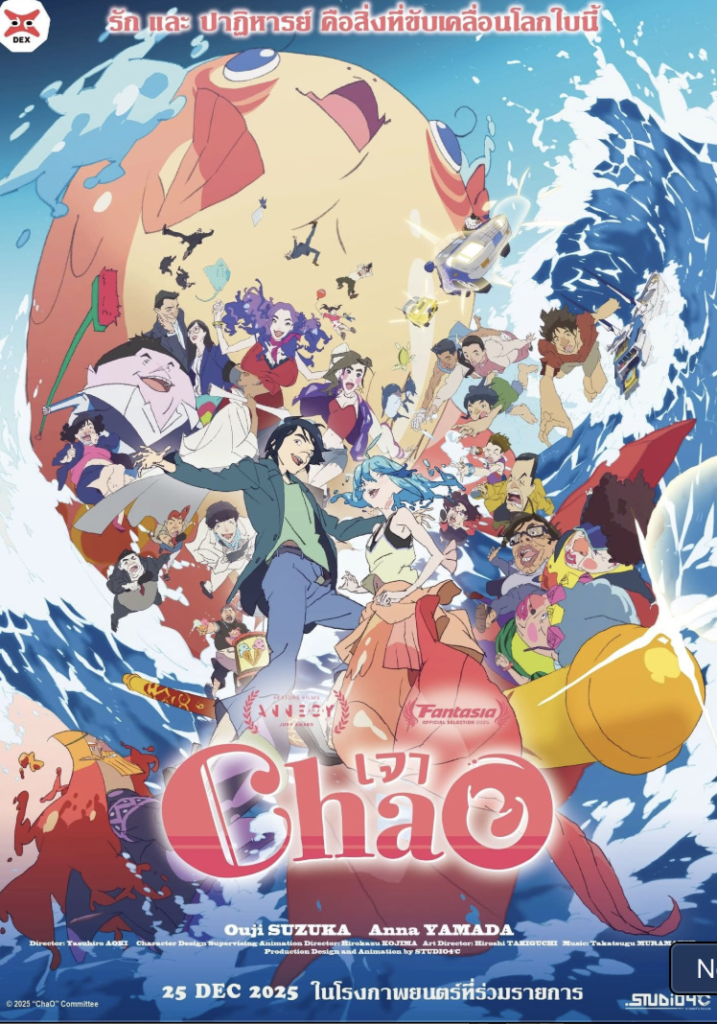
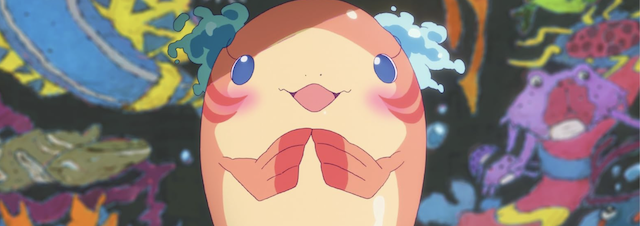
ChaO : In a fantastical future, humans and mermaids share a troubled coexistence. Stephan, an anxious employee at a shipbuilding company, has big ideas to save the sea. But his life explodes into ecstatic chaos when bubbly mermaid princess Chao proposes marriage out of the blue. Between shopping sprees, giant robots, and actual fireworks, the unlikely pair flounder through their new romance and unlock their true feelings.
Exclusive Interview with Director Yasuhiro Aoki
Q: I understand there’s a film called “Amazing Nuts!” that served as the inspiration for this project. Could you tell us how that idea developed and led to this current work?
Yasuhiro Aoki: Originally, “Amazing Nuts” was just a single seed—a concept—and we developed it as a series of short stories (in an omnibus format). I was in charge of one of those stories, which was a short piece under 10 minutes long. The goal was for that work to take root and grow.
It wasn’t easy to just move on to the next thing right away with that idea. I wrote a few scripts, the project got shelved, and I worked with different people, writing and producing scripts—I did that about 15 years ago.
After that, nothing happened for about 10 years, but when I was presented with the “ChaO” project this time, I had this lingering obsession—or maybe even a grudge—about “Amazing Nuts” simmering beneath the surface, and it just clicked perfectly with “ChaO” (in terms of production). The staff is completely different from back then—a total overhaul—but the president (Eiko Tanaka=Studio 4°C) and I both sensed that we shared a similar rhythm in our production process. As we worked on it and sketched out the characters, we felt it was going to work, so we kept building it. Since we were also working on “Amazing Nuts!” in the forest toward the end, having Kumi Koda sing the ending song was another perfect match with “Amazing Nuts!”
When I took that idea to Kumi Koda, she gave her approval right away. There were parts where I tied things together rather forcefully, but it wasn’t as if they were completely unrelated; I built the flow with a sense of unity.
Q: So you’re teaming up with Kumi Koda again. When it came to having her compose the theme song, did you give her any specific instructions beforehand? Or did you just leave it entirely up to her?
Yasuhiro Aoki: Since the movie has a happy ending, I asked her to watch the finished product. This is the first time she’s seen it, but it’s based on that film from 15 years ago (“Amazing Nuts!“). The characters and the world might be slightly different, but if you watch it, you’ll find plenty of similarities. Just watch “ChaO”, that’s all. I gave her those two points to work with, and she created it in about two or three months.
Q: I believe this story is based on, or draws inspiration from, the fairy tale about the Doll Princess. Could you tell us why you chose this subject matter? Also, since Disney has a film called “The Little Mermaid”, were you influenced by that or other films during the production process?
Yasuhiro Aoki: It seems like there’s a cycle with “The Little Mermaid” movies—just when you’ve forgotten about them, another one pops up somewhere. I don’t watch every single one, but I have seen them over the years. I thought they were pretty entertaining. I never, not even for a second, imagined I’d end up creating a story based on *The Little Mermaid
But since I was going to make one, I wanted to make it entertaining, and that’s why I created “ChaO“—it’s all about that contrast. Even though there’s this nonsensical gap, I start off with something serious, or suddenly try to make people cry, and then just when you think that, I wrap it up with another nonsensical comment—that’s how I want to give the audience a roller-coaster ride.
Since “The Little Mermaid” is animation, it’s all fantasy. With animation, nothing starts unless you create it. You have to draw the characters and the backgrounds to get started. Even if you set up a camera, nothing will be captured. So it’s all fantasy. Within that fantasy, it’s cleaner to go all out with the mermaid. I think a romance between a human and a mermaid is cleaner than one between two humans.
It’s impossible, of course. But with the medium of animation, I think it works. As a subject matter, “The Little Mermaid” is actually perfect for eliminating that sense of incongruity. At the same time, since there are many works that have pursued a certain sense of realism, we have to be careful not to lose sight of that. This is also one of the pleasures of that contrast.
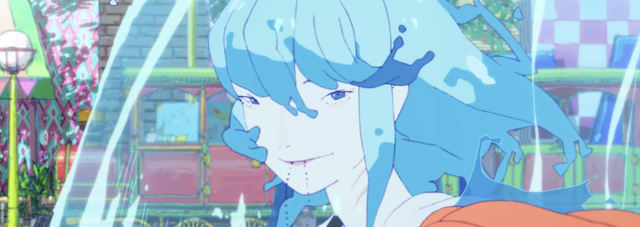
Q: Could you tell us about how you developed those characters? While Chao is somewhat unrealistic, he also has a pure and innocent side, and Stefan has a certain human touch—or a sense of humanity—and both are incredibly charming. When constructing these characters, what specific points did you focus on?
Yasuhiro Aoki: Since they’re always on stage, there’s a basic tendency to lean into the first-person perspective, putting effort into it, tensing up, and trying to look cool. As I mentioned earlier, I build them around that contrast. As for Stefan, the idea is that he’ll naturally grow over time. If you compare the story to a lead role, it’s about struggling with inner conflict, overcoming it, purifying himself, and growing—that’s the narrative. Even if he stays silent, that’s how it should unfold.
If you create a supporting character with the premise that “they’re just a supporting character,” it becomes boring and ordinary. So, by using that contrast, I wanted Stefan to be a simple, ordinary person. It’s better to have the supporting characters solidify that image—otherwise, they might overshadow the lead. If they were just mascots, wouldn’t there be plenty of other characters people would want more than the lead?
That’s why I believe everyone in the supporting cast has the potential to become the lead. Even outside the frame, I imagine they’re still bustling about. After all, animation is all about what’s drawn. It’s not over just because a character goes off-screen or exits the frame; I wanted to create a sense of imagination where viewers might wonder, “Is that character still doing something outside the frame?” That’s the mindset behind the character designs.
 ©Courtesy of GKIDS
Q: Regarding the voice cast for this project, Oji Suzuka was cast as Stefan, and Anna Yamada is voicing “ChaO”. While I can sort of picture Oji Suzuka as Stefan, I was really surprised by Anna Yamada. Could you tell us how the casting process unfolded—whether the other voice actors were selected through auditions or if you approached them directly beforehand?
Yasuhiro Aoki: There weren’t any auditions. I’m just not very good at this sort of thing. I don’t really have a specific voice in mind for a character, but the staff would suggest, “What about this person?” or “That person would be good,” and I’d listen to them and go with it. I wonder how many people I listened to… I listened to quite a few. I think it was somewhere around 10 to 20 people.
While listening to them, I couldn’t tell if Anna Yamada’s voice would be a perfect fit until we actually tried it. I didn’t know, but there wasn’t any pushback from the team. In a way, it’s better if she isn’t too skilled. For example, ChaO is clumsy. She has to navigate the human world on those legs, so the fact that she struggles to do it well is what makes her cute and charming. It would be a problem if she were only skilled with her voice.
She’s the kind of character who has a certain clumsiness—or rather, a certain helplessness—that transforms into cuteness. I don’t remember exactly which candidate she was, but when we suggested Ms. Yamada, she accepted the offer.
Q: I heard that the setting for this work is modeled after Shanghai. The story strikes a great balance between a futuristic feel and a sense of reality, creating an atmosphere that allows the audience to naturally immerse themselves in the story’s world—it’s a truly fascinating perspective. Could you tell me what aspects you focused on when creating this setting?
Yasuhiro Aoki: It really comes down to the energy, or rather, the atmosphere. In Japan, things might feel a bit different—whether it’s Chao’s acting or the direction. But even within Asia, Shanghai has a much higher density of information, and there’s a distinct vitality to the people, or perhaps the “temperature” of the city, that’s clearly different.
With that in mind, I actually visited Shanghai twice to scout locations. During those trips, art director Hiroyuki Takiguchi and I carefully identified the elements we absolutely had to preserve and those we needed to emphasize. We fine-tuned our vision together. Even though it might seem chaotic, we made sure to depict real life accurately. As usual, there are comic-book-style expressions, but we also paid close attention to the framing and camera angles. This approach allows the film to maintain a dual nature—as I mentioned earlier—where you’re left wondering, “Is this a comic-book style where it’s okay to go over the top, or is the realism the drama?” It’s a film that balances both aspects.
Q: When you actually visited Shanghai, were there any places or aspects that left a strong impression on you, and could you tell us if those are reflected in this film?
Yasuhiro Aoki: Regarding that sense of the future you mentioned earlier—that’s exactly how it was. I went there twice in a six-month period. The rules had changed between my first and second visits. Things that were possible the first time were no longer allowed by the time I returned. For instance, during my first visit, there were no bike-sharing services. By the time I went back the second time, they were everywhere—you could ride anywhere, drop off anywhere, and as long as you registered, you were free to do so.
This was around 2016 or 2017. On one hand, I came back feeling like I’d experienced quite a glimpse of the future, but on the other hand, the area where Stéphane lived—the old Drum Tower district—was a part of Shanghai where French culture from the past still lingered. It was a city where old-fashioned elements, like the lack of private bathrooms or shared facilities, were still very much a part of daily life. So that contrast—that was quite a gap, too.
But looking back, there were rows of incredibly tall skyscrapers standing side by side—more than in Japan. When I asked, “Is this safe in an earthquake?” they said, “We don’t have earthquakes like Japan does, so there are no foundations. If one did hit, they might collapse, but it’s fine.” That contrast between the intense sense of the future and the old-fashioned, row-house-like neighborhoods really struck me.
©Courtesy of GKIDS
Q: You mentioned earlier that you worked with Art Director Takiguchi to create that world. Were there any particular points you were careful to focus on, or specific aspects you saw in Shanghai that you wanted to incorporate?
Yasuhiro Aoki: It was my first time in Shanghai as well, but the parts I wanted to incorporate tend to end up being tourist spots. So I told Mr. Takiguchi that we didn’t want it to turn into a tourist video.
We made sure not to overlook the everyday moments of people’s lives. We focused on capturing places that, even if we pointed them out, would just look like ordinary streets when you actually visited them—memorizing those scenes and bringing them back to translate into our visuals. We did include the TV Tower, though, because you can’t really say it’s Shanghai without it.
Q: This film won the Jury Prize at the Annecy International Animation Film Festival. What was the reaction like there? I find this film particularly fascinating because it seems to blend social commentary with entertainment. Since the reaction there was different from what we see in Japan, what aspects of the local response did you find most interesting?
Yasuhiro Aoki: It’s actually being released later in Japan. I first watched it myself when the audience filled the theater in Annecy, France—there were about a thousand people in the venue. That was my first time seeing the audience’s reaction. I think that when people from other countries watch it, China and Japan often don’t look all that different to them. But the distinct cultures and the backgrounds that immediately catch the eye are interesting to them—and at that moment, they see it as a single entity. It’s the same as when we look at the cobblestone streets in France and, just by seeing them, feel a sense of romance or get drawn into the movie. I think people there view Asian culture with a different set of values than we do, just based on that alone.
And as for the “ChaO” gap? That was definitely part of the fun, and I think they probably enjoyed it. When I returned to Japan, I remember receiving a huge round of applause and a real sense of excitement. My hands were actually shaking. After that, there was about an hour of autograph requests, but my hands were shaking so much I couldn’t write. I just couldn’t handle the overwhelming response. I remember saying I couldn’t write, but somehow managing to sign them while my hands were still shaking.
Q: This film feels less like a Japanese production and more like a work aimed at a global audience. Are there any specific aspects you’d like viewers to grasp or understand through this film? Finally, if you have any plans for your next project, I’d be grateful if you could share them with us.
Yasuhiro Aoki: I think, ultimately, I’m depicting something universal. It starts with the idea that she is important, doesn’t it? Ultimately, ChaO witnesses the trauma of Stefan losing his parents when he was young—while still in the egg. Trusting Stefan, who accepted her as family at that time, she comes ashore. When Stefan realizes this, he understands that she wasn’t just that ChaO from back then, but someone who shared that grief with him. Right at the very end, there’s a doodle on the wall of the ship he used to draw, isn’t there? He draws ChaO’s picture there—finishes the egg drawing—and once the family portrait is complete, “ChaO” ends. This is something that’s the same in any country. I want everyone, no matter what country they’re from, to experience it in the same way. That sense of catharsis, or purification, comes after the movie ends. As for my next project, it’s another kind of contrast—since I made “ChaO”, I’m finally starting work on something like this next month. Maybe I shouldn’t say anything about it yet.
If you like the interview, share your thoughts below!
Check out more of Nobuhiro’s Articles.
Here’s the trailer of the film.