

©Courtesy of Japan Cuts
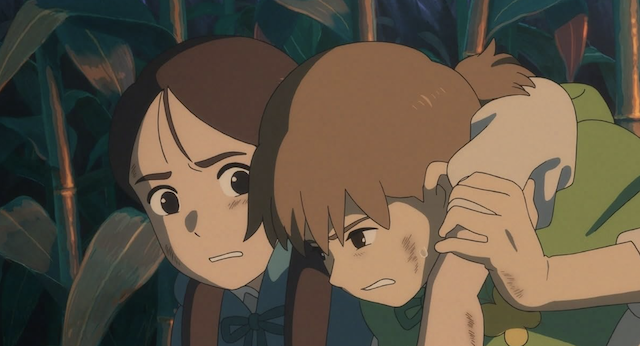
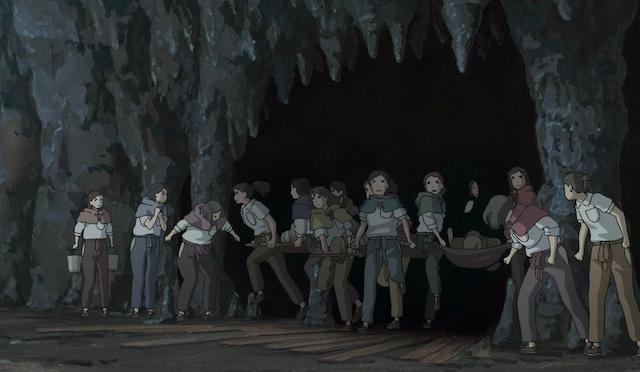
Competition was fierce, but the Battle of Okinawa might have been the most brutal 82 days of World War II’s Pacific Theater. The tragedy escalated and compounded when Okinawan civilians were used as human shields. Propaganda misinformation regarding American G.I.’s directly led to horrific mass suicides, including many of the so-called “Himeyuri Students.” Deceptively recruited from an Okinawan high school and teacher’s college, the young women thought they were being dispatched to a Red Cross hospital, but instead, they were forced to perform triage on the frontlines, under unsanitary conditions, amid the crossfire. Years later, the Himeyuri Students’ fate still haunts the world. They inspired Machiko Kyou’s manga, which in turn director-screenwriter Yukimitsu Ina adapted into an anime feature to commemorate the 80th anniversary of the end of WWII. Cocoon: One Summer of Girlhood is a short but devastating film that GKIDS will release in theaters following its American premiere at this year’s Japan Cuts festival.
San is a shy, sensitive girl, who idolizes her older, far more confident classmate, Mayu. Both understand they must eventually leave their idyllic island to serve as military nurses, but as the film opens, war seems very far away. Frankly, San’s struggle with her insecurities already provide challenge enough for the youngster like her. Then the enemy forces invade, terrorizing the island.
Although the film and Kyou’ manga were inspired by the Himeyuri Students, the fighting that erupts is definitely not the Battle of Okinawa. For starters, it is an entirely one-sided engagement, whereas 1945 battle was one of the hardest fought of the entire Island-Hopping campaign, on both sides. However, it undeniably depicts the fear and hopelesness of the students and other Okinawan women, who were indeed used as human shields and then gaslit by the Japanese military to commit suicide.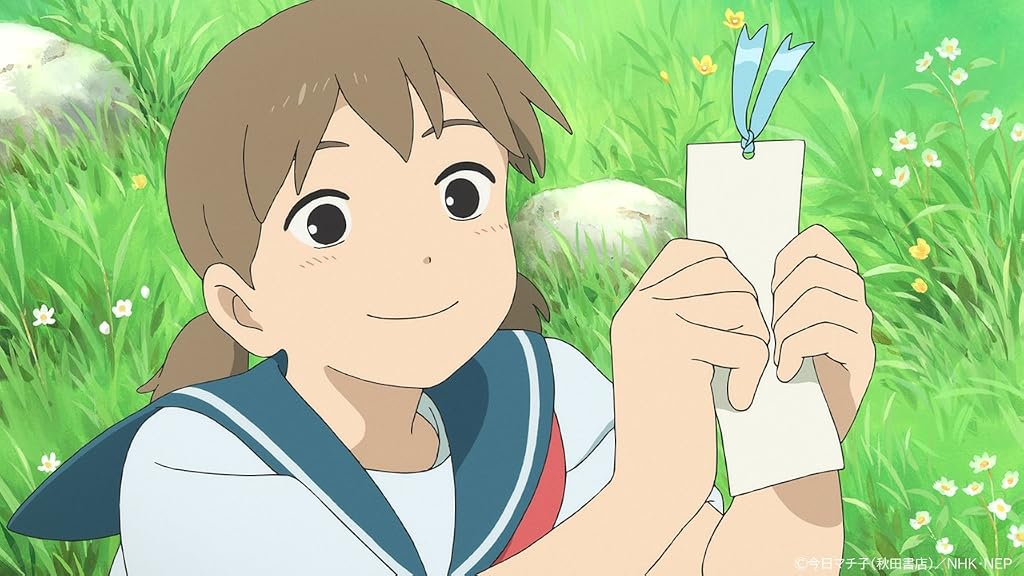
©Courtesy of Japan Cuts
Regardless, few films capture the death of innocence as forcefully and poetically as Cocoon. Throughout the battle scenes, whenever one of San’s classmates is shot, flower petals instead of blood explodes from their wounds. Technically, this technique is not gory, but each instance packs a brutal emotional punch.
Indeed, the animation is absolutely gorgeous throughout the film, even when illustrating the horrors of war. The Okinawa-like island truly looks like a Ghibli-worthy paradise, particularly the picturesque offshore rock formations. Of course, that rather makes sense, considering the animation was produced by the SASAYURI studio, which was founded by Ghibli animator Hitomi Tateno. In addition, Ghibli veterans Akihito Yamashita and Shinji Otsuka served as lead animators on the film, bringing further experience from the illustrious studio.
Honestly, if the beauty of the animation and the earnest vulnerability of the characters do not wreck you, the minimalist but keenly resonant score composed by Kensuke Ushio should finish the job. It perfectly translates the film’s mournfulness into musical terms.
Cocoon only lasts an hour and change, but its distinctive and heartbreakingly elegiac tone remains undiminished as a result. Ina also creates a fair amount of suspense throughout San’s desperate scramble to escape the encroaching foreign army, without getting bogged down in details. Yet, if the film ran much longer, Ina would probably have to flesh out more of the particulars, at the expense of its visual expressionism, which might have watered-down the fable-like vibe.
Given its allegorical nature, Cocoon represents exactly the sort of serious film that maybe only works as animation. Ironically, it is also a good example of Poe’s “Unity of Effect,” in which every element builds in concert towards the desired payoff. Recommended for fans of symbolically charged animation (in the tradition of Flow), Cocoon: One Summer of Girlhood opens in North American theaters this September 4th, via GKIDS, following its sold-out screening at Japan Cuts.
 ©Courtesy of Japan Cuts
Grade: A-
If you like the interview, share your thoughts below!
Check out more of Joe’s articles.