

ⓒCourtesy of Japan Cuts
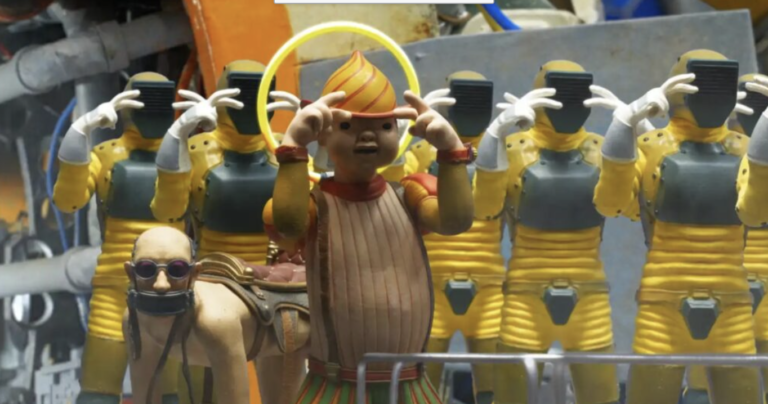
In this prequel, the clones will attack. However, you will never mistake Takahide Hori’s latest stop-motion animated feature for that other film. You might even appreciate it more, if you give it half a chance. Science fiction fans will be hard-pressed to find world-building as inventive and immersive, even in tent-poles with exponentially greater budgets. Filmmaker Takahide Hori returns to the world of his cult-hit Junk Head with Junk World, which had its American premiere at the 2026 Japan Cuts.
Viewers who haven’t seen Junk Head should still enjoy Hori’s new film without any prior knowledge of its strange dystopian world. It is set one millennium before the first installment of his envisioned trilogy, so there isn’t much narrative continuity to worry over. Frankly, the first film was not exactly plot-heavy anyway. It was really more about exploring Hori’s weird and macabre world.
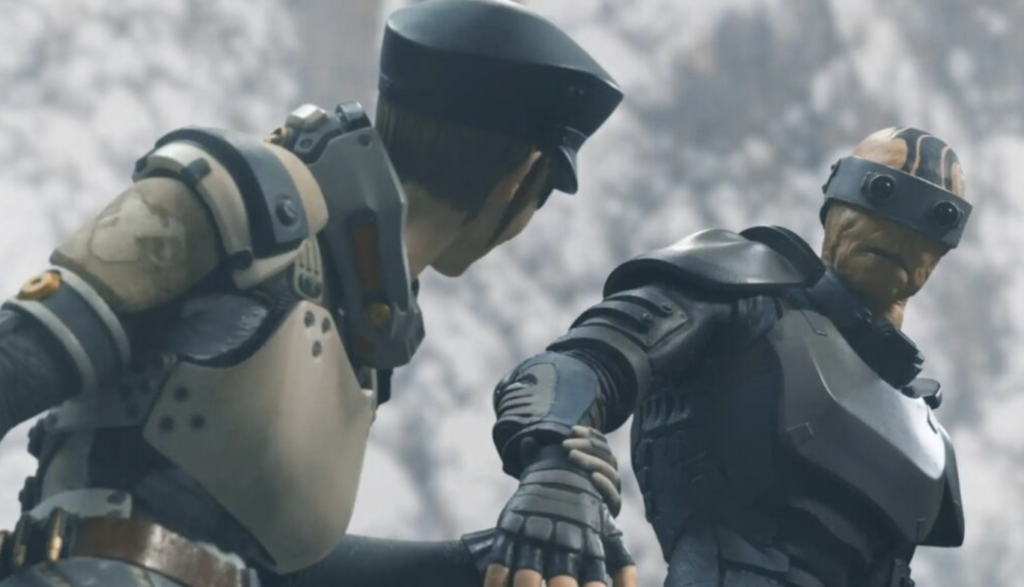
In contrast, stuff happens in Junk World. As the film opens, the humans who live above have forged an uneasy truce with the artificial people known as “Mulligans” who survive below. Originally created to serve as sterile slaves, the Mulligans rebelled against humankind, cloning themselves repeatedly to repopulate their ranks. Peace was brokered but resentment remains. Consequently, the summit meeting called to investigate anomalies detected deep within the planet’s subterranean regions is tense, even before it is attacked by a separatist Mulligan cult.
 ⓒCourtesy of Japan Cuts
Forced to fight side-by-side, the human (mostly) Lady Torys and her personal servant robot Robin reluctantly team-up with Dante, the leader of the loyalist Mulligan military contingent. Unfortunately, they must also protect the clueless human ambassador and his bratty junior aide, as they flee down towards the anomaly.
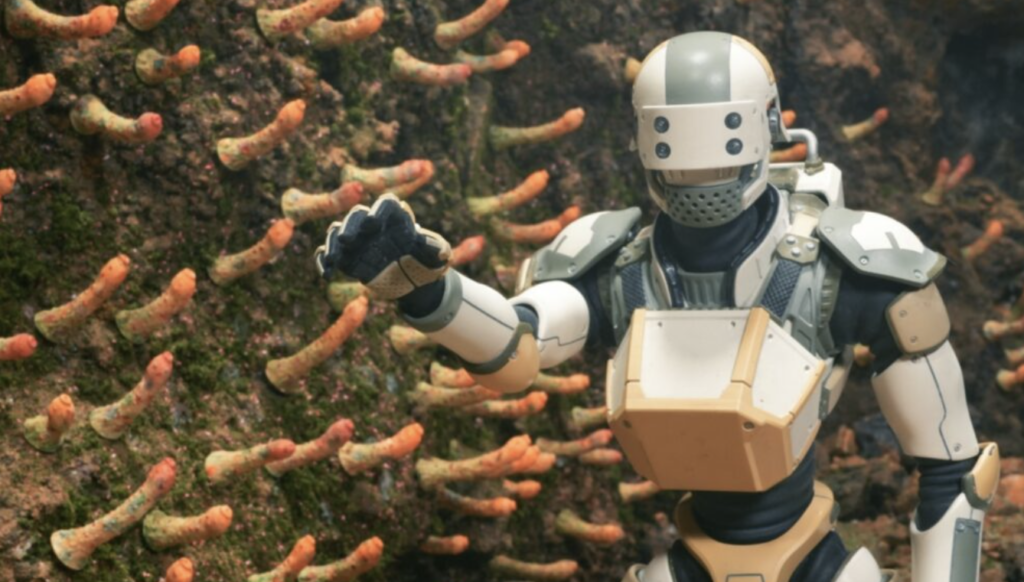
Right from the start, Hori delivers more big science fiction set pieces than the original film. However, he still creates plenty of new and bizarre mutants, whose grotesqueness will surely delight fans of H.R. Giger, who was clearly a major influence on Hori. Honestly, there is so much blood and ooze in Junk World viewers might crave a bar of soap and a bucket of hot water while they watch.
Indeed, Hori’s stop-motion is unusually textured and detailed, as well as dirty and mucky. It is a monstrous world, but a seamlessly rendered one. The same was true for Junk Head, but Hori really raises his storytelling game in the second film.
In fact, when Robin ventures into the dimensional portal during the third act, all the crazy space-time distortions will make audiences’ collective heads spin. You would need detailed story diagrams and intricate, intersecting timelines to explain what transpires in the closing twenty minutes, or so. Yet, it all feels like it makes some kind of dark, twisted sense in the moment.
Frankly, Hori one-ups himself impressively with Junk World. It is an incomparable film from a unique stop-motion animation artist. It might not be for all tastes, but it is arguably more accessible than the first Junk film. Very highly recommended for adventurous fans of animation and/or science fiction, Junk World will surely generate passionate admirers from subsequent festivals following it Japan Cuts premiere.
ⓒCourtesy of Japan Cuts
Grade: A
Check out more of Joe’s articles.
Here’s the trailer of the film.