

©Courtesy of Well Go USA Entertainment
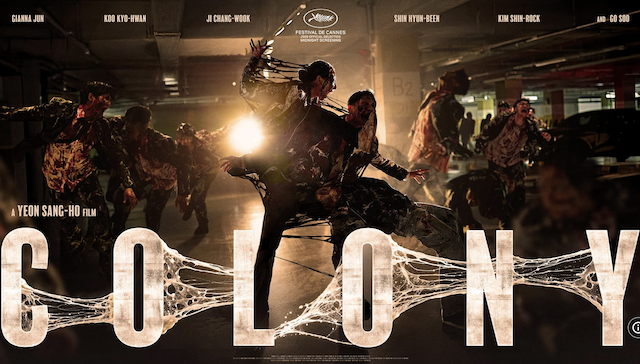
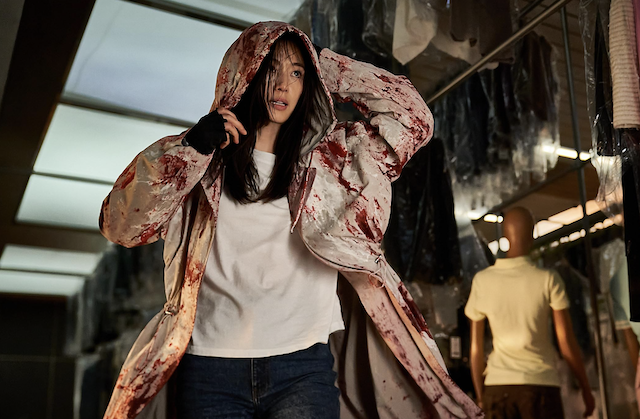
Colony : Horror master Yeon Sang-ho (Train to Busan) directs a new Korean zombie thriller starring Jun Ji-hyun and Koo Kyo-hwan. Professor Se-jeong (Jun) is thrust into a bloody nightmare when a rapidly mutating virus is released during a biotech conference causing authorities to seal the facility. Trapped inside with no escape, Se-jeong along with a small group of survivors must fight to stay alive while the infected undergo horrific transformations.
Director : Yeon Sang-ho
Producer : Hailey Yoomin Yang, Sung Joon-ho
Screenwriter : Yeon Sang-ho, Choe Gyu-seok
Distributor : Well Go USA Entertainment
Production Co : wow point, The Midnight Studio, Smilegate
Rating : R (Bloody Violent Content|Some Language)
Genre : Horror, Action
Original Language : Korean
Release Date (Theaters) : Aug 28, 2026, Limited
Runtime : 2h 2m
©Courtesy of Well Go USA Entertainment
Exclusive Interview with Director Yeon Sang-ho
Q : One of the fascinating things about this movie was the collective intelligence of zombies which is a little bit different from many zombie movies that I’ve seen. Could you talk about how you came up with that concept? What was the motivation behind it?
Yeon Sang-ho: This came about because I was working with the writer Choi Kyu-seok, on the series “Hellbound.” “Hellbound” is actually based on the comics, and we had worked on that “Hellbound” together which also deals with themes of collectivism and a herd mentality.
Choi Kyu-seok and I were having conversations about this, and we felt that in this high-speed information technology era that we’re living in that has given rise to universal intelligence or universal thought, and taking that to the extreme, that becomes a form of AI. And we thought that the perils of what AI brings up in this era is that it really gives no room for individual thought or minority opinion.
And so we thought that it would be fun to make a film, dealing with these themes, and we thought that the subject would be effective in dealing with this. And so that’s how, the concept came about.
Q : What’s also engaging about this film is that because of the virus, obviously they didn’t want it to spread, so whole building became under the quarantine. It’s kind of similar concept from “Train to Busan” because people confined into the one train. I love this concept of putting people in a confined situation because there’s no room to go outside, but they have to figure it out to go outside. So, could you talk how did you come up with this confined location to shoot on?
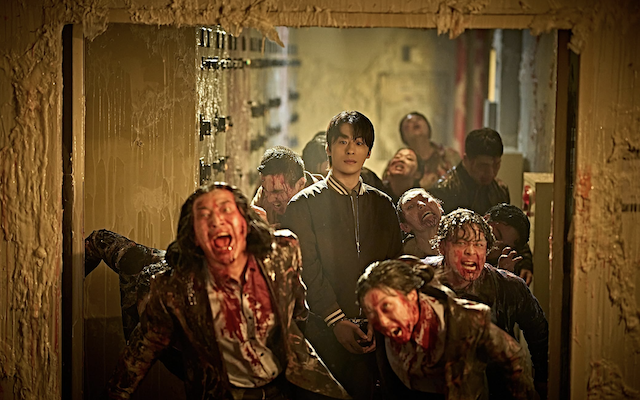
Yeon Sang-ho: Especially for “Colony” what I wanted to portray in this limited space is that it’s been imagined as almost an infectious disaster film. And the comparison that I wanted to make was between two groups in this limited space which is the zombie group and the human being group.
The zombie group represents a group that starts out very primitive but through collective intelligence they fast evolved into a more advanced species. Whereas the human group they start as a civilized group that based on reasoning but due to selfishness or due to individual traits it quickly descends into a more barbaric state.
Q : That’s good contrast, that’s what I find it interesting. It goes different directions. When people in the building got infected, the female character like a Se Jeong played by Jun Ji-hyun or Choi Hyeon Hui played by Kim Shin-rock, their instinct to protect the student across the hall, which is fascinating about this maternal instinct compared to the guy who prefers to shut the door. The comparison between a man and a woman. That was kind of fascinating element that you show at the beginning of the film.
Yeon Sang-ho: In my mind I don’t think of it as like a gendered issue. For example, the character of Koo Kyo-hwan, he’s also a male character who actively seeks out to save the students. So I don’t think it’s a gendered issue in my mind. More important for me, I tried to portray it along the lines of what kind of occupation that each individual had. For example the police character, the police representing, the power of the state.
He is someone who is reluctant to actually take on, that risk even though he’s a public servant and is required to take on that risk. So for me, I think that’s what I was trying to symbolize more was that irony.
©Courtesy of Well Go USA Entertainment
Q : Another element that I find is fascinating is that those zombies have this collective intelligence almost like a human behavior in a certain perspective. But the human also try to outsmart sometimes by putting the false information or setting different odor and stuff like that. So, could talk about the creation of mind game between the zombie and the human by writing a script with a co-writer Choi Kyu-seok?
Yeon Sang-ho: I think I was inspired by AI and the way it learns, the process of machine learning for AI. Because to our eyes, AI is able to learn so quickly. And sometimes, they feel as if they are human, but then sometimes they make these obvious mistakes that human beings would never make. And so I think there is that uncanny discrepancy that happens in that learning process that I wanted to reflect in the learning process for these zombies as well.
I focused on each stage of evolution for the zombies and how the logic changes, for each stage. So each stage is able to give off a different kind of suspense or tension for the audience. For example, one stage can be more action-oriented, another stage could be more mind game-oriented, so that audience is never left, bored or not entertained. And I think, in the modern era that theatergoers are engaging, I was focusing a lot more on the experiential aspect for the audience.
And I think this relationship between the two students symbolizes what Seo Yeong Cheol, the villain says that “The tragedy of human species which is the tragedy of imperfect communication.”
When you look at their relationship throughout the film, there’s a lot of things that they talk about. They talk of apologizing to each other. Their relationship is in the very end, you never know what they’re truly thinking, or if their intentions are actually genuine what their true intentions are. I do feel like it is symbolic of what Seo Yeong Cheol says that “The tragedy of human species which is the tragedy of imperfect communication.”
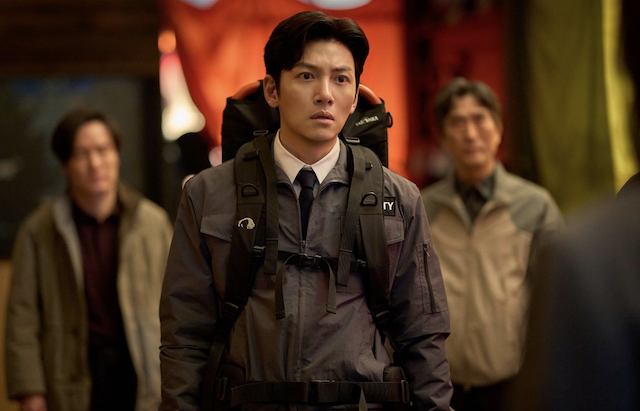
Q : I wanna also ask about the dynamic relationship with two lead characters, ex-husband and ex-wife, played by Jun Ji-hyun and Go Too, I’m curious to know it seems like, ex-wife has still have a feeling in a way, even though the ex-husband kind of moved on having wife and kids.
They’re still actually hanging around having a dinner together sometimes, but did you write their background story more than what’s on screen here? I’m curious to know how because you wanted to infuse the relationship to the actors. Do you also writer background story of ex-wife and ex-husband characters that built up prior to what’s on the screen?
Yeon Sang-ho: So there wasn’t any particular backstory that I had. Something in the script that I wanted to portray was that is a woman of principle, especially for justice. And there’s a line that says that he broke up with her because that was too burdensome for him. But, he is the one who actually goes to save the student in the beginning of the film. That is something that he would do, but he has a family that’s not something that he would do readily.
But I want to think that just by spending those several hours with his ex-wife, her principles and her presence is actually something that is infectious to him.
I think that is a pretty special type of human communication that forms probably unavailable to zombies. The fact that we are able to influence one another in our own presence through our relationships, is a very human form of communication. And I wanted to portray that there.
©Courtesy of Well Go USA Entertainment
If you like the interview, share your thoughts below!