

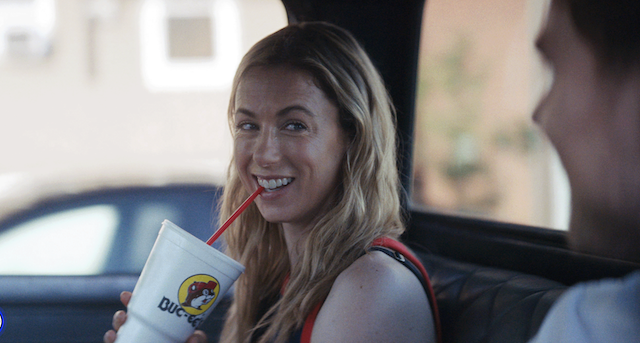
©Courtesy of Sundance Film Festival
The most idiosyncratic take on the homecoming rom-com blends sharp humor with art-house sensibilities. The new movie, Chasing Summer, does just that by sincerity challenging the protagonist’s instinct to deflect intimacy. Both vulnerable and visually captivating, the latest homecoming story refuses to settle for the expected.
Celebrated Sundance Film Festival alum Josephine Decker (director of 2018’s Madeline’s Madeline and 2020’s Shirley) helmed Chasing Summer. Acclaimed comedian Iliza Shlesinger wrote and plays the main character in the new comedy.
Chasing Summer follows Jamie (Shlesinger), a 38-year-old disaster relief worker whose life starts to unravel. Her change in circumstances is difficult, as she’s preparing to leave for a prestigious assignment in Jakarta. She’s shocked to learn that she’s unexpectedly fired from her dream job.
Shlesinger anchors the movie with a performance defined by tightly wound anxiety and fragile self-awareness. Jamie often observes herself from a distance, as she braces for embarrassment before it even has the opportunity to arise.
That guardedness feels intentional, as the protagonist has built her life around leaving before she can be left. But that caution also makes her emotionally cryptic and difficult to understand at times.
As a result, Shlesinger’s comedic sharpness occasionally feels muted. She plays the material more serious than it intended to be throughout the script. But the actress’ commitment to highlighting her character’s varied emotions is undeniable. In quieter moments, she reveals a moment of vulnerability that gives Jamie dimension.
While Shlesinger portray the film’s protagonist, Wareing ultimately provides the project’s emotional stability. The actor plays Colby with a sense of sincerity that isn’t smug. The supporting character proves to be one of the more open, attentive and refreshingly self-possessed people in Jamie’s life.
Wareing’s chemistry with Shlesinger is the film’s most compelling elements; their flirtation evolves from generational jokes when they were in high school to something genuinely tender in the present day. In scenes between them, the movie briefly finds harmony, blending awkward humor with a soft sensuality.
Mullally also shines in the comedy, as she brought sass and nuance to the mother-daughter dynamic. As Layanne, the actress delivered passive-aggressive comments that are perfectly balance with genuine concern for Jamie. A late-act judgment between the two characters hints at deeper emotional stakes than the screenplay consistently sustains during most of the story.
Welling, meanwhile, leans into subdued middle-aged disillusionment as Chase. However, the script never fully justifies Jamie’s lingering fixation on him.
Another stellar supporting turn comes from Freeman, who adds grit as Marissa. The actress’ performance suggests sibling tensions the narrative only partially explores.
Narratively, Chasing Summer treads familiar ground but struggles with cohesion. The story frames Jamie’s past scandal and her unresolved feelings for Chase as defining traumas. However, those conflicts never quite accumulate the dramatic significance the script insists they carry. Her central crisis — returning home to regroup — feels surprisingly minor in contrast to the global disasters she tackles in her professional life.
The romantic arc with Colby is more fully realized. What begins as a mildly absurd fling becomes a sincere exploration of vulnerability and self-worth. Through him, Jamie confronts her habit of transience — her tendency to enter crisis zones, offer aid and leave before deeper attachments form. This subplot provides the clearest emotional throughline and satisfying character growth.
However, shift tonal changes often undercut the story’s momentum. Abrupt shifts between broad comedy, sensual fantasies and near-parody create the sense of two competing films stitched together. The tension between Decker’s art-house impulses as a director and Shlesinger’s punchline-forward writing is both the film’s greatest strength and its central liability.
Despite the movie’s ever-changing tonal changes in its story and character developments, Decker was able to capture the project’s emotional arcs through its visuals. While working with cinematographer Eric Branco, the helmer captured Texas in luminous, humid hues with widescreen compositions that glow with melancholy. The camera also circles the characters in long, fluid takes, which create a tactile sense of longing.
Chasing Summer is strongest when its elements align, such as when Shlesinger and Wareing’s chemistry is naturally captured in Branco’s lyrical camerawork. It may not fully reconcile its artistic impulses with its romantic comedy roots, but it’s still personal and flawed. The movie is an intriguing attempt to turn a familiar homecoming story into a narrative that’s stranger, riskier and occasionally quite moving.
Overall: B
Chasing Summer debuted in the Premieres section of this year’s Sundance Film Festival on January 26 at the Eccles Center Theatre in Park City.
If you like the review, share your thoughts below!