
©Courtesy of Tribeca Festival
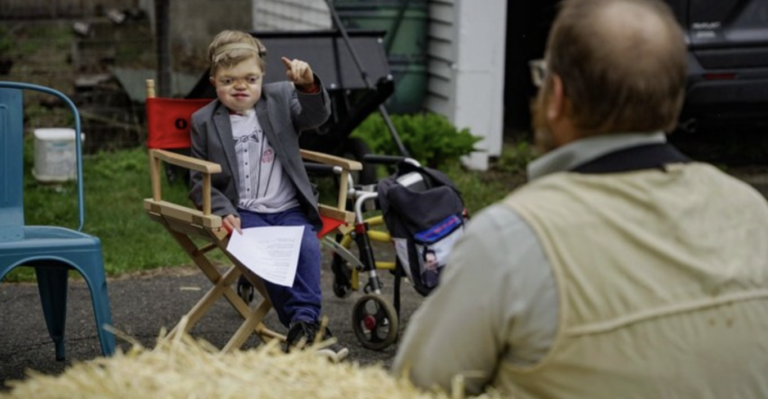
A small body is thrown out the window of a two-story house, followed by shrieks of horror. Has there been an accident? No — the “small body” is actually a dummy and this is the set of a murder mystery project conceived by Oliver, an imaginative preteen who relishes the storytelling process, from directing actors to mixing food coloring and creating fake blood.A rambunctious 12 year old growing up with disabilities, Oliver is often spirited and always creative, using his archive of murder mystery books to craft stories, aided by his parents Casey and Chad, as well as his younger sister Willa. Casey and Chad work hard to create a grounded upbringing for Oliver and Willa, determinedly dealing with Oliver’s extensive medical bills and his physical therapy needs, all while Oliver’s exuberance and passion for storytelling never dissipates. With Oliver’s teenage years approaching, however, a range of new complex feelings begin to surface… as he begins to craft an ambitious murder mystery caper alongside his family and circle of friends.In Kids Like Me, co-directors Cynthia Lowen (Battleground, TF22) and Jon Cohrs capture an endearing portrait of an ingenious boy navigating limitations through his soaring imagination — resulting in a sensitive, big-hearted (and funny!) coming-of-age story.—Jose Rodriguez.
Producer : Cynthia Lowen, Jon Cohrs
Executive Producer : Jim LeBrecht, Grace Lay, Cher Lee, Tony Shalhoub, Jonathan Logan, Meadow Fund, Resonance Philanthropies, Alysa Nahmias, Megan Gelstein, Outlier Films, Adora Cheung, Jason Goldman, Kat Manalac
Sound : Coll Anderson
Co-Executive Producer : Meredith Crowley, Jonathan Weiner, Nicole Page
Editor : Victoria Lesiw
Cinematographer : Jon Cohrs, Cynthia Lowen, Barbie Leung , Jenni Morello
Music : Mark Orton, John Hancock
Cast : Tony Shalhoub
Exclusive Interview with Producers/Directors Cynthia Lowen and Jon Cohrs
Q : I really enjoyed this film, I’m curious to know what was your initiation process. How did you get to know Oliver’s family and how did you get the permission to shoot the documentary?
Cynthia Lowen: years ago, they were visiting us, and every night around the dinner table, Oliver wanted us to do these role plays of murder mysteries. And he would cast us all and say “You’re,” “the murderer, and you’re hiding something,” and, “You’re the jealous person.” And he would create these plots and then direct us in acting out these plots he had in mind.
And I think at that time it was clear that Oliver had this real drive as a storyteller and a real vision for the kind of stories he wanted to see and experience and direct. And knowing the family for so long, we also knew a lot of their, struggles and the challenges that they face. It just seemed okay, I think this is the right time to ask them if they’re ready to do or open to doing a documentary together.
Q : What was engaging about this documentary is that film takes very unconventional filmmaking approach. The film really focus on how Oliver wants to make a mystery movie, and even deal with the serious disability issue Oliver has to face. It captures in a very much light tone throughout the film. And it really made me chuckle sometimes. How did you two decide to make this film to angle this approach? That was really brilliant
Jon Cohrs: It was always important for this to show, the joy of the family, Oliver’s sense of humor. What we showed is Oliver’s real personality. He is somebody who’s constantly cracking jokes and has these one-liners. And so it was natural and the appropriate way to represent Oliver and Casey and Chad and Willa. So it grew organically.
What was difficult for us was, figuring out the right approach to weave together the murder mystery and the documentary. And the key for that was the community and how the community came together to create this murder mystery, and that’s how we were able to move from, a traditional verite type documentary into Oliver’s narrative and creative process.
Cynthia Lowen: One other thing I wanted to add to that question. We spoke with the family before we started, we captured it on camera the first film shoot when we said, “What’s the story you all wanna tell?” What should we do here? What should we do together?” And the family wanted to depict elements of their lives, but Oliver was always really clear, “I wanna make a murder mystery movie.” And I think that was part of the real driver for us to have that dimension in this documentary.
And the other thing about this and disability and his film is that this isn’t overtly an advocacy film, but it is in many ways about equity and access and disability rights. I think what’s so exciting is that we get to enter Oliver’s imagination. when Oliver casts Detective Oliver.
He’s not limited in any way. It’s not like a detective with a disability. It’s like Detective Oliver is Detective Oliver, and he’s gonna go out and solve these problems and tackle these crimes, and he’s not held back in any way by his disability. And I think seeing that dimension of Oliver’s imagination was really important.
Q : I thought what was fascinating about Oliver’s parents, Casey and Chad was that how they parenting about those two kids, Willa and Oliver. When Oliver and Willa fought each other, instead of the parents taking a side with Oliver because of his disability, they made those kids to see each of their perspective, why they fought and everything. What was your fascination about their parenting when you’re shooting, and working together.
Jon Cohrs: I think one thing that I think is really important was to show the complexity, to show the whole family to show how the family navigates their own worlds and so I think it’s important for us to be able to show Casey and Chad both, how they were incredible parents and kinda how they navigate a complex situation. And also just to show the sort of the realness of it, the fact that they have struggles like every family. Chad struggles, kids fight like every kid, every sibling fights. And so there’s also a a normality to it all that I think is incredibly important.
Q : I thought it was remarkable that Oliver attend the school with the regular kids, not with the disability kids. Could talk about their parental decision and how the students and community help Oliver out in a school.
Cynthia Lowen: I think that it was really exciting to be able to follow Oliver at his public school. It’s very difficult to get access to film in public schools with young people just because of permissions But we were really lucky and I think because I’m from the community and this was my school system as a kid. They welcomed us in. And I think what we saw was really something that is the way it should be. That Oliver is able to receive care for his medical needs in class. He’s not segregated. He’s not removed from the classroom when he needs to have his tracheostomy tube cleared, or when he needs to be fed, he uses a feeding tube. He doesn’t miss academic time. He doesn’t miss social time.
I think was like a model of what we hope educators can take away from this film is that kids really thrive when they have the resources and are equipped, and when schools are equipped to to provide these services. And unfortunately, this is not like this in the whole country or most schools in the whole country.
This happens to be a public school that has the resources to provide these things. Oliver’s aide is provided by the school. Some people have asked, “Oh, does his family pay for Christa(Supportive aid person) to be with him?” And no, this is part of the care and accessibility requirements that the school is meeting.
But again, it’s really unequal throughout the United States. It depends a lot from district to district on funding, and there’s a lot of states right now where the federal funding that supports the kind of resources that Oliver accesses is under threat. In several states, nine states are trying to strip away this federal funding.
That is another kind of advocacy dimension of the film that within the film itself is very subtle, but within the work that we’re hoping to do with this film so that this film has purpose, that’s a big part of saying these are the kinds of resources that we want young people with disabilities to have access to in their public schools.
Q : Speaking of community and support from Montague, Massachusetts where Oliver’s family resides, I think sense of community and personality were really helpful to Oliver. What was it like shooting that location, and how the community support Oliver there?
Jon Cohrs: I think there’s so much that we didn’t show. Yeah … for Oliver’s 10th birthday, the town had a parade. A murder mystery parade where everyone dressed up. I think the community-
Cynthia Lowen: The police closed the streets down- and participated in the parade.
Jon Cohrs: This was the height of the pandemic, and so it was an incredible opportunity for people to come out and celebrate together. This was done in part by Oliver’s inspiration and love of murder mysteries.
It’s a small community that’s very tight-knit. It’s a very sort of creative and, quirky community. in a beautiful way they jump at any opportunity to participate and create these social events that you see partly in the film.
From our perspective in terms of filming it it’s just a matter of being around Halloween is infamous in Montague. So we of course knew that shooting Halloween was something that we had to do. And it’s really special there. And I just think over the course of filming we were able to capture a lot of great events. And I think-to such a degree that we actually had to make some difficult choices. In the filmmaking process of things that we did wanna include that, you just at some point…can’t.
Q : Could you talk about his relationship with his favorite show “Monk”, and how did you two get Tony Shalhoub to involve with this film, not only to appear in the film, but also become an executive producer in this film? So, Could you talk about his likeness of the show and the relationship with Tony Shalhoub?
Cynthia Lowen: Yeah. So “Monk” is interwoven into the film and Oliver’s life in a very organic way. you enter their house, and there’s “Monk” books everywhere. Oliver’s very likely to be watching a “Monk” episode on his tablet. Oliver’s sort of always telling us, we’d be in the middle of shooting or trying to ask him about something, and he’d wanna tell us about a “Monk” episode.
So there were just so many little moments where he had mentioned Monk, and then as he was developing his murder mystery, he was like, “Oh, w- like, if we could get Tony, that would be incredible.” And so what we did was we found a connection to Tony through our executive producer, Jim Lebrecht, and we edited a little short piece of Oliver having all these little moments of talking about “Monk”. And when we sent it to Tony, he wrote back,”Oliver’s biggest fan.”
Jon Cohrs: Yeah.
Cynthia Lowen: And then from there agreed to be an executive producer and also to be in the film, and then came to the premiere, and yeah, it has been great.
Q : I’m not really familiar with the hearing aid kit called Baha(a premium-power hearing device) which is bone activated hearing aid, could you talk about how that’s helping Oliver, and how that’s actually affecting other disability kids that have same actual disability?
Jon Cohrs: It’s something that he wears on a band on his head.It has a microphone, it picks up sound and then it creates vibrations that he can then through bone conduction can hear. And it has, I think it’s Bluetooth enabled, but there’s a wireless component of it. I’m not sure if it’s Bluetooth or wireless, but basically it enables teachers and aides to be able to talk to him directly through a microphone so that he can participate more directly in the classroom.
Because the bone conduction device does a great job of amplifying sound, but it’s not quite as clear. When there’s clapping or broadband noise, it’s a little bit difficult for Oliver to pick out conversations. And so that’s partly why the wireless component is added and then I think, what was the second part of your question? I’m trying to remember what you asked.
Q : How this hearing aid kit helping other kids with the disability.
Cynthia Lowen: Oliver points out that his teachers wear a microphone, so that the sound is conducted directly into his Baha. This is another example of a tool made available through his public school that supports his education, and his access to being in, a general education environment.
Q :.I think it’s physical education class or something that Oliver is exercising, doing movement with other kids. I thought that was fascinating that he could join and perform. So, could you talk about shooting that sequence and how, the teacher and student takes extra careful about Oliver’s movement and all that.
Jon Cohrs: I think that was just one class like any other class that we shot, and we followed Oliver through many school days. I think from a school perspective, we had to clarify things in advance with teachers and administration, and so we had those conversations prior to shooting.
In terms of the actual process of shooting, that was just shooting Oliver and part of his daily routine at school. We had filmed many other classes. That one had some nice moments, particularly with his classmates and with the teacher.
Q : I have to ask you two as a filmmakers, what are the elements that fascinate you about the Oliver’s filmmaking?
Cynthia Lowen: That’s a good one. For us, we’d never made a murder mystery movie before. Oliver said you’ve come to the right place.” ‘Cause he knows the genre. So I think just understanding the cozy mystery genre, and the rules where the crime is always solved- there’s always this satisfying answer.
I think that was an interesting counterpoint to some of the things that are expressed in the documentary, where Casey says, “Looking for answers that don’t exist is not the way that I can live my life.” there was this inherent tension, between the parents coming to peace with the unknown- and living day by day with whatever the challenges might be that Oliver or their family is facing, and trying not to, Casey says, “Future cast,” trying not to imagine too much or become over attached to what she might think the future is and existing with the unknown.
And Oliver, on the other hand, loves these forms of mystery where you know there will be an answer, you know that the things will be solved, you know that there will be satisfying closure, and I think that was a tension that we were interested in exploring as these two counterpoints to their lived experience.
Jon Cohrs: I think something else that was fascinating for us is how… the degree to which he strives to be a student of the genre. He takes enormous amounts of notes. He has summaries of every episode that he’s watched. He really understands these structures with detail and has ideas for murder mystery scripts. And so the depth and understanding and detail that he has with the genre and his love of it is real. It’s real and exciting to be a part of.
Q : In the film, talk about the parents, Casey and Chad, they are both in the educational field. I’m curious to know how their work in a actually educational field helped to treat their own kids. Did they talk about any of the effect of their work that helping those two kids that they are raising? Do they also talk about any of the their work? Because I don’t think we see that much, but I’m curious because their perspective is kinda important to raising a kid as well.
Cynthia Lowen: Yeah, I think Chad really brings a lot of interest in talking to young people about history, and civil rights, and social justice, and understanding a lot of the tougher history of the United States. And I think that he really comes from a background of advocacy and awareness around issues of equity structural inequity. So something that for them that they were really aware of was their own privilege. That they understood, they as middle-class white folks who have education and live in Massachusetts-
Live in Massachusetts ands have access healthcare.They had access to things that other people in different situations and different backgrounds might not have. Moving ahead, we’ll see what happens with the film and how they are interacting with it and the world around it.
For Chad the social justice and the awareness of privilege is really important for him. And in raising their own children, that comes into play. And wanting to treat Willa and Oliver with equity and not treating Oliver differently in how they parent, and their expectations, and their enthusiasm to encourage both children to chase their dreams.
Q : The film was showing at Tribeca, how was the reception there, and how do you want audience to take away from this film?
Jon Cohrs: What are your answers?
Cynthia Lowen: The film’s been great. We’ve been getting really… The audience reactions have been really wonderful, and people have been very moved and really seem to connect with a lot of the different themes in it.
A lot of people connect to the sibling relationship, and sibling rivalry and that tension. And other folks connect to the experience of being parents and the challenges of being parents. Other people love murder mysteries. So I think it’s been really cool to see just how everyone has a way to have an entry point.
I think what we want parents and audiences, everyone to take away is to examine their own communities with an awareness for the barriers that might exist for young people to pursue and chase their dreams, and to have a stake in dismantling those barriers
Q : How about you, Jon?
Jon Cohrs: I think what’s important for us is that, there’s a profound joy in the whole process, in the family, and that we really want that to be conveyed in the film, in addition to some of the more challenging topics. I think that’s always been important for us, and I think that’s also one of the strengths of a cozy murder mystery.
Q : This was really educational and enjoyable film, and I’m pretty sure you guys gets a lots of accolades in award season later on, thank you so much for your time, Jon and Cynthia.
Jon Cohrs: It’s good to talk to you.
Cynthia Lowen: Thank you, take care.
If you like the interview, share your thoughts below.