

©Courtesy of Tribeca Festival
Mexicanamerican : Expertly merging old VHS home movies with new family interviews, filmmaker Eddie Sánchez traces his parents’ journey from Mexico to the U.S. in this poignant and affecting documentary debut.
What is the cost of the American Dream? Filmmaker Eddie Sanchez sets out to better understand his parents, Lalo and Beby, in this astonishing debut feature documentary, providing a unique, complex and emotionally resonant visual answer to that question. Expertly merging original interviews with the two as they discuss their courtship, their journey to the United States and what their lives were like once they arrived, including the VHS home movies Lalo and Beby once sent over the border as a means of “visiting” the family members they couldn’t physically be with, Mexicanamerican is a decade-spanning collage exploring the cultural and emotional cost of migration.
This poignant and affecting documentary stands not only as a love letter to those whose sacrifices often go unknown and unnoticed but also as a reckoning of what is lost when we don’t ask questions.
Cast & Credits
Producer : Michael Rogerson, Eben Sánchez
Writer : Eddie Sánchez
Sound : Justin Enoch
Music : nudo
Cinematographer : Eddie Sánchez & Eben Sánchez
Editor : Eddie Sánchez
©Courtesy of Tribeca Festival
Exclusive Interview with Writer/Director/Editor Eddie Sánchez
Q : Hey, Eddie. Thank you for doing the interview. I appreciate making the time with me.
Eddie Sánchez: Thank you so much for having me.
Q : Yes, Congratulation for the Audience Award at Tribeca Festival.
Eddie Sánchez: Thank you.
Q : So, what’s your reaction? How do you feel about it? Did you tell it to your parents already?
Eddie Sánchez: Yes, they were the first people I texted. We’re surprised and happy. And I think it just goes to show, how many people connect with this film in a personal way. And I feel fortunate that folks are connecting with it in that way. I’m just so happy.
Q : This film is really served as a love letter to your family. And hopefully that’s transcending to many immigrants people in the US. Could you talk about the initiation process? What was your tipping point to decide to make this film?
Eddie Sánchez: I think for me, the real starting point was the guilt, that I carried as the son of two immigrants who were very rooted in the culture that they originated from- but who as a kid trying to just fit in and grow up in America, I saw their way as old school. As opposed to just being a different culture. Yeah. ‘Cause that’s how you respond to your parents.
I think it’s the music that they like the TV and the movies that they like. They’re almost passe, but I think that complicated things here because it’s not just that it’s a different generation, it’s a different culture entirely. And so I think that me trying to fit in with what was mainstream in America led to me inadvertently disregarding my heritage.
So I wanted to do this not just as a way of getting to know my parents more- … and as a way of honoring my parents, but as a way of honoring where they come from.
Q : I was amazed how much archival footage of your family. They’re videotaping from your early age. Could you talk about how much footage you guys have, how did you narrow it down. Talk about the editing process because it seems really a daunting process, I imagine.
Eddie Sánchez: Yes, the editing process was insane. So we had about 30 hours of home videos. I just went through video by video, taking notes- And at first, the process was looking for things that I found to be cinematically impactful.
Not even in an intellectual way, not even in a way where I could reason why it affected me emotionally or viscerally or even before I knew what the narrative was. I wanted to figure out, what are the puzzle pieces I’m working with? What is unique of the footage? What is actually worth showing on the big screen in a movie theater?
This is not professional footage, right? My parents aren’t cinematographers. But very often, they almost stumble upon these moments of poetry, of beauty in this banal footage, there is really phenomenal stuff. … And I wanted to separate all of that footage, so I had all these little clips.
Some of them would be three minutes long. Some of them were just a few frames. So once I had that, then I took the interviews and rearranged all of their answers, all of the questions, in something of a narrative. Trying to figure out, I think people will find that the structure of the film is very stream-of-conscious.
Because I think it, it jumps from one idea to the other loosely- but intentionally. And that comes from me trying to put together their interview responses in a way that made sense with these hinges in between of “Oh, we were just talking about our grandparents.
Let’s talk about how my parents felt about them.” But once I had the interviews set up, then I figured out “Okay, which of my puzzle pieces from those videotapes will fit underneath that voiceover?”
Q : Throughout the film, there’re some jump cuts. Sometimes footage says play mode, and some of the footage has some static sound. But all the footage seems very daring to me, could you talk about leaving that way? How do you choose the aesthetics choice that way? Because I thought that was really brilliant choice as well.
Eddie Sánchez: I think that there were often times when I was just watching the videos without me touching the videos-, where the home movies would have these hard cuts just because, when you’re taking the footage, you’re not thinking about when you’re pressing record and not.
And I really wanted to lean in to the aesthetics of VHS. I really wanted to embrace that because I feel like there is a universal charm to it. That I think people from a certain age are so enamored with the nostalgic qualities of VHS tape, and I wanted that to be included in the way that the footage was cut.
Yeah. I wanted it to have that herky-jerkiness because I wanted to imitate some sort of, verisimilitude of how how cut- cutting works on VHS, but also because I felt like it, it gave it this energy, it gave it this edge. And I think some of my favorite moments in the VHS tapes were the cuts to the commercials and the TV broadcasts from the videotapes.
When you put a VHS tape in a VCR and you’re just kinda flipping through channels, and sometimes you accidentally record over your wedding video and it’s just like a broadcast. I felt like all of those little pieces of media that I threw in there as well also spoke to the media diet that I had versus what my parents had- what they were watching on TV, what shaped their identity, what shaped my identity based off of what we were watching. ‘Cause that’s ultimately, like I said, I feel like we all become who we are based off of what we’re consuming. So that was also part of the idea.
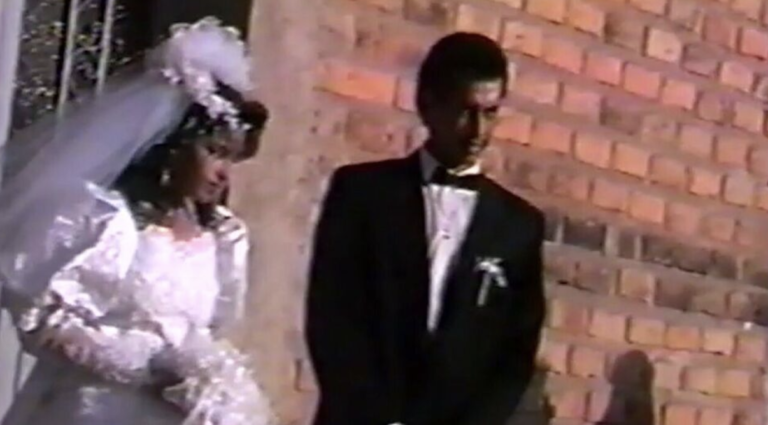
Q : That was interesting, I thought it was really funny when you asked your parents about their first kiss. Mother and father has a different reaction. So, could you talk about when you heard this story for the first time. It made me cracking up, but I understood about mother’s position, obviously she’s coming from a authentic Mexican household.
Eddie Sánchez: The first kiss was something that I knew was true, and I wanted them to get into it because I thought, A, it was a great way to introduce them.
For those that haven’t seen the film yet they had their first kiss on their wedding day. And I always thought that was ridiculous just growing up But to them, that is the culture that they grew up in, and that was the norm, right?
I thought it was a great introduction to them, because my dad was being very funny and said “No, wait, that’s not true. We ha- we kissed a little bit before,” but I think he’s probably just embarrassed. But I think that it’s a great introduction to them and the world that they come from because it is foreign even to me as their son. And I think that it also just showed how lovely they are and it just makes their romance, all the more remarkable. I think they have a very strong marriage and love for each other and I wanted to get that across as well.
Q : That was a really interesting way to show their characteristic in the beginning. That was a really entry point that was really successful. Let’s talk about your mother because she was coming from 14 sibling. That’s a lot. She was talking about the last three kid was born in a hospital, but rest of the kids were born in the home.
Eddie Sánchez: Yes.
Q : Is it typical to giving a birth in their home in the Mexico, particularly in a certain rural area back then? Because oftentimes when the kids grow up with more than 10 sibling, they have to take care of their own younger children, and they have to clean up their house from very early age, and do all the house chores. So, could you talk about her experience, because I thought that was a really engaging elements about how she grew up in the Mexico.
Eddie Sánchez: My parents both had a lot of siblings my mom was one of 13. They were very impoverished. Only the last three were born in a hospital. A lot of them had to share beds. it meant a lot more responsibilities for especially the women in those families.
They had to do all the house chores. It was expected of them after they come home from school to do work in the kitchen luckily I have seen their hometowns modernize a lot over the past several decades. What’s funny is that all of her siblings, all of their children, all of my mom’s nieces and nephews on her side of the family grew up to become doctors. It’s,
Q : Oh, really?
Eddie Sánchez: So it’s this isn’t in the movie, but I think it’s a real… It goes to show how things change in Mexico as well, there is also this modernity that exists in that part of the world. That it’s not just oh, America is what’s modern. But I think that is also the reason why they came to the United States It is because of that poverty, like meat was a luxury to them. and I think it really shapes who they are…and what they valued when raising me.
Q : When your parents arrived in Oregon, nothing was in Spanish. not a choice of bilingual, not even the Mexican food. Could you talk about how they are adjusting when they arrive in Oregon, they’re trapped in the house and are watching American TV to learn English. I’m curious what they trying to have fun back then there’s not much of Spanish cultural circumstances there. So talk about how they’re having the fun, what they are adjusting to the US back then?
Eddie Sánchez: Yeah. No, back in the day, it wasn’t like it is today this was before Univision was on TV, Spanish language TV.
And so I think the reality is my dad, when he first came in, he didn’t really do anything for fun. They didn’t really go out. it was also the goal was to save money. they would spend some money on clothing. They would I think my dad has a line in the movie, something like, “We would go…
What we did for fun was go to Kmart.” And they would go to buy some stuff, but they wouldn’t wear it because they wouldn’t be going out. When my dad was coming to the US to work in those early days, it was purely to make money. And then they would come back to the US after six months or a year and spend that money at home. They’d pay for their weddings. They’d be able to pay for houses they’d built.
But it really was just absolute boredom. They would call their family back home, and that was it. That’s how they kinda spent their time, writing letters, making phone calls. And it wasn’t until maybe the late ’90s where that started to change.
©Courtesy of Tribeca Festival
Q : When you heard about your parents’ story about how they’re crossing the border, particularly mother story towards the end, it’s incredible story. So, could you talk about the sacrifice they made to actually came to US and making not only their life but also your life better.
Eddie Sánchez: It is incredibly difficult to come to the United States. The process, we don’t really get into the details of what it takes but it is incredibly difficult. the limitations that are in place are very strict.
Where they came from, they came from a lot of poverty, what they would work in a week in the United States would take them, three months to make in Mexico.
It would be for way more difficult work, like a lot more backbreaking labor in Mexico than it would be in the United States. they came from this town where every young man would go to the United States. It was almost like, my dad puts it like it was like going to college.
This rite of passage where once you were 16 or 17, you would start making these six-month-long trips year-long trips to the US and back, But they didn’t want that for me. my mom had to make this sort of very difficult decision of she was the only one in her family at the time to be in the United States.
Nobody else had made that decision. from my mom’s side of the family, it was very difficult, but she knew that- There was more opportunity in the United States, and she wanted that for my siblings and I. She wanted us not to have to worry about how are we gonna cross the border, how are we gonna make that money, it endangers your life. It’s very risky to do that sort of stuff. Especially given the types of people you have to hire.. and get help from in order to do That’s, that was their logic.
Q : In the movie, if your father mentioned that his parents visit them when they moved to Oregon, but some of the sibling have never got together in the one places after your father left to Mexico, so could you take about how difficult to actually get whole familt together at this point, because they are living Mexico, rest of the families are living actually all over the US.
Eddie Sánchez: Like you said, my eldest uncle on my dad’s side was the first one to come to the US. And ever since he did that, my dad is one of seven, and his immediate family has never all been reunited since then.
Now my grandfather on my dad’s side has passed. So that opportunity is no longer even available to them, for them all to be together. And this is the issue with mixed-status families. I have aunts and uncles in Mexico It’s not that they have any visas or anything. And luckily everybody in the US now they are citizens, and they can go back. But even then there’s also the issue of money, of paying for being able to come back to the United States. And so it still hasn’t really happened. And that’s something that my mother was very frustrated by, that’s not a unique story. A lot of families have had to deal with that because of how difficult it is to be able to cross that border- safely and legally.
Q : And now it’s the Trump situation making harder than what’s used to be.
Eddie Sánchez: Unfortunately.
Q : I’m curious to know, your brother Eben helped to produce, and also did some cinematography in this film. So, could you talk about how did you two divvy up your chores, how did you two make this film?
Eddie Sánchez: So in the beginning, the very first interview we had, when it was like almost a completely different idea for the movie, it was during Covid. And so I live in New York City that’s where I am right now. They are in Oregon, so I had to Zoom, because it was Covid, he was my person on the ground. So basically, I had these ideas, I had the questions to ask my parents. But Eben, my brother and co-producer was the one who executed everything on the ground in person. At least for that first interview.
And that’s why he also has an associate director credit, because he had a lot of control over how the camera was set up and how we were gonna do things. I wanted to make sure he had that credit. But then, as the years have gone on, I’ve been able to visit my parents with my own camera.
From that point on, he also was the sound mixer during production. We’re a small crew. We didn’t have any budget to work on for this film. Some of the other crew members are just my cousins who were volunteering.
I’d ask my cousins to come visit us, and just hold the camera this way for a second, and that was it. So he really was, a major part of the creation of this film.
Q : This film won the audience award at the Tribeca. Now that you made the documentary about your family, how do you wanna move on? What kind of film that you wanna make in the future?
Eddie Sánchez: I have a background in narrative, so the next film I wanna make, I would love to make a narrative feature. I have a few ideas already. what I’ve learned from this experience is that I lead with emotion.
I lead with sentimentality sometimes even. I’m not afraid of sentimentality. But I think the thing that fascinates me most thematically is borders. not just the literal borders like the ones in my film. But like the borders that separate us. in this movie, what separated me between me and my parents?
What, where did that distance come from? Why was I not as interested in the things they were interested in? But also other borders like class, like gender race, ideology, These are things that fascinate me, and I have an idea for a feature that is it’s a coming of age romance.
But it’s about these two high school sweethearts who live in the same trailer park, and one gets the opportunity to go to university in New York in a very prestigious university, and the other can’t afford to go to school. So that’s just an example of these- divisions where, like, all of a sudden these two people who love each other now have this thing dividing them that is very class-based and very based on education. I think that’s the filmmaker I wanna be, and what I wanna keep exploring.
Q : Yeah, that would be a great idea because there’s so many Spanish community in the United States.
Eddie Sánchez: Yes.
Q : This will be the last question. I wanna make it quick how do you want the audience to take away from this film?
Eddie Sánchez: I think it’s twofold. For one part of my audience, if you have never experienced immigration or if you don’t even know anybody in your community who has gone through that experience, I would love for this to offer folks some insight into it.
Without the politics, without the nitty-gritty of the systemic issues the policies at play, I just want it to be this sort of text that people can refer to to realize these are human beings making very human decisions based on what they love, what they fear, et cetera.
I think the other half is if you have had these experiences, if you come from a family like mine, I want this film to offer you catharsis, a catalyst for conversation. Especially because I personally don’t think I’ve seen a film capture these experiences in a way that was true to me. So I wanted to make that for other people.
Q : I had a good time talking to you, Eddie. Thank you so much for making the time with me. I truly appreciate it.
Eddie Sánchez: Thank you, this was great.
If you liked the interview, share your thoughts below!
Check out more of Nobuhiro’s articles.
Here’s the trailer of the film.