


ⓒCourtesy of the New York Asian Film Festival
Combining visceral horror with sharp social commentary can often transform familiar genre conventions into a more ambitious story. Writer-director Yeon Sang-ho returns with Colony, a zombie thriller that reinforces his status as a distinctive genre filmmaker.
Following the success of his 2016 horror movie, Train to Busan, Yeon proved the apocalypse can explore themes beyond survival. His new drama uses the destruction of society to examine social conformity and the frightening consequences of collective thinking.
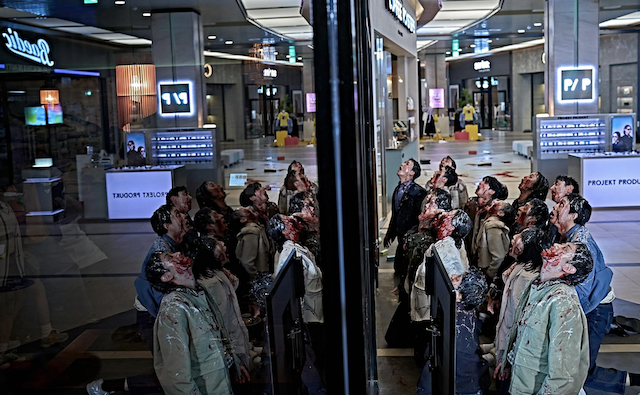
The infected in Colony are frightening not simply because they are violent, but because they represent the complete surrender of personal agency. They move with a shared purpose, responding to an unseen force rather than their own instincts or desires.
In doing so, the thriller expands the traditional zombie metaphor into a broader critique of social systems and mass behavior. The story emphasizes how easily people can be drawn toward ideas and movements without fully understanding the consequences. Yeon’s apocalypse is not only about survival against monsters; it is about the terrifying possibility that humanity can become its own collective machine.
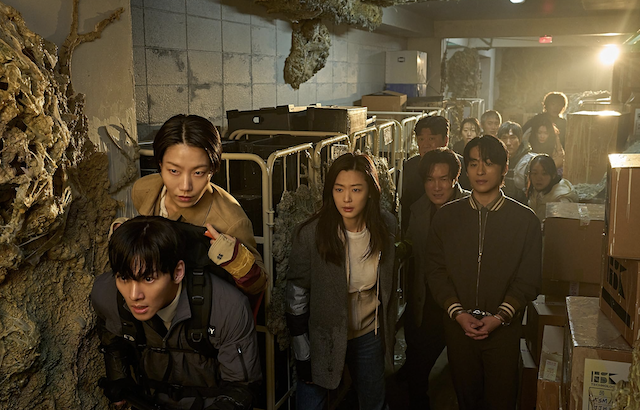
That theme is reflected most powerfully in the film’s striking visual language. Yeon introduces a distinctive addition to the zombie genre through a mysterious white, string-like substance that emerges from the infected and spreads across their bodies and surroundings. The material gradually overtakes walls, floors and entire sections of the environment, transforming once-familiar spaces into something grotesque and otherworldly.
The film’s primary setting – a sleek office complex with a shopping mall at its base – becomes a showcase for Yeon’s ability to turn ordinary architecture into a landscape of horror. What begins as a polished, modern environment slowly mutates into a nightmare vision, with the strange organic substance creating an atmosphere reminiscent of the biomechanical grotesquerie associated with H.R. Giger. It’s an inspired creative choice that gives Colony a distinct identity, allowing the feature to stand apart from its many zombie predecessors.
ⓒCourtesy of the New York Asian Film Festival
The technical elements are among the drama’s strongest achievements. The makeup, costumes and visual effects combine to create infected creatures that feel like part of a larger biological system rather than conventional horror antagonists. The production design plays an equally important role, with every visual detail reinforcing the film’s themes of assimilation, contamination and the disappearance of individuality. The result is a world that feels simultaneously familiar and alien, grounded in reality while constantly pushing toward surreal nightmare imagery.
At the center of this chaos is Jun, who delivers a commanding performance as Kwon Se-jeong, an unemployed scientist who unexpectedly emerges as a leader during the crisis. Jun brings considerable depth to a character whose transformation becomes one of the movie’s emotional foundations. Initially defined by uncertainty and isolation, Se-jeong gradually develops into a determined figure capable of inspiring those around her.
Jun’s performance is especially effective because she avoids turning Se-jeong into a conventional action heroine. Instead, she portrays a person forced to adapt under extraordinary circumstances, carrying fear and doubt alongside her growing sense of responsibility. Her evolution gives the thriller a strong emotional center and provides a human perspective amid the overwhelming scale of the disaster.
The ensemble cast further strengthens the film. Koo Kyo-hwan delivers a memorable turn as the story’s antagonist, a figure whose motivations initially appear understandable before gradually becoming more extreme. Koo brings complexity to a character who is not defined by simple villainy, but by the dangerous progression from desperation to obsession. His performance adds another layer to the drama’s exploration of how fear and conviction can become destructive forces.
Supporting performances from Shin, Kim and the rest of the ensemble help maintain the movie’s emotional momentum. Each character explores survival, loyalty and the choices people face as society begins to collapse.
Yeon’s greatest strength has always been his ability to balance genre spectacle with emotional urgency. Train to Busan became a worldwide phenomenon because it paired relentless action with genuine human stakes. Colony continues that tradition while pursuing a darker and more philosophical direction. His new film is less interested in the mechanics of the outbreak than in what the outbreak reveals about society itself.
While the zombie genre has become increasingly familiar, Yeon finds new possibilities within its framework. Colony is not simply another story about the dead rising. It’s a story about the living losing their sense of self. Its most chilling question is not whether humanity can survive an apocalypse. The most unsettling exploration delves into whether survival is meaningful if individuality disappears in the process.
The ambitious Colony confirms Yeon’s status as a filmmaker capable of using genre cinema to explore complex social anxieties. With its inventive imagery, impressive craftsmanship and timely themes, the project emerges as a standout zombie thriller. It delivers the expected thrills while offering something far more unsettling beneath the surface.
Colony had its North American Premiere on July 10 during the New York Asian Film Festival (NYAFF). The feature served as the festival’s Opening Night Film. The screening included an introduction and Q&A with Yeon and Jun. The latter won the Extraordinary Star Asia Award Recipient at the festival.
ⓒCourtesy of the New York Asian Film Festival
Overall: A-
If you like the review, share your thoughts below!
Check out more of Karen Benardello’s articles.
Here’s the trailer of the film.