

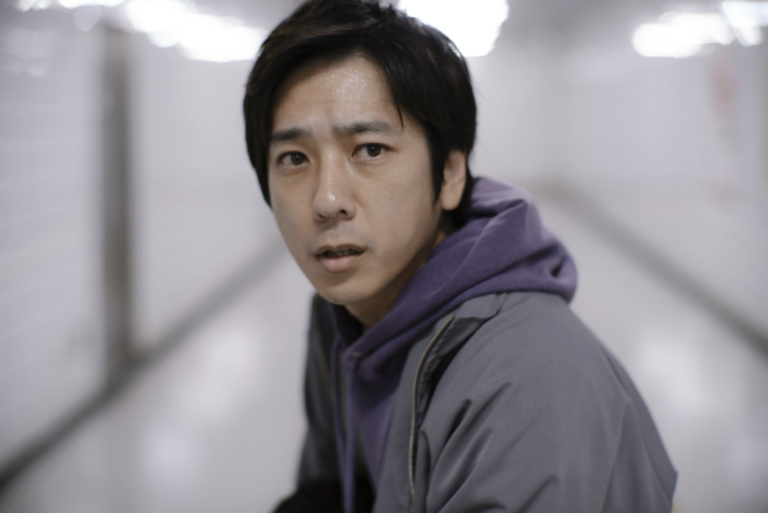
©Courtesy of Neon

Q: Mr. Kawamura, as a film producer, you’ve brought to the screen animated films such as “Your Name”, “Suzume*, as well as live-action films like “Confession”, “Villain”, and “Monster”. As a novelist, you’ve also written “If Cats Disappeared from the World” and “April Come She Will”. Could you tell us what inspired you to adapt the video game “Exit 8”, which you’re turning into a film? I hear Dante’s Divine Comedy also influenced you to some extent…
Genki Kawamura: That’s right. I played it myself right after it came out and thought the design was incredibly interesting. At the same time, I watched a ton of gameplay videos on YouTube featuring all kinds of people playing it. That’s when I realized there were as many stories as there were players.
Even though it’s such a simple game, it really brings out people’s true nature—so it felt to me like a space akin to Purgatory in Dante’s Divine Comedy.
The idea that humans, trapped in this looping purgatory, confront the sins within their own hearts through these anomalies—that outer shell of the story began to take shape, and I thought, “Maybe I could turn this into a movie.” That was the starting point.
Q: I haven’t played the game myself, so I’m not familiar with the gameplay, but I think the premise itself is very simple: you don’t miss the anomaly and head out through Exit 8. Could you tell me a little about how you thought you could make it more interesting by expanding on that premise with your own ideas, and how you worked with screenwriter Kentaro Hirase to develop those ideas?
Genki Kawamura: That’s right. The main guiding principle wasn’t so much about turning a video game into a movie, but rather about creating a new cinematic experience where the line between film and games is blurred. It all started with a conversation I had with Shigeru Miyamoto of Nintendo ten years ago for a book I published called “Rikei.” At the time, I asked him, “What makes a good game?” He replied that a good game is one that’s fun for the person playing it, but also fun to watch from the sidelines.
Those words were like a prophecy of today’s game streaming culture. After all, the way people play games today has changed—not only for the players themselves, but also with the emergence of the profession of game streamer and the culture of watching on YouTube. I thought that if I turned the very phenomena happening in today’s gaming world into a film—sometimes experiencing the movie subjectively as a player, sometimes as a streamer, and sometimes watching it as if I were watching a streamer play the game—and took on that challenge, it might just become a unique film worthy of premiering at the Cannes Film Festival.
Q : My personal impression of this film was that it reminded me of playing “Dragon Quest” back in the day—specifically, the feeling of watching the NPCs gain their own personalities as they recruit allies and battle enemies. I felt that giving the audience the sense of actually playing that game was incredibly important in this film. Was that something you consciously intended, and were there specific directorial choices made with that in mind?
Genki Kawamura: That’s right. We were constantly fine-tuning the camera work and angles. For example, in streaming, it’s a common experience for the audience to notice something unusual before the player does. We incorporated that kind of thing, or conversely, we had the player notice it first while the audience remains in the dark, or having the audience watch while trying to guess what the player is seeing—since I wanted people to experience it as if they were in a movie theater, I made sure to incorporate elements like waiting time and time for speculation—things that people would just swipe past on a smartphone—quite centrally into the direction.
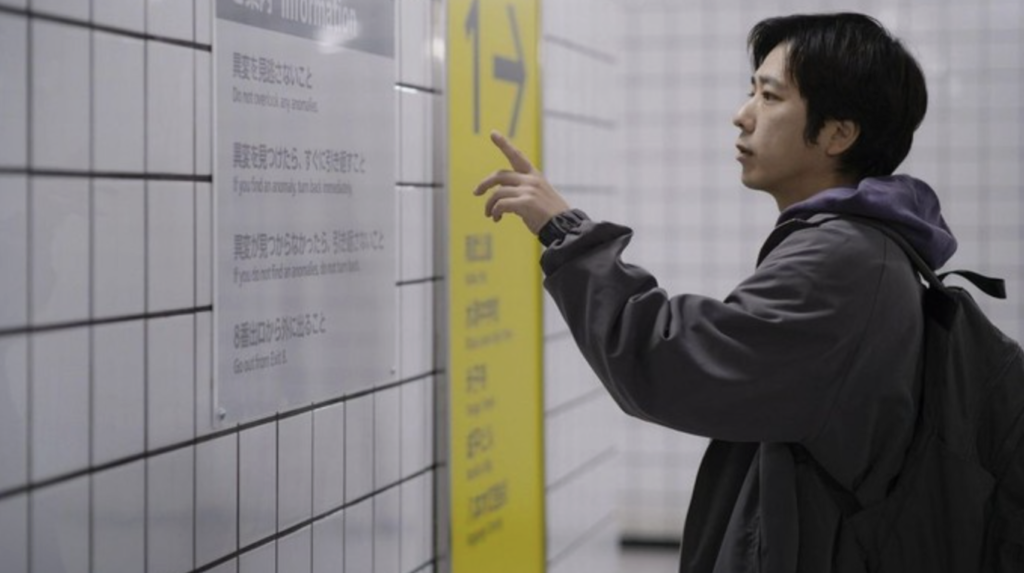 ©Courtesy of Neon
Q: In the film, there are elements—such as the people around the protagonist failing to stop the young man yelling at woman whose baby is crying, or the protagonist being unable to make a decision because the woman he’s about to break up with is pregnant—that reflect a sense of guilt, or perhaps more accurately, a sense of remorse, when something goes wrong. I feel that in this regard, the film captures aspects that aren’t present in the game. What specific considerations did you keep in mind when incorporating these elements into the film?
Genki Kawamura: I take the Tokyo subway to work every day, and whenever I’m on the train—I’m in New York right now, and I think it’s the same there—I notice there are so many people, but everyone seems to be staring at their smartphones, completely oblivious to their surroundings. As a result, small acts of violence happen on the train, but people mostly look the other way—they don’t want to get involved.
And while their smartphones are filled with images of war, violence, and slander, they just scroll through them and pretend not to see. I don’t think there are actually that many people who kill others or steal things, but I got the feeling there are a lot of people who turn a blind eye to the turmoil in the world.
Q: Japanese people, in particular, tend to be like that, don’t they? I think there are a lot of things they just can’t bring themselves to say.
Genki Kawamura: I was wondering if we could draw a parallel between the rules of the game and the choices we make in our daily lives—specifically, whether, when confronted with a sense of guilt—the kind that comes from turning a blind eye to something—in the form of an anomaly in that white corridor, we would simply keep moving forward without noticing it, or whether we would be able to make the decision to turn back.
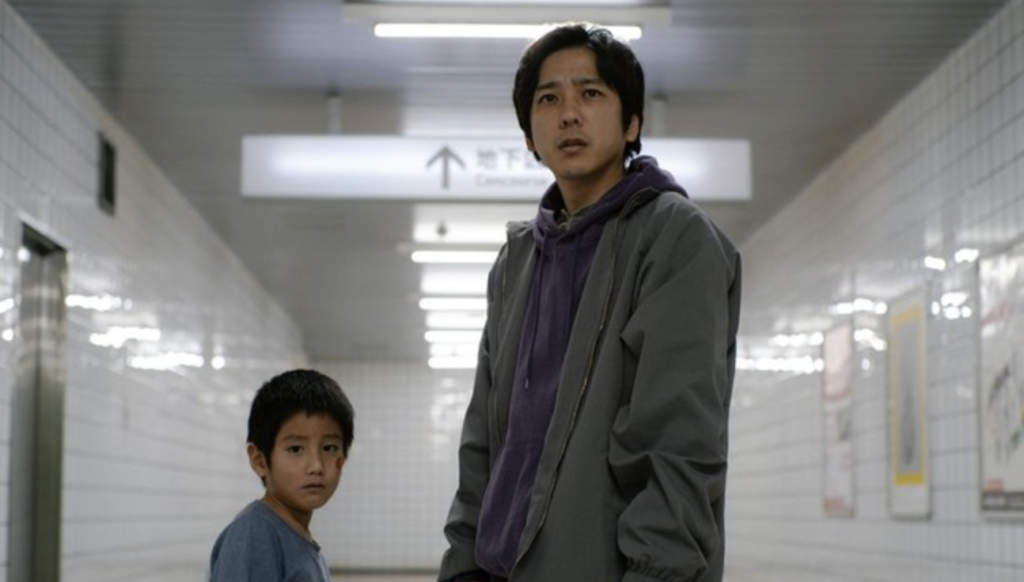 ©Courtesy of Neon
Q: What I found interesting right from the start was that the character played by Kazunari Ninomiya is a nameless, lost man, and the woman played by Nana Komatsu is simply referred to as “a woman”—elements in the film where we don’t really get a glimpse of their backgrounds. I thought it was fascinating that even these details were left to the audience’s imagination. Was there a deliberate choice to exclude such details in order to create a sense of immersion for the audience, almost like a video game?
Genki Kawamura: That’s right. As you mentioned, none of the characters in this game have names. In gaming terms, they’re Non-Playable Characters, or NPCs—in Japan, we sometimes call them “mobs”—and that’s exactly how they were treated. When I’m riding the subway in Tokyo, I’m an NPC player, and I’m the protagonist, right? I’m living in this world thinking I’m the protagonist, but from the perspective of the passengers around me, I’m just an NPC player.
In other words, even though we’re all living as “mobs” or NPCs, each of us has our own life and our own story. So I wanted to express that sense of how our perspective shifts when we’re placed in that game-like space. And while I actually wrote a lot about explaining each character’s background using flashbacks in the novel version of “Exit 8”, But for the movie, I thought it might be better to focus on letting the audience imagine all sorts of things—just imagining what’s happening within the confines of the passageway—rather than delving too deeply into those backstories.
Q: Given that the character had absolutely no backstory, why did you choose Kazunari Ninomiya to play the lead, and how did you direct him without that backstory?
Genki Kawamura: I told Ninomiya-kun that I wanted him to embody “society” itself. In other words, rather than a specific person, it’s more about the mood of the times we live in. It’s that feeling of not wanting to deal with troublesome things, or turning a blind eye to them—ultimately, putting yourself first, prioritizing your own life over family or the responsibilities of being a parent. I wanted him to carry that weight.
Normally, since I’ve written a lot about the character’s background in my novels, I could have had him read those. But I deliberately chose not to give him the novels. Instead, as he struggled to survive, I gradually revealed bits and pieces of his background scene by scene. So, by providing information little by little, I created a gradual transition where he starts out as an NPC and eventually becomes a fully realized human being.
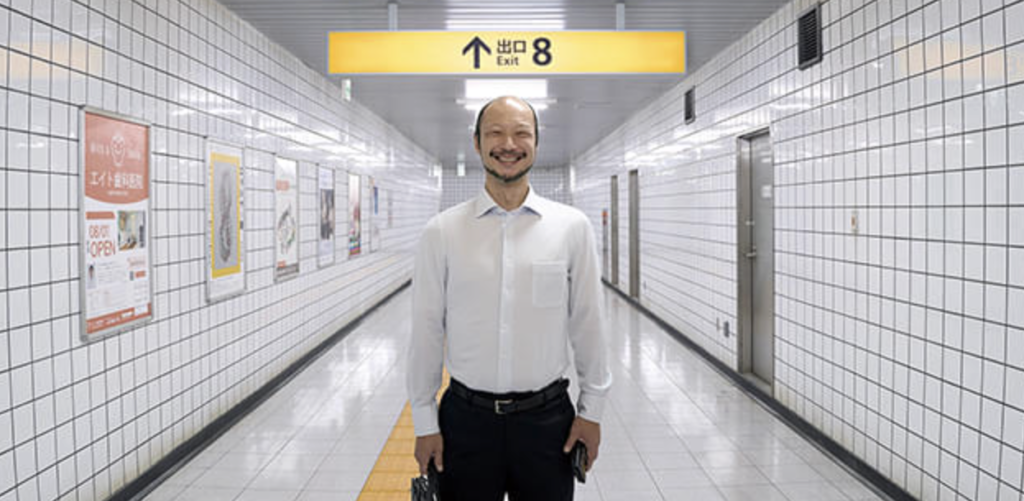 ©Courtesy of Neon
Q: Since I imagine there’s a lot of repetitive work involved, I heard that on set you actually filmed and edited simultaneously. Could you tell me about the benefits of doing that, as well as any challenges you faced?
Genki Kawamura: First of all, the handicap is that we decided the story would unfold exclusively within the loop of that exact same underground passageway, right? That means we wouldn’t use flashbacks or anything like that. If we flip that constraint on its head, the fact that it’s the same space means retakes are possible—that’s the advantage. In Japan, I think only directors like Yoji Yamada and Ryusuke Hamaguchi are really allowed to do retakes; usually, they’re not permitted here.
But since we could do it this time, I wondered if we could create something like real-time rendering in a video game. In other words, we’d shoot according to the script on set, edit it right there, then everyone—including Ninomiya-kun—would watch it. If it didn’t work, we’d rewrite the script on the spot, reshoot it, and edit it back together. That’s why Ninomiya-kun started referring to himself as a “test player” partway through.
We approached it like making a video game. So I thought that if we used a unique production method, it would result in a unique film.
Q: The so-called “mechanical smile” of Yamato Kouchi, who plays “The Walking Man”—a character who merely passes by others in the film—was quite terrifying. I hear he’s currently in New York as well. Could you tell us a little about how you came to cast him? Also, regarding his movements, they were incredibly mechanical, and I found them truly astonishing.
Genki Kawamura: Yamato Kawachi is originally a stage actor who has performed in Shakespearean plays and the like, but he’s hardly ever appeared in films. I actually thought it would be more interesting to see a face I’d never seen before rather than an actor I recognized walking down that hallway. When Mr. Tabata from the casting department suggested him, I thought he was a perfect fit—not only did he look the part, but he also mentioned that he’d been training in walking on stage for a long time, so I felt he was ideally suited for the role.
On set, I directed him by saying things like, “I want you to walk like CGI” or “I want you to laugh like AI.” I was wondering if we could somehow create that sense of unease—that feeling you get when a human physically mimics CGI or AI movements. The inspiration came from the movements of Noh theater actors, specifically the Noh masks and movements that lack vertical motion. I conveyed these ideas to Mr. Kawachi as a reference.
 ©Courtesy of Neon
Q: This film was selected for the Midnight Screenings at the Cannes Film Festival. I believe you yourself have had works screened at Cannes—the short film, “Which One?” and the feature film “Monster”. Recently, the actress Megumi has been working with Netflix to bring Japanese content to the world. What approach do you think is necessary for distributing Japanese films globally in the future? Eight years ago, you founded a production company called “Story.” What approach do you think is necessary for bringing Japanese films to the world in the future?
Genki Kawamura: That’s right. The group I founded eight years ago, called “Story,” is dedicated to the mission of ensuring that Japanese works—whether they’re animations like Makoto Shinkai’s films, projects I’ve created with Kore-eda, or live-action films like this very “Exit 8”—achieve genuine global success. I don’t think you can definitively say, “If you do this, people will watch it globally,” but for live-action films, the most important thing is that film festivals are the only place where they can be discovered. There are opportunities, but plenty of them.
So, this time, as a video game adaptation, we were told it was the first to be included in the Cannes Official Selection. While retaining that sense of Japanese pop culture—like a video game adaptation—we were able to premiere at the Cannes Film Festival with a strong thematic focus, a compelling narrative, and unique visual expression. I think that creating works like this is what leads to a gateway to the world.
Being here in the U.S. now, I realize that having Neon as the distributor is a tremendous asset for this film. I really sense in Neon the confidence and meticulousness of their promotion—or rather, the abundance of ideas—that films like “Parasite” and “Anora” have demonstrated by winning Oscars and the Palme d’Or at Cannes.
Q: I’ve heard that, thanks to your father’s influence, you watched quite a lot of movies growing up. Could you tell us which films actually influenced you as a child, and how do you think those influences are reflected in your filmmaking today?
Genki Kawamura: That’s right. What really stuck with me was a videotape of Kenji Mizoguchi’s “Ugetsu”. Even as a kid, I was just watching in awe as Kazuo Miyagawa(cinematographer), in a single take, connected spaces and moments of time that shouldn’t have been connected through incredibly fluid camerawork. In this film’s incredibly long single shot, where disconnected spaces and time that shouldn’t be connected are brought together.
I was definitely influenced by Mr. Mizoguchi. It’s a technique I also used quite a lot in my first film, “A Hundred Flowers”, but that influence has been significant since I was a child. Also, we had a VHS tape of “Nausicaä of the Valley of the Wind” at home, I watched it over and over again. Even now, figuring out how to bring the expressive qualities of Japanese animation—which is part of my own identity—into live-action is a personal theme of mine. Works like Satoshi Kon’s “Perfect Blue” or Mamoru Oshii’s “Urusei Yatsura 2: Beautiful Dreamer” are absolute masterpieces of the loop genre, and I’ve always wondered if I could capture that same sensibility in live-action.
If you like the interview, share your thoughts below!
Check out more of Nobuhiro’s articles.
Here’s the trailer of the film.